• TalkBass has been independent since 1998. Add your voice.
    Create a free account to reply to discussions, view embedded media, and browse with fewer display ads.
    Join freeLog in
    Want zero display ads or expanded classifieds tools? Compare plans.

Fixing a weak Low E on a 32" Scale.

I recently got a MIJ Aerodyne Jazz Bass with a 32" scale and J-J pickups.

I'm using medium gauge flatwounds (chromes), and the whole bass feels great and sounds great except...

The lowest three or four notes on the bass sound weak, missing low end and missing low mid growl.

Should I look at...
Different flatwounds? Or is this just how flats act at low pitches?

Upgrading pickups (it has factory installed "dimarzio collection" pickups, not made by dimarzio)

Some kind of outboard preamp?

Upgrading the bridge?

Something else?
 
  • Like
Reactions: 31HZ
In theory the things you're considering could potentially help with that problem, but in my experience they probably won't.

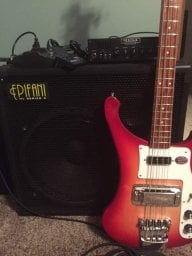
My Rickenbacker 4003 has a weak low E and I've tried everything you mentioned except installing a preamp, plus endless setup and tweaking, and nothing has ever worked. It's a resonance problem, and replacing one single part is not necessarily enough to fix it. Every component of the bass is making up a single vibrating whole. It's what causes your typical dead spots on the G string too.

For example, I've had 3 different bridges on my bass, not specifically for the purpose of fixing this issue but because each one kept having other problems. But they were all much higher mass than the original, and still the weak E remained. I even had the route under the bridge filled in with a wood block - increasing the mass of the bass even more - and that didn't help either.

Changing the pickups won't work because they're just picking up what the string is doing. If the bass has a resonance problem it means it's vibrating sympathetically with certain frequencies and absorbing energy that would otherwise be retained by the string. I changed the neck pickup on my Rick and it didn't have any effect on this problem.

I've had a bit more success fixing normal type dead spots on the G string. For my Stingray I stuck a 5 gram tire balancing weight on the D string tuning key. That shifted it just enough for the note to aound acceptable. For my Pedulla, Michael Pedulla had to actually route a bunch of holes into the body under the pickups in order to fix it. So, problems like this can be solved by both adding and removing mass, but which direction you need to go, and how much, you don't really know. Plus, my impression is that the lower the note the more the mass needs to change in order to have enough of an effect. I don't know that scientifically, I've just messed around with this stuff for a long time. Who knows how much I'd have to add or remove from my Rick in order to get it right. Or your Fender.

I'm afraid the only sensible thing to do is get rid of the bass. That's what I should have done with my Rick if I hadn't been young and sentimental about it. Otherwise you start down a road of madness and spending with a low chance of success.
 
Personally, I wouldn't do a thing except to put a new set of your preferred strings on it, THEN begin to work through what the possible reasons for a 'weak E' may be. Used strings, whether a week or so old or more, can easily lie to you sonically, so we always start from scratch with a new set.

It's an expensive way to find out you had a bum nut or bridge saddle slot, incorrectly adjusted pickups, or one high spot on one fret, or something else, by spending serious money on new pickups . . . . that carried the same problem over with a different tone.

My first move would be new strings with a complete and proper setup, inspecting for the problems I listed above as you go, as the string(s) will be off to allow inspection.

A lot of times (but not always) this sort of problem turns out to be a 'deader than the others' or internally bogus string that shows no visible defect, and/or incorrectly adjusted pickups.
 
As described above it could be a resonance issue. Try changing the physics by temporarily clamping a few ounces of weight to various spots on the head and see if it make any difference. If it does, then you can decide if you want to work a permanent fix.

I wouldn't expect the nut to affect anything but the open E. More likely, there isn't a good witness point at the bridge.
 
I recently got a MIJ Aerodyne Jazz Bass with a 32" scale and J-J pickups.

I'm using medium gauge flatwounds (chromes), and the whole bass feels great and sounds great except...

The lowest three or four notes on the bass sound weak, missing low end and missing low mid growl.

Should I look at...
Different flatwounds? Or is this just how flats act at low pitches?

Upgrading pickups (it has factory installed "dimarzio collection" pickups, not made by dimarzio)

Some kind of outboard preamp?

Upgrading the bridge?

Something else?
Maybe go down a gauge- medium flats might be too much for that neck
 
I recently got a MIJ Aerodyne Jazz Bass with a 32" scale and J-J pickups.

I'm using medium gauge flatwounds (chromes), and the whole bass feels great and sounds great except...

The lowest three or four notes on the bass sound weak, missing low end and missing low mid growl.

Should I look at...
Different flatwounds? Or is this just how flats act at low pitches?

Upgrading pickups (it has factory installed "dimarzio collection" pickups, not made by dimarzio)

Some kind of outboard preamp?

Upgrading the bridge?

Something else?

Raise your pickups on that side.
Verify setup with new strings.
 
In theory the things you're considering could potentially help with that problem, but in my experience they probably won't.

My Rickenbacker 4003 has a weak low E and I've tried everything you mentioned except installing a preamp, plus endless setup and tweaking, and nothing has ever worked. It's a resonance problem, and replacing one single part is not necessarily enough to fix it. Every component of the bass is making up a single vibrating whole. It's what causes your typical dead spots on the G string too.

For example, I've had 3 different bridges on my bass, not specifically for the purpose of fixing this issue but because each one kept having other problems. But they were all much higher mass than the original, and still the weak E remained. I even had the route under the bridge filled in with a wood block - increasing the mass of the bass even more - and that didn't help either.

Changing the pickups won't work because they're just picking up what the string is doing. If the bass has a resonance problem it means it's vibrating sympathetically with certain frequencies and absorbing energy that would otherwise be retained by the string. I changed the neck pickup on my Rick and it didn't have any effect on this problem.

I've had a bit more success fixing normal type dead spots on the G string. For my Stingray I stuck a 5 gram tire balancing weight on the D string tuning key. That shifted it just enough for the note to aound acceptable. For my Pedulla, Michael Pedulla had to actually route a bunch of holes into the body under the pickups in order to fix it. So, problems like this can be solved by both adding and removing mass, but which direction you need to go, and how much, you don't really know. Plus, my impression is that the lower the note the more the mass needs to change in order to have enough of an effect. I don't know that scientifically, I've just messed around with this stuff for a long time. Who knows how much I'd have to add or remove from my Rick in order to get it right. Or your Fender.

I'm afraid the only sensible thing to do is get rid of the bass. That's what I should have done with my Rick if I hadn't been young and sentimental about it. Otherwise you start down a road of madness and spending with a low chance of success.

I'm not nearly this fatalistic, but this is probably right. You can try strings, pickups, making sure there isn't a problem with the nut, etc., but sometimes wood just doesn't want to be a bass.
 
I'm not nearly this fatalistic, but this is probably right. You can try strings, pickups, making sure there isn't a problem with the nut, etc., but sometimes wood just doesn't want to be a bass.
It sounded fine with the strings it shipped with and with ernie ball brite flats. I just really like chromes and was hoping to make them work.
 
It’s not very likely a resonance issue in that location over that range of notes, but it’s not impossible. The fact that it’s a 32” scale adds a twist that might possibly have some affect, but I still doubt it.

A 34” scale “Fender style” bass (in standard tuning) that has any dead spots will almost always have spots confined to one or two adjacent notes on frets 4, 5, 6, 7, or 8 of the G string. A 32” scale is less likely to have dead spots, but if it has any, I’m not sure where they would be. I am fairly sure there wouldn’t be more than one or two notes that are dead and if there are two, they would for sure be adjacent. “The lowest 3 or 4 notes” doesn’t sound like a common dead spot issue.

I bet you will find the problem is a string or pickup height issue, or possibly the nut slot width / depth.