
Enjoy the benefits of a premium membership!
Upgrade Account
-
TalkBass has been independent since 1998. Add your voice.
Create a free account to reply to discussions, view embedded media, and browse with fewer display ads.
Join free Log in
Want zero display ads or expanded classifieds tools? Compare plans.
You are using an out of date browser. It may not display this or other websites correctly.
You should upgrade or use an alternative browser.
You should upgrade or use an alternative browser.
Flat position in Sansamp BDDI?
- Thread starter fbass87
- Start date
More options
Who Replied?
I think you're in the wrong section for this topic. the effects section would be more suitable. secondly, the first picture looks like a flat setting to me(even though people say that the tech 21 sansamp bass driver has a scooped sound).

Interesting observation but I would think that you could switch the bypass on and off and fiqure it but I could be wrong.
Unless I am very mistaken the presence knob is boost-only, so it would be flat all the way counter-clockwise.
flat is 12 o'clock for EQ. it is not for blend, drive and presence. drive and presence is at 0 (7 o'clock). and take a look at your user manual for blend and level, a can not remember now is it 7 or 5 o'clock.....
on my PBDDI 12 o'clock level is not flat - meaning - it is not the same signal level on/off.
on my PBDDI 12 o'clock level is not flat - meaning - it is not the same signal level on/off.

Flat is only 12:00 for a control that's boost/cut. A traditional Fender tone bank is anything but flat with all the knobs at the mid point. I don't know for sure what SansAmp did, but the best way to find a "flat" setting is to use the by-pass switch, Set the knobs, and if the sound changes when you hit the by-pass, it ain't flat.
John
John

the flat for presence and drive are all the way to the left. In fact, those two settings are also controlled by the blend control. The bass and treble are not. So theoreetically with the blend all the way to the left and bass and treble at 12 o'clock it should be "flat". However, even in that setting you can hear a mid scoop as soon as you turn it on.
the first picture looks like a flat setting to me(even though people say that the tech 21 sansamp bass driver has a scooped sound).
It's not that we're simply saying it does - it actually does have a mid scoop! However, it's not a typical mid scoop, and the SansAmp's EQ can't really dial it down or up because of its shape. It's a deep, notch-like scoop around 1KHz, IIRC. The scoop, along with the rest of the BDDI's natural EQ curve, is a major part of its "miked amp" emulation sound. There's a great thread here confirming the natural EQ curve with a "pink noise" test if you're interested.
http://www.talkbass.com/forum/showthread.php?t=394187
As for a "flat" setting (not literally a flat EQ curve, but "flat" by BDDI standards) is:
Bass: 12 O'Clock
Treble: 12 O'Clock
Presence: Zero (it's a boost-only feature)
Blend: Maximum (results in 100% SansAmp sound, 0% clean)
As for Drive and Level, there aren't any "flat" settings as they're dependent on your bass and your personal preferences on growl and dirt.
It's not that we're simply saying it does - it actually does have a mid scoop! However, it's not a typical mid scoop, and the SansAmp's EQ can't really dial it down or up because of its shape. It's a deep, notch-like scoop around 1KHz, IIRC. The scoop, along with the rest of the BDDI's natural EQ curve, is a major part of its "miked amp" emulation sound. There's a great thread here confirming the natural EQ curve with a "pink noise" test if you're interested.
http://www.talkbass.com/forum/showthread.php?t=394187
As for a "flat" setting (not literally a flat EQ curve, but "flat" by BDDI standards) is:
Bass: 12 O'Clock
Treble: 12 O'Clock
Presence: Zero (it's a boost-only feature)
Blend: Maximum (results in 100% SansAmp sound, 0% clean)
As for Drive and Level, there aren't any "flat" settings as they're dependent on your bass and your personal preferences on growl and dirt.
Really...the sansamp has a mid-range. even though it's not a typical mid-range. I would of thought that the sansamp bass driver has a factory set mid eq that the guys from tech 21 would believe is to be the ideal mid eq for an svt sound. either that or the sansamp bass driver is meant to have a smooth, beefy sound. I don't own a sansamp bass driver so I wouldn't know about it. all I know is that the sansamp bass driver is a tube-emulation pedal. thanks for the info. one other thing. what's a pink noise?
scotch
It's not rocket science!
- Nov 12, 2006
- 6,944
- 2,081
- 51
- Disclosures
- Please see Profile for Endorsement disclosures
The "flat" setting with the BDDI is "bypass". 
Also, I'm not sure what happened to the graphs with that analysis thread... I'll see if I can track that down. (well, Putfile account was hijacked & I don't know what thappened to my local copies of the jpegs... bummer)
Pink Noise:
Random noise with equal energy per octave. Our ears perceive this as sounding relatively "flat" in frequency response (since pink noise is based on octaves rather than individual frequencies, there is no increase in energy in the high octaves). Because of this, and because Real Time Analyzers (RTA) tend to look at octave or 1/3 octave ranges, pink noise is very useful for measuring the frequency response of audio equipment, as well as for determining room response for sound reinforcement applications.
Also, I'm not sure what happened to the graphs with that analysis thread... I'll see if I can track that down. (well, Putfile account was hijacked & I don't know what thappened to my local copies of the jpegs... bummer)
Pink Noise:
Random noise with equal energy per octave. Our ears perceive this as sounding relatively "flat" in frequency response (since pink noise is based on octaves rather than individual frequencies, there is no increase in energy in the high octaves). Because of this, and because Real Time Analyzers (RTA) tend to look at octave or 1/3 octave ranges, pink noise is very useful for measuring the frequency response of audio equipment, as well as for determining room response for sound reinforcement applications.

I just picked up an ADA MB-1 and the first thing I did was try to mimic my SansAmp RBI sound. Once upon a time I saved the pink noise graph of the SansAmp BDDI to my local drive for future reference. I've now uploaded it so it's on a fairly stable host and won't get lost again.
I used it to help me shape the EQ in the MB-1 to get that scooped mid sound. Eventually I'll post an A-B comparison to my Clips page for everyone's review. But it's hard to cop the SansAmp tone as it totally kills the mids, so much so that a typical EQ in other preamps simply can't scoop the mids that aggressively, and kills the ultra highs, while still preserving the low end and tight high mids. That's a lot of EQ to try to mimic. Plus the SansAmp just has a nice smoothness to it. I really like the sound, personally.
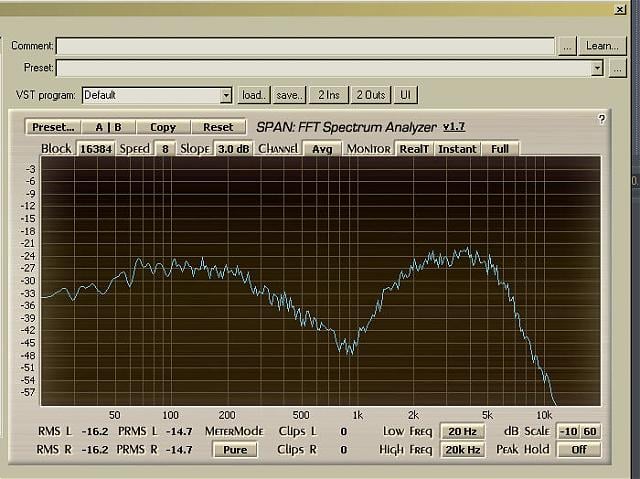
I used it to help me shape the EQ in the MB-1 to get that scooped mid sound. Eventually I'll post an A-B comparison to my Clips page for everyone's review. But it's hard to cop the SansAmp tone as it totally kills the mids, so much so that a typical EQ in other preamps simply can't scoop the mids that aggressively, and kills the ultra highs, while still preserving the low end and tight high mids. That's a lot of EQ to try to mimic. Plus the SansAmp just has a nice smoothness to it. I really like the sound, personally.
Latest posts
-

-

-

-
Post a funnier picture than the one above - Parallel Universe Edition
- Latest: BassicJazzy
-
