• TalkBass has been independent since 1998. Add your voice.
    Create a free account to reply to discussions, view embedded media, and browse with fewer display ads.
    Join freeLog in
    Want zero display ads or expanded classifieds tools? Compare plans.

Flatback Ampeg 810 wiring

I’m working on a new to me flatback 810. At some point, the XLR jack was removed and the wires were spliced with a standard 1/4” cable. I’d like to clean things up a bit and in my searches I found a bunch of old threads with conflicting information so I figured I’d make a new thread instead of bumping an old one.

I wanted to go back to a stock XLR but someone said it was dangerous? Why would it be dangerous? I don’t mind buying the XLR to 1/4” cable.

I bought a regular switchcraft 1/4” jack and jackplate and saw someone else say not to use that without insulating the jack plate?

The cab will be paired with a second classic 810 powered by my 73 SVT. Also, any idea what year it is based off the serial number?
 

Attachments

  • 12E9FF15-8102-4870-B656-94728F139DF2.jpeg
    12E9FF15-8102-4870-B656-94728F139DF2.jpeg
    1.2 MB · Views: 200
  • A3E2A874-DF4D-44B4-96D3-AB33802B44C2.jpeg
    A3E2A874-DF4D-44B4-96D3-AB33802B44C2.jpeg
    1.4 MB · Views: 174
I’m working on a new to me flatback 810. At some point, the XLR jack was removed and the wires were spliced with a standard 1/4” cable. I’d like to clean things up a bit and in my searches I found a bunch of old threads with conflicting information so I figured I’d make a new thread instead of bumping an old one.

I wanted to go back to a stock XLR but someone said it was dangerous? Why would it be dangerous? I don’t mind buying the XLR to 1/4” cable.

I bought a regular switchcraft 1/4” jack and jackplate and saw someone else say not to use that without insulating the jack plate?

The cab will be paired with a second classic 810 powered by my 73 SVT. Also, any idea what year it is based off the serial number?


I'm no expert but I think the second pair of lugs on those 4 prong XLR jacks completed the circuit for the standby switch in case you forgot to plug the cab in and turn on the head so 120 would have been going through it, whether that's dangerous is debatable I suppose but there are other who know a lot more than me here. My first SVT had the XLR jack and the attached hardwired speaker cable. It's difficult to figure out the year with serial numbers if not impossible. Linden NJ is early though but not sure when they sold Ampeg to Magnavox. The two cabs in my avatar are flatbacks and both were converted to standard 1/4" years ago before I bought them. My cabs are in the U.S so can't check them. You can get the year by the numbers on the backs of the speakers though, they will have the last two numbers such as 72, 69 etc. I think this is a '69, not positive about that either. These CTS speakers were the earliest ones, they changed to Eminence after a few years.

Link Removed
 
Last edited:
  • Like
Reactions: thedudebrah
No useful information from the serial number. The speaker codes will tell you when they were made, typically the cab a few months later.

Many ‘73 SVT’s had a ¼” speaker jack instead of the chassis mounted cable and 4-pin XLR plug.

Bob is right about the safety circuit. The cab shorted two pins. The safety circuit is easy to defeat in the head.
 
I'd forget the 4-pin XLR -- a regular NL4-MP Speakon connector fits in the hole, and that's what I'd use unless one is just an absolute stickler for period accuracy. Unless you actually have an amp with the 4-pin connector and the stand-by circuit implemented, it's pointless to worry about the second pair of contacts. And the pins on an XLR4 are pretty small -- I doubt they're actually rated for the 300 watts or so the cab is good for.


Edit: Here's the input panel of my ancient SVT cab, modified to accept a Speakon.
View attachment 4701342
Hmmm... that didn't work. I'll post in a new response.
 
Last edited:
I'm no expert but I think the second pair of lugs on those 4 prong XLR jacks completed the circuit for the standby switch in case you forgot to plug the cab in and turn on the head so 120 would have been going through it, whether that's dangerous is debatable I suppose but there are other who know a lot more than me here. My first SVT had the XLR jack and the attached hardwired speaker cable. It's difficult to figure out the year with serial numbers if not impossible. Linden NJ is early though but not sure when they sold Ampeg to Magnavox. The two cabs in my avatar are flatbacks and both were converted to standard 1/4" years ago before I bought them. My cabs are in the U.S so can't check them. You can get the year by the numbers on the backs of the speakers though, they will have the last two numbers such as 72, 69 etc. I think this is a '69, not positive about that either. These CTS speakers were the earliest ones, they changed to Eminence after a few years.

Link Removed
So is it odd that there are only two wires sticking out of the hole where the jack would be? Maybe I’ll pull a speaker out to see if there are two more wires tucked in there and date it in the process.
 
I'd forget the 4-pin XLR -- a regular NL4-MP Speakon connector fits in the hole, and that's what I'd use unless one is just an absolute stickler for period accuracy. Unless you actually have an amp with the 4-pin connector and the stand-by circuit implemented, it's pointless to worry about the second pair of contacts. And the pins on an XLR4 are pretty small -- I doubt they're actually rated for the 300 watts or so the cab is good for.


Edit: Here's the input panel of my ancient SVT cab, modified to accept a Speakon.
View attachment 4701342
Hmmm... that didn't work. I'll post in a new response.

The amp just has regular 1/4” outputs so I’d rather just install the 1/4” input jack that I bought. What was the jargon I read about insulating the jack? Ever heard anything like that before? And does it matter which wire goes to which pole on the input jack?
 
  • Like
Reactions: bobyoung53
Here is the original wiring from the 69 schematic:
upload_2022-5-25_16-37-6.png


The amp expects 4 ohms when only the XLR is used. If you add a second cab using J3, the output is switched to 2 ohms.

As you see, the XLR has a jumper across pins 2 and 3 that functions as a safety interlock to protect the amp. Note this is a 4 pin XLR, and not a standard 3 pin XLR.

This part of the schematic shows how the interlock is connected to the power supply:

upload_2022-5-25_16-50-39.png


Front panel Power Switch shown in red. When power is flipped on, AC Hot and Neutral are distributed along the paths shown in green and blue. This turns on only the heater supply. The standby switch and interlock prevent the green path from traveling to the primary winding of the HT supplies. So the amp does not produce voltage for the plate supply or screen supply.

Note early amps also included the timer tube, but the tube sockets on most amps has been jumpered.

AFAIK, there is no good reason to reinstall the interlock circuit. If your amp has two 1/4 inch outputs, install a 1/4" panel mount jack on the cab and call it a day.

AFAIK there is no need to insulate the jack plate with an SVT. The negative speaker out is tied to ground inside the amp. This is from the 74 schematic:
upload_2022-5-25_17-4-53.png

Notice the bottom line (YEL Commmon) is tied to ground.

The advice to insulate the jack plate relates to amps that have a differential output. Amps that operate in bridge mode, including most Class-D amps, have differential outputs. Differential means AC is applied to both the + and - output terminals, so insulating the jack panel is desired to prevent a shock hazard and the possibility of accidentally shorting out the - side of the output. IMHO the biggest risk comes from the metal sleeve of the 1/4" plug. This is one reason why 1/4" speaker cables are not desirable.
 
Last edited:
I'd forget the 4-pin XLR -- a regular NL4-MP Speakon connector fits in the hole, and that's what I'd use unless one is just an absolute stickler for period accuracy. Unless you actually have an amp with the 4-pin connector and the stand-by circuit implemented, it's pointless to worry about the second pair of contacts. And the pins on an XLR4 are pretty small -- I doubt they're actually rated for the 300 watts or so the cab is good for.


Edit: Here's the input panel of my ancient SVT cab, modified to accept a Speakon.
View attachment 4701342
Hmmm... that didn't work. I'll post in a new response.


They're actually rated at 240 WRMS, you were supposed to use two cabs.
 
The amp just has regular 1/4” outputs so I’d rather just install the 1/4” input jack that I bought. What was the jargon I read about insulating the jack? Ever heard anything like that before? And does it matter which wire goes to which pole on the input jack?


I know nothing about insulating the jack plate unless it was something to do with the original XLR plate. And I would assume that the black wire would go to the large part of the jack (ground) and the green would go to the center pin. You want to make sure it's in phase with any other cab if you ever use two which is actually what they called for. I've used one cab a lot though just don't go crazy with it unless you like blowing speakers, those speakers are only 30 watt speakers. If you're not sure which wire is positive try a battery across the two wires, whichever way makes the speakers go out instead of in the wire on the positive pole of the battery is the positive wire and should go to the center pin of the jack.
But again there are other people here who know more than me such as @beans-on-toast
 
Last edited:
  • Like
Reactions: beans-on-toast
I missed that, he has a Skunkworks head? Or it was in that thread I assume.
I do have a Skunkworks head, but that’s not the one I’m using currently. I’m using a 1973 SVT which just has a speaker output on the back and then an output for an extension speaker.

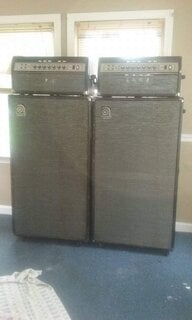
I’m coming from an SVT-VR which also has the 2 and 4 ohm selector switch, so I am familiar with when to use it. Here’s all the ol gals together.
 

Attachments

  • B2D937F9-D7EC-4F5F-9BEE-12BE34602FD2.jpeg
    B2D937F9-D7EC-4F5F-9BEE-12BE34602FD2.jpeg
    106.5 KB · Views: 155
I do have a Skunkworks head, but that’s not the one I’m using currently. I’m using a 1973 SVT which just has a speaker output on the back and then an output for an extension speaker.

I’m coming from an SVT-VR which also has the 2 and 4 ohm selector switch, so I am familiar with when to use it. Here’s all the ol gals together.


Very nice, these are mine plus a 6146B blueline head, both late 70's Magnavox heads and the cabs are flatbacks, never checked the age of them though.

upload_2022-5-25_18-48-37.jpeg
 
I'm no expert but I think the second pair of lugs on those 4 prong XLR jacks completed the circuit for the standby switch in case you forgot to plug the cab in and turn on the head so 120 would have been going through it, whether that's dangerous is debatable I suppose but there are other who know a lot more than me here. My first SVT had the XLR jack and the attached hardwired speaker cable. It's difficult to figure out the year with serial numbers if not impossible. Linden NJ is early though but not sure when they sold Ampeg to Magnavox. The two cabs in my avatar are flatbacks and both were converted to standard 1/4" years ago before I bought them. My cabs are in the U.S so can't check them. You can get the year by the numbers on the backs of the speakers though, they will have the last two numbers such as 72, 69 etc. I think this is a '69, not positive about that either. These CTS speakers were the earliest ones, they changed to Eminence after a few years.

Link Removed

With this speaker, I believe 137 is the manufacturer code for CTS and the 7329 translates to the speaker being made in the 29th week of 1973.
 
My ears say YES!!!
My back says NO!!!!!

:)


The cabs aren't as bad to move as people think as long as you have a good vehicle that's easy to load, now the heads are a different story but I use two wheelers which also makes those easy to move.

With this speaker, I believe 137 is the manufacturer code for CTS and the 7329 translates to the speaker being made in the 29th week of 1973.


I didn't know CTS made those speakers that late, those things blew easily (at least when I used one cab), the later Eminence SVT 10's seem to handle more power although they're rated the same and to me they sound the same, a lot of people disagree though, I think my flatbacks have the Eminence in them and sound great. I'm going to have to date mine when I get back.
 
  • Like
Reactions: Kendescending
With this speaker, I believe 137 is the manufacturer code for CTS and the 7329 translates to the speaker being made in the 29th week of 1973.

Pulled a speaker tonight and if I’m reading it right, 35th week of 1973? That means it matches my 1973 head by pure coincidence because I bought them at different times.
 

Attachments

  • 15DCBFE2-FF8E-4016-9FA4-DB592ED9D4B7.jpeg
    15DCBFE2-FF8E-4016-9FA4-DB592ED9D4B7.jpeg
    1.4 MB · Views: 51