• TalkBass has been independent since 1998. Add your voice.
    Create a free account to reply to discussions, view embedded media, and browse with fewer display ads.
    Join freeLog in
    Want zero display ads or expanded classifieds tools? Compare plans.

Flattest amp & cab set-up?

Hmmm... I thought the point was that some people use their amp/speaker combination as another tool in the creation of their bass tone (in contrast with the "pure" uncolored reproduction of the instrument approach)?

Personally, I like having a speaker that is reasonably flat, as it gives me a "blank palette" for creating/reproducing my tone. Plus, I'm not fighting with a cabinet that has a strongly colored, single, voice. This allows more tonal flexibility, as I can sculpt by adding or subtracting EQ without having to work around the idiosyncrasies of the speaker. So, in my case, the relatively flat speaker is much less of a variable than the instrument, amplification, and effects.
 
I find it offensive that you would hold the opinion that someones equipment limits how meaningful or creative their art is.
I never said that at all. Using a canned algorithm to achieve a certain tone is just another means to an end. It does not limit a person's creativity, nor does it make his/her creative statement more or less valid or meaningful. You read a little too much into what I said. I'll further refine my point so it's more clear to you, and so it gets the thread back on track:

If you sculpt a tone via modeller using headphones or some other hi-fi type source like studio monitors, then you would more likely prefer a flat amp/cab combination to accurately reproduce that sound.

You turned my comment into a criticism of people who use modelers, and that was not even close to what I was saying. Hell, I use one for recording guitar parts.
 
Someone playing an instrument, through any kind of amplification, is creating music.
That's what I said.

My point was that if you use a cab modeler to get the sound of a particular modeled cab and amp, you would want a flat cabinet to produce the sound with as little color as possible. Otherwise, It is changing the sound you are trying to model.

OTOH, it can be a creative form of it's own. e.g. a flip top being modeled through a bassman. It's a whole new sound! :P
 
I never said that at all. Using a canned algorithm to achieve a certain tone is just another means to an end. It does not limit a person's creativity, nor does it make his/her creative statement more or less valid or meaningful. You read a little too much into what I said. I'll further refine my point so it's more clear to you, and so it gets the thread back on track:

If you sculpt a tone via modeller using headphones or some other hi-fi type source like studio monitors, then you would more likely prefer a flat amp/cab combination to accurately reproduce that sound.

You turned my comment into a criticism of people who use modelers, and that was not even close to what I was saying. Hell, I use one for recording guitar parts.

See I was looking at this post:

I think you missed the spirit of his point on the Line 6 comment. Yes, of course they're still making music, but they have chosen to use a modeler to reproduce a specific tone. While the user can (and usually does) tweak this modelled sound to his/her own specs, the basic tone is kind of pre-determined. So using modelers really blurs the line between creating a tone, and reproducing a tone in a new and creative way.

And interpreted it as saying if one uses a flat cab or modelers, they are less creative in some way.

If that is not the case, then apologies.
 
The closest I have found is a Markbass cabinet and head (can't remember which model #'s), which seemed to have really flat output, which changed significantly when a different bass and preamp section was used.

To me you're talking more about 'transparent' than 'flat'. Markbass stuff is not flat at all, but it sounds good and lets the character of different instruments come through clearly.
 
To me you're talking more about 'transparent' than 'flat'. Markbass stuff is not flat at all, but it sounds good and lets the character of different instruments come through clearly.
Just curious how you're defining 'transparent' in comparison with 'flat'?

In my view, a flat speaker is essentially an uncolored speaker, or one which does not have its own sonic character and faithfully reproduces the signal fed into it; in that sense it "transparently" converts the electrical signal it receives into sound waves. This could be contrasted with a colored (non-flat) speaker, say a typical bass cabinet with a huge peak in the low midrange and a hole in the upper midrange between the woofer and the tweeter, like the D210XLT; such a speaker does not transparently reproduce the signal. Put another way, a flat speaker should effectively not be heard as a speaker at all. Rather, its coloration should be effectively inaudible, or transparent, as if there is no speaker at all, just the tone of the instrument.
 
Last edited:
  • Like
Reactions: Arjank
Just curious how you're defining 'transparent' in comparison with 'flat'?

To me non-flat is like having a pre-set EQ curve baked into the rig. Not inherently bad, but it emphasizes/de-emphasizes some frequencies.
Non-transparent means it sounds more or less the same no matter what bass you play through it. A lot of less expensive modeling rigs sound that way to me.

Flat and transparent would be like plugging directly into a good PA, which some people would like, but others not so much.
Non-flat and transparent would be a rig that improves the raw sound of the bass, but still lets small nuances in technique and the differences between instruments come through clearly.
 
I use a pedal board to process my signal, for everything from tube amp sounds (Tech 21 VT bass) to the sound of Stevie Wonders clarinet on "Superstition" ... So I want the amp to be as flat/transparent as it can reasonably be. To that end a Mark Bass LM II into a pair of Euphonic Audio VL 208s ( a favorite cab over on the DB side) works well for my purpose ... AND it sounds great with a plain old P bass plugged strait in.
 
Just curious how you're defining 'transparent' in comparison with 'flat'?

In my mind, there is a huge difference between transparent and flat.

Transparent, to me, says that the amp plays no role in the shaping of the instrument's tone at all. What you put in is what it puts out... Only louder.

Flat, to me, implies that any natural frequency bumps or dips in the tone of the instrument are attenuated or amplified, respectively, via EQ, in order to ensure that the entire frequency spectrum is represented equally.

Amps can be either transparent or flat, or neither.
But cabs can only be transparent or not transparent. A cabinet can't be flat.
 
Audiophiles seek flatness to reproduce musicians' highly shaped sounds accurately.

Reproduction and shaping are entirely different processes.

Couldn't agree more. I have been an audiophile for 30 years and a bass player for 50.
Look for completely different things in audio vs pro equipment
If everything sounded the same there would only be one manufacturer.
Everyone perceives sound differently.
 
Duke couldn't say this but I can---the Thunderchild cabinets are by far the flattest cabs out there. Duke knows cabinet and crossover design as well or better than anyone else on the planet. The Acme's are pretty darn flat, too. At least in the lower octaves.

When I was first working on the designs of my cabs I was shooting for flatness. But I realized that unless you're modeling, we're not in the business of "sound reproduction" but in the business of "sound production". Maybe for some this might require a flat measuring cabinet. For most there is a voicing ---typically not at all flat---that provides the proper function of what we're looking for.

Duke and I talk all the time and we've helped each other accomplish specific voicings that we're after. I remember pushing him on the design of his 1203. More prominent mids---not at all flat. He was kindof bummed---music played back through it didn't sound right.But that's the cab he's selling tons of. Because while not flat---it is highly functional. All of the Hathor series are going for voicings that aren't at all flat. On all of my cabs I've inched (some more than inches!) toward a voicing that provides a specific function.

Flat seems like a nice theoretical goal--and might nail it for many player's needs, but most need a voicing that's not flat to fill their functional needs. But if you want flat---buy a Thunderchild.
 
More prominent mids---not at all flat. He was kindof bummed---music played back through it didn't sound right.But that's the cab he's selling tons of. Because while not flat---it is highly functional.

The "flat" of one design is not the same as the "flat"of other designs.
I know my 210 with coaxial mid/high unit is "flat" (+/- 2dB between 55-15.000hz within 30degrees off-axis horizontal/vertical) Allthough it is "flat" and sounds very neutral with music, the mids pop out when you play bass through this cab even when I set the tone controls neutral on my pre-amp(of course it also depends on the type of bassguitar). It's NOT only the frequency response that matters, there's a lot more to it.
 
In my mind, there is a huge difference between transparent and flat.

Transparent, to me, says that the amp plays no role in the shaping of the instrument's tone at all. What you put in is what it puts out... Only louder.

Flat, to me, implies that any natural frequency bumps or dips in the tone of the instrument are attenuated or amplified, respectively, via EQ, in order to ensure that the entire frequency spectrum is represented equally.

Amps can be either transparent or flat, or neither.
But cabs can only be transparent or not transparent. A cabinet can't be flat.

I'm having trouble not seeing a contradiction there.
 
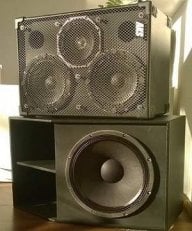
image.jpg


I have found that the venue you are playing in can have a significant effect on flat frequency response.:)
 
Last edited:
  • Like
Reactions: lz4005
Duke couldn't say this but I can---the Thunderchild cabinets are by far the flattest cabs out there. Duke knows cabinet and crossover design as well or better than anyone else on the planet. The Acme's are pretty darn flat, too. At least in the lower octaves.

I'd like to see some decent frequency response plots to support the above claim. The BGM review of the TC112AF shows a significant dip in the upper midrange between 2 - 4 kHz. I also seem to recall reading something about Duke purposely designing it this way. Note, I'm not saying that they TCs are bad in any way, just that they are not studio monitor flat, nor are they "by far the flattest cabs out there".

AFAIK, the true 3-way fEARfuls are as flat as reasonably possible given the drivers and components involved.
 
I'm having trouble not seeing a contradiction there.
I agree.

If you have to make serious EQ adjustments on your amp to "flatten" out the signal from your instrument, then your amplification system is not flat. Perhaps it could be called "EQ corrected" or something. FWIW, I do this with my acoustic guitar in an effort to make the plugged-in tone sound like the acoustic sound coming from the instrument; the resultant EQ is anything but flat!
 
"Flat" on its own doesn't mean anything. Are we talking on-axis frequency response, off-axis responses, or power response? What is the transient response? What is the dynamic response? What are the various other methods of distortion (harmonic, intermodulation) and how do they manifest?

"Transparent" is a much better word. Or "accurate".

A cab with much flatter on-axis frequency response than another cab be far less transparent or accurate because it isn't as good in the other aspects of accuracy. When listening to any audio equipment it's the weaknesses you will hear most - the weakest link will dominate.
 
  • Like
Reactions: oysteivi