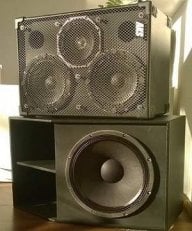
I'd like to see some decent frequency response plots to support the above claim. The BGM review of the TC112AF shows a significant dip in the upper midrange between 2 - 4 kHz. I also seem to recall reading something about Duke purposely designing it this way. Note, I'm not saying that they TCs are bad in any way, just that they are not studio monitor flat, nor are they "by far the flattest cabs out there".
Good eyes!
The on-axis dip in the TC112 in the 2-4 kHz region is there for two reasons: To offset excess energy in the vertical plane in that region, and to keep the horn from sounding like a horn.
The horn that I used in that model is too small in the vertical dimension to have good pattern control below about 3.5 kHz or so, so what happens is, the pattern actually flares in the vertical plane in that region. This is called "pattern flip", and it happens with rectangular horns. I'm more interested in the summed in-room response than in the on-axis response, so I compensate for that vertical pattern flare by introducing an on-axis dip.
So I traded off a "flat" measurement in order to more closely approximate a "flat" sound.
Also, the 2-4 kHz region is where the ear is most sensitive, so anomalies in that region tend to be particularly audible. The horn I used is a very gentle waveguide-style device, but it has one design flaw: The round-overs at the mouth are too small in radius for wavelengths of about 4 kHz and below, so they will be a source of diffraction in that region. I can explain why diffraction is particularly audible if you would like (after I get back from an audio show that I will leave for in a few hours), but the solution I chose was to shade back that region just a bit more, so the response actually ends up being down a bit more than was needed to compensate for the "pattern flip" phenomenon described above.
So once again I traded off a "flat" measurement in order to more closely approximate a "flat" sound. In this case the net benefit of the tradeoff is level-dependent (varies with SPL... I'll explain if you're interested when I get back... but have you ever heard a PA cab that sounded pretty good at modest volume levels yet made your ears bleed when cranked? That was level-dependence in action).
Many years ago I built a speaker that measured very close to flat. It was like plus or minus 1.5 dB on-axis from the lower limits of my measurement setup to about 20 kHz or so. I remember vividly tweaking the crossover and getting closer and closer to flat, and the speaker sounded worse and worse. I persevered, having faith that when I got to "flat", everything would snap into place. Well when I finally got there, I had one of the worst sounding speakers I'd ever heard. This experience sent me to the local university library on a quest to find out "what really matters" perceptually.
I'm still on that quest.