• TalkBass has been independent since 1998. Add your voice.
    Create a free account to reply to discussions, view embedded media, and browse with fewer display ads.
    Join freeLog in
    Want zero display ads or expanded classifieds tools? Compare plans.

Flipping a right handed for a lefty

How difficult is the flipping process? Assuming I'm ok with the body and jack and everything being upside down, I know I'd have to replace the bridge, is there anything to consider?

Also, how hard is it to replace a bridge? I can't imagine it's that difficult but I'm pretty clueless on the construction side of basses.
 
  • Like
Reactions: SC Bassboy
Solution
What kind of bass is it?

Asking, because a symmetrical shape might simplify things. You've already accepted some of the drawbacks and at the core of it, just flipping the strings isn't that hard. The mechanics of how the instrument functions going forward though will be affected. I guess what I'm saying here; an upside-down Fender shape isn't going to work very well. It won't balance and it will be awkward to tune. Something more symmetrical with a 2+2 headstock is negotiable.

I've done a few acoustic guitar conversions, both ways... right>left and more recently a left>right. I usually try to talk people out of it, and did talk one guy off the ledge on a really nice left-handed Performing Artist guitar recently, but in a couple...
What kind of bass is it?

Asking, because a symmetrical shape might simplify things. You've already accepted some of the drawbacks and at the core of it, just flipping the strings isn't that hard. The mechanics of how the instrument functions going forward though will be affected. I guess what I'm saying here; an upside-down Fender shape isn't going to work very well. It won't balance and it will be awkward to tune. Something more symmetrical with a 2+2 headstock is negotiable.

I've done a few acoustic guitar conversions, both ways... right>left and more recently a left>right. I usually try to talk people out of it, and did talk one guy off the ledge on a really nice left-handed Performing Artist guitar recently, but in a couple cases, they were family items that held sentimental value. Folks just wanted to keep playing Dad's guitar.
It’s a 5 string Fender Jazz bass 😔

Any way to help with the body imbalance short of destroying it or learning to play right handed?
 
As a lefty myself I wouldn't bother. Too many left handed options to be had at all price points. Unless you’re bored and looking for a project. Does it only come right handed?
It’s a gift from a friend, I’m getting it for free and It’s perfectly functional. Unfortunately it’s a Fender Jazz bass which I’m being told is horrible to play upside down
 
  • Like
Reactions: wissler
What kind of bass is it? That will help us give you suggestions. I converted one of my P-basses to southpaw for a friend last year. The bridge is fine, you just have to adjust all the saddles in reverse. The nut though... that's your challenge. I was able to remove mine in one piece by scoring the glue/paint around the nut with an Xacto knife and then softly tapping on the side of the nut with a 1/8 punch and a hammer. That doesn't always work. A lot of times the nut breaks during removal. If it doesn't break, you just flip it around backwards and re-install.
A Fender Jazz bass, and it’s a 5 string
 
  • Like
Reactions: SC Bassboy
It’s a 5 string Fender Jazz bass 😔

Any way to help with the body imbalance short of destroying it or learning to play right handed?
Not really.

It’s a gift from a friend, I’m getting it for free and It’s perfectly functional.
That's a sticky one. If this was me I'd actually return it with apologies and a nice "thanks, but this is too nice to alter." Or ask if they mind you trading for a left-handed one similar to it?

I've gifted a bunch of instruments in the past couple years, and every time I've either asked first, or let the recipient choose which they'd like. This one is awkward.
 
Flipping a nut around is not a good idea. On a well cut nut, the slots have a bit of an angle on their bottoms - the string goes from flat (parallel to the fretboard) to a down angle when headed towards the tuner. A well cut nut will have the bottom of the string slots cut at an intermediate angle - which gives you a gentler transition at each end of the nut slot, and the string "rides" on the bottom of that slot.

If you flip a nut, the bottom of the nut slot has an angle going the wrong way - the string will be "perched" on a ridge at the back end of the nut - all the force is on one point, and the string is now vibrating not from the front of the nut, but from the back - intonation wise that's not right, and it's likely to buzz in the slot. Having all the force on that point, the string is also likely to get hung up, making tuning stability a problem.

Nuts are seemingly simple, until you get into the details, when you learn they aren't really as simple as they seem.

Get a new nut and have it cut properly.
^^^THIS^^^
 
  • Like
Reactions: wissler
Or... you could just learn to play upside down!
if6wsowrfxkausj36p9w1rjmgv4tmv39.jpg


Seriously though, don't do this. :D
 
  • Like
Reactions: Fullmoon1971
Or... you could just learn to play upside down!
if6wsowrfxkausj36p9w1rjmgv4tmv39.jpg


Seriously though, don't do this. :D
That's how Lee Pomeroy plays. Although he uses a lefty bass and he plays left-handed, his basses are strung like a righty bass (instead of EADG, it's GDAE). The strings are upside-down. It's weird to watch him play. It messes with my mind a bit. Check it out.....

 
Last edited:
What kind of bass is it?

Asking, because a symmetrical shape might simplify things. You've already accepted some of the drawbacks and at the core of it, just flipping the strings isn't that hard. The mechanics of how the instrument functions going forward though will be affected. I guess what I'm saying here; an upside-down Fender shape isn't going to work very well. It won't balance and it will be awkward to tune. Something more symmetrical with a 2+2 headstock is negotiable.

I've done a few acoustic guitar conversions, both ways... right>left and more recently a left>right. I usually try to talk people out of it, and did talk one guy off the ledge on a really nice left-handed Performing Artist guitar recently, but in a couple cases, they were family items that held sentimental value. Folks just wanted to keep playing Dad's guitar.

Or... you could just learn to play upside down!
if6wsowrfxkausj36p9w1rjmgv4tmv39.jpg


Seriously though, don't do this. :D
I had actually never thought of that! That’s probably what I’ll do, thanks :)
 
Solution
I had actually never thought of that! That’s probably what I’ll do, thanks :)
I've played that way all my life. It's mostly fine until you try to learn slap, then you have to really re-think how you approch it. It's a good conversation piece, but if I were starting out now, I'd probably learn "correctly". Now when I buy lefy instruments, I have to restring them righty. :D
 
I came up with a third problem. I have a Fender Jazz. I sat in a chair and flipped it over. The volume and tone controls were directly under where I wanted to rest the forearm of my plucking hand on the body of the instrument.

So, overall it will be very awkward playing in that orientation.

Sometimes even something that is free might not be a good deal.
 
I used a pin-vise (tiny hand-drill) to put divots on the right-hand side of the neck to match those on the left, then put a dab of gloss white paint into the divots. Now I've got markers that I can actually see.

One of my basses is symmetrical, so flipping it wasn't the worst thing in the world. I have several others that are NOT symmetrical, and they would have all of the problems listed in the previous posts, plus others: unequal cutouts prevent you from reaching the upper frets, the strap-holder on the short horn causes neck dive, depending on playing style you may need to reach over the controls to get to the strings, both bridge and nut need to be rotated or replaced to reverse the string order, the tiny side fret markers are on the wrong side of the neck, and the output jack ends up toward the top instead of having the cord hang down out of the way.

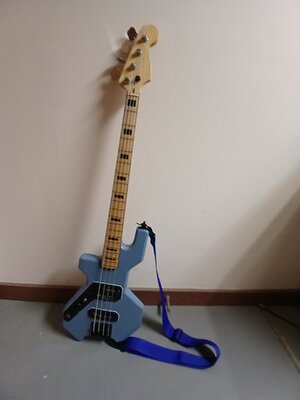
I just finished cobbling together a semi-left-handed Franken-bass out of a jazz bass clone neck and a cheap lefty Chinese bass body that ran afoul of an electric saber saw (it doesn't look much like a Fender bass now, and will look even less so once I modify the headstock). That solves the problem of the strap-holder on the short horn throwing the center of balance too far back and causing neck dive. Note that I don't have the issue with changing the bridge and nut, because I play with the low-E string on the bottom.

Kovax_Lefty_Bass20260409.jpg