Dont be fooled by those who say that a thicker string is the way to go, i use warwick black labels (45-tw135)on my MIM jazz V and the b string is absolutly awful, the good sound comes out basically from the player (technique) then you must have some good pickups that have a good response for slow wave patters like the one of the b string, then you meet up with quality better construction and better materials really make the diference specially the overall mass of the bridge and nut. A good cab helps alot specially a 15" to get deep low end tones.

Enjoy the benefits of a premium membership!
Upgrade Account
-
TalkBass has been independent since 1998. Add your voice.
Create a free account to reply to discussions, view embedded media, and browse with fewer display ads.
Join free Log in
Want zero display ads or expanded classifieds tools? Compare plans.
You are using an out of date browser. It may not display this or other websites correctly.
You should upgrade or use an alternative browser.
You should upgrade or use an alternative browser.
Floppy 5th String
- Thread starter BHuntsalot
- Start date
More options
Who Replied?
If someone wants to play a longer scale bass than 34", that's cool. I prefer 34" scale. There are PLENTY of 34" scale basses with a "B" string that is articulate with a great feel. Having owned/played Modulus basses (35"), Foderas (34 and 35), Sadowskys and many others, I can say there is no difference in the quality of the B string between well designed basses regardless of a scale length of 34 or 35. OTOH, I've played a poorly designed 36" that sounded like crap on every string 
Perhaps there are other factors at work with more "luthiers" (some otherwise known as "guy with a bandsaw in the garage now making basses because the rustic furniture market is a bit soft right now"...) making 35+ scale. Maybe factors like marketing? Trying to differentiate a brand?
Maybe it's just easier to not screw it up with a longer scale?
Perhaps there are other factors at work with more "luthiers" (some otherwise known as "guy with a bandsaw in the garage now making basses because the rustic furniture market is a bit soft right now"...) making 35+ scale. Maybe factors like marketing? Trying to differentiate a brand?
Maybe it's just easier to not screw it up with a longer scale?
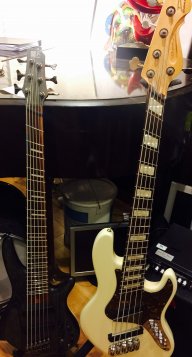
Note that with thicker strings, the thickness of the core string is often what makes the difference in tension. That's why I tend to find that with some manufacturers, the .125 - .135s feel pretty much the same, even though they sound different. Then you put on a .140 and it will feel much tighter.

Cort Curbows R0XxOr.
Had a 5 and a 6, B not floppy.
Now I have a Ristola, 34" scale, and my low A string is not floppy. Build quality, thick strings. And the occasional virgin sacrifice at midnight to keep things just right. Though it's getting tougher to find virgins to sacrifice..
Had a 5 and a 6, B not floppy.
Now I have a Ristola, 34" scale, and my low A string is not floppy. Build quality, thick strings. And the occasional virgin sacrifice at midnight to keep things just right. Though it's getting tougher to find virgins to sacrifice..

 Buy a Stingray 5....done deal.
Try a Dingwall with fanned frets. 37" B to a 34" G. Allows for equal string tension across all strings. B string is tight and thunderous. Fanned frets are easy to get used to.

Actually, 125-135 works just fine for most folks, including myself, as also indicated by what exists in the vast majority of the most popular 5 string sets.M.Gilberto said:Physics does indeed state that a longer string length will increase the string tension. Since changing the scale length of your instrument isn't something you can do easily [!], I'd like to suggest the ALTERNATE, and perhaps more obvious physics-inspired solution: FATTER STRING.
Most people play wimpy little 125-135 low Bs on their contrabasses.
True, but in the case of a bass string, the above is oversimplification by omission of some very significant things which make huge differences in the physical model.I have played a 145... This is not rocket science. A thicker string increases tension.
Bass strings are not solid wire, so it's a much more complicated physical model... they're a actually a complex system of a varying number of windings of various sizes and materials of wire over a solid core, which can also vary in size, material, and also shape, all of which being subject to varying construction processes, all of which are independent of the overall string size, and all of which making huge diffs in tension and how they feel to us.
Don't get me wrong, if the 145's work best for you, that's totally cool, but I find that even on a 35" scale bass, anything bigger than a 135 tends to have overtones that are way too strong for my tastes. Less definition, clarity, and focus... a clouded fundamental... especially past the 5th fret... and personally, I like to use my B all the way up to at least the 12th fret.
I think the answer can't be made any simpler than to say it lies in a BALANCED combination of instrument materials, design, construction, setup, scale length, string size, AND string construction.
To take any one of these things and single it out as the one primary thing that will define a "tight B" I think is far too oversimplified.
For example, you could take a .200 off a knucklehead bass and tune it to a B on a crappy bass, and it'll still sound like crap. Take a "wimpy little" .125, put it on a Roscoe, and you'll need new underwear after the first pluck.
All this IMHO, of course.

Physical answers exist though.angelopb said:You are going to get all kinds of conflicting advice here. Physics says you get better intonation and feel on the low B with a longer than 34" scale length.
But the guys with the standard 34" scale are going to scream "build-quality über alles" And their bass just happens to be an example of an extremely well-built 34" 5 or 6 string bass.
Good luck finding a helpful answer. Don't overlook technique too. Whenever you play a B string, you can't beat it up like the E string. It needs to be plucked, picked or slapped with accuracy and focus. Generally, I play mine closer to the bridge.
What you feel when you play a string is tightness, not tension. Tension could only be felt by pulling the end of the string. Tightness is its resultant for the most part.
Tightness depends on tension but also on the rigidity of the beam that supports it and the liberty of the nodes at each end.
The more rigid the beam the tighter the string. So thicker necks, laminations, volutes, cast (as opposed to bent) bridges, rigid neck-body assembly, basically anything that helps keeping a fixed distance between the 2 ends of the string (reducing inner moments) will make it feel tighter.
The nodes (ends of the strings) can't be brought back to a simple model. They're somewhere between an embedded and pivot assembly. The nearer from embedded the tighter the string. The simplest way to help this is to break the angle behind the string, although the impact is minimal.
I still have no explanation for the supposed effect of longer string ends though, like Mike Pope's Fodera or Gary Willis's bridge washer trick. It seems to work for them at least.


Jeff Rader said:Perhaps there are other factors at work with more "luthiers" making 35+ scale. Maybe factors like marketing?
I'd like to think that the luthiers who build less instruments per year than the big-name companies are more concerned with great tone and playability rather than marketing stratgies. I can see Fender, Warwick, or MusicMan producing a 35" scale 5-string if the overall sales numbers were drastically dominated by other companies offering 35" scale 5-strings.
I do agree, that sales figures do play an important role with manufacturers, but I'd like to think when a Mike Tobias or Keith Roscoe (and all the other 'indie' luthiers who offer a 35" scale) design and produce their instruments, they're focsussing on what helps give their instruments the best overall tone that their instruments can produce.
With that, IMO the majority of the smaller-scale (no pun intended) builders don't view a 35" scale as a gimmick to increase sales. I truly feel they view the 35" scale is 'best' for the basses they design, build, and sell. And if a 5-string with a 34" scale sounded superior to their 35" scale couinterparts, I really don't think they'd bother producing a 35" scale 5-string. By judging the posts debating this topic, it would be easier for every builder to produce a 34" scale 5-string and 'convince ' all of us that the 34" scale in the only the way to go.
I'm not saying for a moment that a 34" scale 5-string can't have a great sounding B-string. IMO Mike Pedulla's 5's & 6's have awesome-sounding B-strings, and Mike's products are 34" scale instruments. I haven't had the chance to try a Ken Smith or Fodera 5-string ( with a 35" scale length scale) but I don't doubt both brands are as great sounding as they can possibly be. nd as I posted before, I rather like the sound of my 34"scale StingRay-5's B-string.
Although I no longer own a Pedulla bass, I really admire their tone and craftmanship. Their 5 and 6-stringed basses are all 34" scale, and they sound great.
Just in my limited experience with 5-strings the 35" scale basses had the best feeling and sounding B-Strings. But YMMV.
The few 5th I tried:
-Musicman SR5: Very good 5th, a very clear sound, good feeling while playing it, warm and clear for the 5th.
-Warwick Thumb 1987: A floppy 5th...
-F Bass BN5, the most unreal 5th, the bass is very well balanced, and the 5th sound is not "eating" the others strings.....I fall in love with that 5, so I ordered it...and will have it soon!
Just my 2cents!
Vince
-Musicman SR5: Very good 5th, a very clear sound, good feeling while playing it, warm and clear for the 5th.
-Warwick Thumb 1987: A floppy 5th...
-F Bass BN5, the most unreal 5th, the bass is very well balanced, and the 5th sound is not "eating" the others strings.....I fall in love with that 5, so I ordered it...and will have it soon!
Just my 2cents!
Vince
VinceLovesF said:-F Bass BN5, the most unreal 5th, the bass is very well balanced, and the 5th sound is not "eating" the others strings.....I fall in love with that 5, so I ordered it...and will have it soon!
Just my 2cents!
Vince
F basses come with 34.5" scale. maybe the neutral option between 34" and 35", but once again luthiers made better 5rs than mass production companies.
The thing I find most hilarious about this thread is that people are actually debating the subtle differences between a 34 and 35 inch scale. What makes this truly preposterous is that a low B string should really be something like 6 feet long, as it is in a concert grand piano. The note is something like 75 feet long in free air, for chrissakes. Do you guys really think that a single inch is truly a night-and-day difference? It's certainly not a deal-breaker, as I can assure you that there are a lot of 34" scale instruments with very nice, well balanced low B strings.
The fact is that this thread was about floppy B strings - and indeed, not all basses have floppy B strings.
I have some basses that wear 130 low Bs and aren't floppy at all...but the fact remains, that if you happen to have a particular instrument that seems to have ANY string that seems tighter or looser than the others proportionally, it can often be compensated for with minor adjustments in string gauge.
If you have a bass that has the tone, feel, balance, and personality that you want, but find that the B string could be a little tighter to better even out the string-to-string feel...then try a fatter string. It could be all that's needed to compensate on that instrument, and make it a truly balanced axe.
[Invalid or Expired Link Removed] has a lot of published tables on string gauges and often lists tension for each string. A lot can be learned just by looking at a few tables. Tension also varies wildly from brand to brand.
You may now resume fighting over .5"-1" of scale length...
The fact is that this thread was about floppy B strings - and indeed, not all basses have floppy B strings.
I have some basses that wear 130 low Bs and aren't floppy at all...but the fact remains, that if you happen to have a particular instrument that seems to have ANY string that seems tighter or looser than the others proportionally, it can often be compensated for with minor adjustments in string gauge.
If you have a bass that has the tone, feel, balance, and personality that you want, but find that the B string could be a little tighter to better even out the string-to-string feel...then try a fatter string. It could be all that's needed to compensate on that instrument, and make it a truly balanced axe.
[Invalid or Expired Link Removed] has a lot of published tables on string gauges and often lists tension for each string. A lot can be learned just by looking at a few tables. Tension also varies wildly from brand to brand.
You may now resume fighting over .5"-1" of scale length...
Several good posts I'm reading here, but I'd also like to emphasize something I sorta' eluded to but didn't say specifically...
There's a difference between "tension" and "stiffness", and I think most people get confused about this and lump it all together, because adding tension can add stiffness, but that's not the only thing that can get you a stiffer B.
For example, you can have a stiffer string that actually has LOWER tension, depending on the construction of the string, and I think most people would just assume it has more tension on it.
The point is, yeah, if you took exactly the same kind of string and simply went to a larger guage, yes, it would get "stiffer" because of the added tension, but my point is, there's lots more to the picture, and I don't think folks really care about how much tension the string puts on the neck... I think what they're really after is getting the string to not be too "slinky" for their tastes, and reducing fret buzz when they dig in a bit, and you can change string brands or models to accomplish this as well as moving to larger guagues, and then you don't have to mod the nut.
I did point out that bass construction matters, but that's not something you can "easily change", so if we're not talking about switching instruments, we can throw that out. However, someone else also pointed out technique, which is something you can without too much difficulty (if that's something you'd be interested in doing... some aren't).
There's a difference between "tension" and "stiffness", and I think most people get confused about this and lump it all together, because adding tension can add stiffness, but that's not the only thing that can get you a stiffer B.
For example, you can have a stiffer string that actually has LOWER tension, depending on the construction of the string, and I think most people would just assume it has more tension on it.
The point is, yeah, if you took exactly the same kind of string and simply went to a larger guage, yes, it would get "stiffer" because of the added tension, but my point is, there's lots more to the picture, and I don't think folks really care about how much tension the string puts on the neck... I think what they're really after is getting the string to not be too "slinky" for their tastes, and reducing fret buzz when they dig in a bit, and you can change string brands or models to accomplish this as well as moving to larger guagues, and then you don't have to mod the nut.
I did point out that bass construction matters, but that's not something you can "easily change", so if we're not talking about switching instruments, we can throw that out. However, someone else also pointed out technique, which is something you can without too much difficulty (if that's something you'd be interested in doing... some aren't).

D'yer Mak'er said:I own a Cort Curbow 5 string. I LOVE IT. It is not a common bass and it can be hard to find one in the flesh, but if you get a chance, do yourself a favor and try one out. It's really great, and at an excellent price (their 5 strings generally go for $450 - that's what I bought mine for and it was the price most people were asking).
It's one of the best you'll find in that price range, in my opinion.
I support this thought too

Umm...to each his own, I had one years ago and I could never get past the sound of the ebanol firetboard (clankety clank clank). Weird shape as well, a little small in the body. Nice looker I suppose that's why I took a shot. I lasted 2 weeks then traded it for an Ibanez. Had 2 American Jazz 5's and the "B" strings were ok, but my Stingray 5? Now that's<b> <i>defined </i></b>brother....D'yer Mak'er said:I own a Cort Curbow 5 string. I LOVE IT. It is not a common bass and it can be hard to find one in the flesh, but if you get a chance, do yourself a favor and try one out. It's really great, and at an excellent price (their 5 strings generally go for $450 - that's what I bought mine for and it was the price most people were asking).
It's one of the best you'll find in that price range, in my opinion.
Really? Hmm, I have two Taylor acoustics with ebony fretboards...never heard a peep. Ebanol is synthetic, so is luthite for that matter. The Curbow just sounded "fake"....can't explain it.Jazz Ad said:Ebonol fretboards clank just like ebony in my experience.
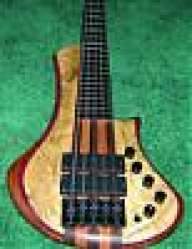
Trip's custom Alembic 8:
[Invalid or Expired Link Removed]
The web site says it's 34" scale, but actually, it's a 32" scale, as Trip says here:
http://www.talkbass.com/forum/showpost.php?p=1840784&postcount=9
I heard him play this thing a while back at a NAMM Summersession when he first got it, and the B string sounded EXCELLENT.
The bottom line is, you don't need a 35" or even a 34" scale to have a great B string if the bass is made and setup right (which I think is the crux of this entire thread).
[Invalid or Expired Link Removed]
The web site says it's 34" scale, but actually, it's a 32" scale, as Trip says here:
http://www.talkbass.com/forum/showpost.php?p=1840784&postcount=9
I heard him play this thing a while back at a NAMM Summersession when he first got it, and the B string sounded EXCELLENT.
The bottom line is, you don't need a 35" or even a 34" scale to have a great B string if the bass is made and setup right (which I think is the crux of this entire thread).


