• TalkBass has been independent since 1998. Add your voice.
    Create a free account to reply to discussions, view embedded media, and browse with fewer display ads.
    Join freeLog in
    Want zero display ads or expanded classifieds tools? Compare plans.

Floppy B String

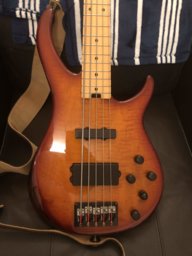
Ever since I've owned my bass, a MIM Jazz 5 I've noticed that the low B string feels as if it could do with a bit more tension. I've realised just recently that I've subconsciously been avoiding using it because of the way it feels, which defeats the purpose of playing a 5 string. Outside of getting a new bass entirely, is there anything I can do with my string arrangement to change the tensile load?

I was thinking of perhaps going up or down in gauge on the B string alone and leaving the other strings at their current gauge, or changing to an entirely different set if need be. I'm currently using D'addario half wounds, regular gauge.
 
Greater thickness means more tension to achieve the same pitch.

Not always.


To the OP, what gauge B string is on it right now? Switching to a larger gauge "may" work, depending on if the company in question ups the core wire diameter, to allow better stability at that tuning.
 
Not always. To the OP, what gauge B string is on it right now? Switching to a larger gauge "may" work, depending on if the company in question ups the core wire diameter, to allow better stability at that tuning.

OK, let's get all physics-intensive on this. For any string, if there is a greater mass per length, then a greater tension will be required to achieve the same frequency. In general, that means that a thicker string will achieve greater tension at a given pitch--but it does depend on the alloys used and the packing density of wire core/wrap. How's that, Jon?
 
  • Like
Reactions: Jon Moody
OK, let's get all physics-intensive on this. For any string, if there is a greater mass per length, then a greater tension will be required to achieve the same frequency. In general, that means that a thicker string will achieve greater tension at a given pitch--but it does depend on the alloys used and the packing density of wire core/wrap. How's that, Jon?

:)

I was going to bring up that by "going up" in gauge, from our DYB125 to DYB126, actually goes DOWN in tension when tuned to the same pitch.
 
Try a Chrome B?

Sounds like the OP's only option, given that (at least, according to BSO) you can only get the Half Rounds in .130 B string. Although, going from the Half Round .130 to a Chrome .132 won't give you much more tension (34.5 to 35.9), more importantly it might have the stiffness needed to feel "correct" to the OP.
 
Call BSO for their recommendation. I wanted flat wound strings and settled on Chromes which only have a 132 B string. Nice feel and tension is fine for me. I also needed to use a larger B string and found I like a 130 or 132 gauge for the feel and tone. Anything lower in gauge felt like a rubber band.
 
  • Like
Reactions: KickingBass
OK, let's get all physics-intensive on this. For any string, if there is a greater mass per length, then a greater tension will be required to achieve the same frequency. In general, that means that a thicker string will achieve greater tension at a given pitch--but it does depend on the alloys used and the packing density of wire core/wrap. How's that, Jon?

It also depends on the 'stiffness' of the string, largely (but not exclusively) determined by core material and core size.

EDIT: Sometimes I'm wrong.
 
Last edited:
It also depends on the 'stiffness' of the string, largely (but not exclusively) determined by core material and core size.

Nope. It's independent of modulus (stiffness). The relevant equation for a vibrating string is: f = sqrt(T/M) where f is the frequency of vibration, T is the tension in the string and M is the mass per unit length. rearranging, we get: T = M * f^2. In any elastic wave system, you always end up with frequency depending on the ratio of "restoring elasticity" in some form (here captured as tension) to the inertia of the system (here captured as mass per unit length).
 
  • Like
Reactions: twoByFour
Tension as we think about it is actually based on two things: the actual tension of the string, which is solely based on three factors (tuning of the string, length of string, and mass of the string) and stiffness of the string.

Mass of the string is usually related to gauge, but it also depends on the ratio of core to winding, as well as the diameter of the core and the diameter of the winding wire. Strings with bigger cores and smaller wrap wire will have a higher tension than small core with big wrap wire, and flatwounds will have the highest tension per gauge.

Stiffness also depends on core diameter and core shape. A lot of strings nowadays are hex core strings, which are stiffer than the round core strings (most DR strings are examples of round core strings, with the biggest exception being their Lo Riders, which have higher "tension" meaning you can set the action lower hence the name of the string).

It's a complex thing, tension.
 
Nope. It's independent of modulus (stiffness). The relevant equation for a vibrating string is: f = sqrt(T/M) where f is the frequency of vibration, T is the tension in the string and M is the mass per unit length. rearranging, we get: T = M * f^2. In any elastic wave system, you always end up with frequency depending on the ratio of "restoring elasticity" in some form (here captured as tension) to the inertia of the system (here captured as mass per unit length).

Well, I learned something new today. How embarrassing, I just assumed it was like a spring, which does have a relationship of stiffness to frequency. I probably should have researched it before blurting out my misinformation.

http://en.wikipedia.org/wiki/Mersenne's_laws