• TalkBass has been independent since 1998. Add your voice.
    Create a free account to reply to discussions, view embedded media, and browse with fewer display ads.
    Join freeLog in
    Want zero display ads or expanded classifieds tools? Compare plans.

Fodera Club Part IV

Status
Not open for further replies.
You might be disappointed. Titanium may be stiffer (and I say may because only some formulations are stiffer than brass) and has a high strength/weight ratio (which means nothing for a bridge), but it also is the rubber band of metals- it soaks up vibrations at various frequencies substantially more than brass.

I'm not convinced, and I've played an AJ with a titanium bridge in Japan. I think a lot of it is the appeal of the exotic.
I have also heard that it may just be quite brittle.
Not sure if that is at all true.
I was, for this reason, advised against a titanium truss rod when I had my most recent bass made.
I was considering it for its light weight.
But there probably are different alloys out there some more some less suited to use on instrument parts.
I'm still interested in trying it in a bridge.
At the time I was looking at KTS parts.
http://www.k-t-s.com/
 
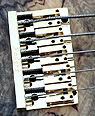
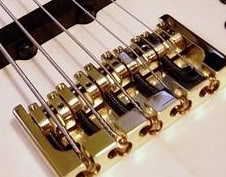
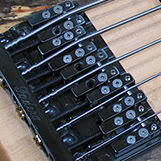
Yes, these photos DO match my descriptions...

I guess

#1
1.jpg


#2 No photo ;)


#3
2.jpg


#4
3.jpg


Locking version
lock.jpg
 
Just some general additional thoughts...

1. The "Hipshot" Fodera bridge is 100% brass just like the other.
2. There seems to be some perception that the Hipshot version is in some way "inferior." I thought that I pointed out that both sonically and functionally they are identical. I also mentioned that I have one on one of my Monarchs (and I could have easily replaced it).
3. The cost difference between the two, although wider than it was when the Hipshot version was first introduced, remains nominal. As mentioned in my initial post we want to maintain relationships with two vendors for such a critical proprietary part. By putting all of one type of bridge on one series (the NYC's) and all of the other on the Customs we ALWAYS know which drill pattern to use...which makes final set up easier.
4. On titanium bridges. They are INCREDIBLY beautiful, exotic and expensive and AJ feels that they carry a tonal advantage (to brass). The certainly save weight. However, they are expensive (each is literally machined by hand by one person) and this is one of the reasons that they are not more widely used. Additionally, the tone difference is not universally desired and, for better or worse, the only way to tell that is to buy one and A/B it with your own ears on your own rig...I am still personally playing brass as is Joey. Mike Pope's new bass will have a Titanium bridge as will the bass that we are making for Yiorgos Fakanas...so the decision is a personal one. Very much like the choice between nickel and SS strings...

I hope that all of this helps...
 
Just some general additional thoughts...

1. The "Hipshot" Fodera bridge is 100% brass just like the other.
2. There seems to be some perception that the Hipshot version is in some way "inferior." I thought that I pointed out that both sonically and functionally they are identical. I also mentioned that I have one on one of my Monarchs (and I could have easily replaced it).
3. The cost difference between the two, although wider than it was when the Hipshot version was first introduced, remains nominal. As mentioned in my initial post we want to maintain relationships with two vendors for such a critical proprietary part. By putting all of one type of bridge on one series (the NYC's) and all of the other on the Customs we ALWAYS know which drill pattern to use...which makes final set up easier.
4. On titanium bridges. They are INCREDIBLY beautiful, exotic and expensive and AJ feels that they carry a tonal advantage (to brass). The certainly save weight. However, they are expensive (each is literally machined by hand by one person) and this is one of the reasons that they are not more widely used. Additionally, the tone difference is not universally desired and, for better or worse, the only way to tell that is to buy one and A/B it with your own ears on your own rig...I am still personally playing brass as is Joey. Mike Pope's new bass will have a Titanium bridge as will the bass that we are making for Yiorgos Fakanas...so the decision is a personal one. Very much like the choice between nickel and SS strings...

I hope that all of this helps...

How Would you describe the difference in tone , between titanium and brass, sitting right "at the source"?
And- how about aluminium?
:)
 
Hello,
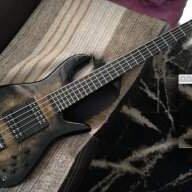
I've just bought an old and beautiful Fodera Monarch 4 (same desing as Vic's #1) with EMG's PU (in a shop in the US, thanks to internet) and I've received this bass for two days, but... there's something wrong with the preamp.
In active mode, the preamp makes noise (in lows frequency) and stops definetly to work after few minutes :( ! , so it's impossible to play in the active mode.
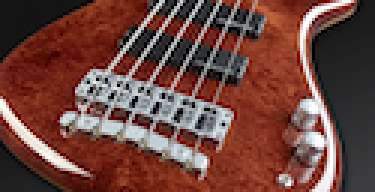
The preamp looks like an old one and HZ1 is printed on (so I'm thinking that it's an old Haz lab preamp, but I'm not shure).
As I'm living in France (EU), it will be certainly complicated to make it repair, so I'm thinking to replace this preamp with an other one.
Is there someone who has try an other preamp as Haz lab in an old Monarch (serail number MB942) ?
In addition, I have send a mail to Fodera shop to ask their advice.
Thanks
 
As we mentioned in my email to you, it sounds like a problem with the preamp. Since you just bought the bass used from a shop, we would recommend starting with them as your first point of contact. We can certainly fix it for you here at the shop, but there will be costs involved. Depending on the issue, we might be able to fix the HAZ Preamp, or, if not, we could install a new Fodera / Pope preamp for you.


Hello,
I've just bought an old and beautiful Fodera Monarch 4 (same desing as Vic's #1) with EMG's PU (in a shop in the US, thanks to internet) and I've received this bass for two days, but... there's something wrong with the preamp.
In active mode, the preamp makes noise (in lows frequency) and stops definetly to work after few minutes :( ! , so it's impossible to play in the active mode.
The preamp looks like an old one and HZ1 is printed on (so I'm thinking that it's an old Haz lab preamp, but I'm not shure).
As I'm living in France (EU), it will be certainly complicated to make it repair, so I'm thinking to replace this preamp with an other one.
Is there someone who has try an other preamp as Haz lab in an old Monarch (serail number MB942) ?
In addition, I have send a mail to Fodera shop to ask their advice.
Thanks
 
That looks to be one of the very first "Extended Low-B" headstocks that we did. The offset truss rod cover was necessary due to the way the early Extended Low-B headstocks were laid out...


Hi

Is it normal ?
[Invalid or Expired Link Removed]

I've never seen such "original and mysterious" work before.
Can't believe it.
 
Gang --

I just realized (thanks Mike!) that I made a mistake in the post above about Mike Pope's new bass. I remebered that we had made a very special bridge for him and therefore mistakenly remembered it as being Titanium...

In actuality his was the first 17.5 mm spaced Fodera bridges that we made. It is made out of brass. Sorry for the confusion!!
 
All good. Should be seeing that moving PU mechanism any day now too. Being able to go from 70's to 60's spacing (and beyond) will make that bass incredibly flexible. I'm really psyched!

Interesting. Wouldn't that be about the same thing as just tapping the inner versus outer coil of the bridge pickup? If you mounted the bridge pickup dual coil with the rear coil in 70's position, that should be quite close to 60's with the front coil (around 1/2" closer). That would most probably get you all the way there, especially if you have a 35" instrument, which kind of messes with those exact pickup positions anyway.
 
On a side note, I just finished a piano trio project here with my brother on drums and John Patitucci on bass (me on piano). Holy crap, he played his butt off. All acoustic bass. And for the folks who think Foderas are too expensive, his acoustic (a Jean Baptiste Vuillaume...one of only 4 or 5 ever made) would sell for the better part of $100,000.00. makes $8400.00 seem pretty reasonable to me :-)
 
On a side note, I just finished a piano trio project here with my brother on drums and John Patitucci on bass (me on piano). Holy crap, he played his butt off. All acoustic bass. And for the folks who think Foderas are too expensive, his acoustic (a Jean Baptiste Vuillaume...one of only 4 or 5 ever made) would sell for the better part of $100,000.00. makes $8400.00 seem pretty reasonable to me :-)
Very cool! Please keep us updated as to when it will be available.
 
Interesting. Wouldn't that be about the same thing as just tapping the inner versus outer coil of the bridge pickup? If you mounted the bridge pickup dual coil with the rear coil in 70's position, that should be quite close to 60's with the front coil (around 1/2" closer).

No. And believe me, I have lots of first hand experience trying all of this stuff. If you put the PU in 70's position and then tap the inner coil you have three problems...

1) you don't have a matched coil to cancel hum with your neck PU anymore

2) and if you correct that issue, the 60's position doesn't sound anywhere near the same having that other coil sitting underneath the closer part of the string.

3) the center to center on the duals is 5/8" and you really only want to go from 2 1/8" to 2 1/2"...or a 3/8" change. That descrepancy of 1/4" makes a HUGE HUGE difference when you're that close to the bridge.
 
No. And believe me, I have lots of first hand experience trying all of this stuff. If you put the PU in 70's position and then tap the inner coil you have three problems...

1) you don't have a matched coil to cancel hum with your neck PU anymore

2) and if you correct that issue, the 60's position doesn't sound anywhere near the same having that other coil sitting underneath the closer part of the string.

3) the center to center on the duals is 5/8" and you really only want to go from 2 1/8" to 2 1/2"...or a 3/8" change. That descrepancy of 1/4" makes a HUGE HUGE difference when you're that close to the bridge.

Interesting. On your point 1, I would assume that the neck pickup would be placed so that the pickup would have one of the coils in jazz bass position for hum cancelling (i.e., of course, you would have to have both pickups in single coil mode to hum cancel and also mimic a J bass in either 70's or 60's version)

+1 though, I guess that 1/4" would have an impact, although again, with a 35" scale instrument (not sure what scale your bass will be), the entire formula kind of goes to heck anyway.

Cool though. Interesting design and I'm sure it will sound killer.
 
Interesting. On your point 1, I would assume that the neck pickup would be placed so that the pickup would have one of the coils in jazz bass position for hum cancelling (i.e., of course, you would have to have both pickups in single coil mode to hum cancel and also mimic a J bass in either 70's or 60's version)

+1 though, I guess that 1/4" would have an impact, although again, with a 35" scale instrument (not sure what scale your bass will be), the entire formula kind of goes to heck anyway.

Cool though. Interesting design and I'm sure it will sound killer.


For 35" scale you just multiply all the numbers by 1.029. It's not a huge difference, but all same points apply.

2 1/8" becomes about 2 3/16" and so on. I don't necessarily hear a change of 1/16" personally. But the difference is cumulative.

My moving PU mechanism will allow for adjustments in detented increments of .125" and a total travel of 1", from bridge coil at 2" to bridge coil at 3". So I'll get all the fender spots, plus a bunch more.

To your point 1 response, you have the coil that is in the neck position at the J-bass spot. But the way these kinds of passive PU's work (forgive me if this is old news to you...it's not to some), in order to hum cancel, you pair a North magnet (bridge) with a south magnet (Neck) but the Neck is an "up side down" wind. So any signal generated by a combination of the magnetic field and the electrical coil is inverted twice relative to the bridge PU...or 360 degrees out of phase...or in phase. But the noise is only effectively being picked up by the coils independant of the magnets. So the noise is 180 degrees out of phase. So when the two PU's are blended, the noise is in each one backwards and hence gets cancelled.

The catch with the dual coil thing is that the "inner" coil of a bridge PU is wound the same as the outer coil of a neck PU. So if you use only the coil on the neck PU that is in the correct spot, when you blend it with the "outer" coil of the bridge it's fine, but if you blend it with the inner coil of the bridge, you get lots of noise (more than one coil alone). If you reverse the polarity to cancel the noise, you also put your main signal out of phase.
 
On a side note, I just finished a piano trio project here with my brother on drums and John Patitucci on bass (me on piano). Holy crap, he played his butt off. All acoustic bass. And for the folks who think Foderas are too expensive, his acoustic (a Jean Baptiste Vuillaume...one of only 4 or 5 ever made) would sell for the better part of $100,000.00. makes $8400.00 seem pretty reasonable to me :-)

I don't think we should really pay more for a bass than Jaco, Chris Squire, Gary Willis and other bass giants initialy paid for their respective stock basses, unless having better results.
So the rest is sales & marketing nice to have stuff and "look at me how sexy I am !"

Best regards
 
Status
Not open for further replies.