• TalkBass has been independent since 1998. Add your voice.
    Create a free account to reply to discussions, view embedded media, and browse with fewer display ads.
    Join freeLog in
    Want zero display ads or expanded classifieds tools? Compare plans.

Fodera Club Part VII

Status
Not open for further replies.
For the majority of Fodera's history we used a catalyzed urethane lacquer. More recently (over a year ago) we switched (due to supplier issues and environmental concerns) to a catalyzed acrylic lacquer.

The products are virtually identical in terms of "performance." It is an extremely thin, light finish material that spreads very evenly but does NOT fill gaps well at all. Thus the need for multiple coats with rub outs in between the coats.

The alternative would be to use a grain filler first and then the catalyzed acrylic lacquer over it, but we tried that and the grain filler (in our opinion) really choked the sound of the instruments. This would cut the labor time for our finishing process by 2/3's, but the results just don't sound as good...

So contrary to the way it sounds, many coats of a thin, breathable material yields are far thinner final finish than fewer coats of a thicker one. Make sense?

Regards,

Jason


Sorry to come back to that already talked about subject of varnish and laquer etc.
It was mentioned that fodera use urethane if I remember correctly.
Is that the same stuff as used in boat building?
and... where do you see the benefit of many coats of varnish over fewer ones apart from it wearing off less quickly (it seem counter intuitive to me to put many coats on a body that is made to vibrate).
Thanks again! :)
 
For the majority of Fodera's history we used a catalyzed urethane lacquer. More recently (over a year ago) we switched (due to supplier issues and environmental concerns) to a catalyzed acrylic lacquer.

The products are virtually identical in terms of "performance." It is an extremely thin, light finish material that spreads very evenly but does NOT fill gaps well at all. Thus the need for multiple coats with rub outs in between the coats.

The alternative would be to use a grain filler first and then the catalyzed acrylic lacquer over it, but we tried that and the grain filler (in our opinion) really choked the sound of the instruments. This would cut the labor time for our finishing process by 2/3's, but the results just don't sound as good...

So contrary to the way it sounds, many coats of a thin, breathable material yields are far thinner final finish than fewer coats of a thicker one. Make sense?

Regards,

Jason

Absolutely, thanks!
I did not think of the grainfiller issues :-)
 
Talking about lacquer and finishes:

After extensively working my new Monarch I'm realizing some spots of the matte lacquer becoming glossy. Especially close to the bridge PU where my thumb rests and at the slap area close to the g-string and the end of the fingerboard.

Is there any easy way to treat this? I'm very reluctant to apply some standard "chemistry", because I'm afraid of irreversible damage of the wonderful finish.
 
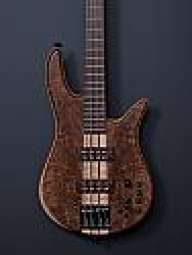
Why "treat" it? It is a natural part of the instrument being used. If you look at an older Fodera that has really been lovingly played, the finish wears to a near gloss from use. I personally LOVE that look!

That said, if you really want it to be returned to the way it looked when you first got it, you can gently rub the glossy areas with either 0000 Steel wool or a 1000 Abralon pad (being careful if you use steel wool to get the fibers nowhere near the pickups).

The only problem with doing this at home is that to be done right, you really should disassemble the entire instrument, rub EVERY part of the bass evenly and then rewax it when finished...also, every time you do this you are removing some of the finish and, eventually you WILL rub through to bear wood...


Talking about lacquer and finishes:

After extensively working my new Monarch I'm realizing some spots of the matte lacquer becoming glossy. Especially close to the bridge PU where my thumb rests and at the slap area close to the g-string and the end of the fingerboard.

Is there any easy way to treat this? I'm very reluctant to apply some standard "chemistry", because I'm afraid of irreversible damage of the wonderful finish.
 
Thanks Jason.

Basically I agree. Why treat it? Those marks are like personal stamps. Though it takes some time for getting used to. The bass looked so overwhelming great when it was brand new.

Taking the whole bass apart and using steel wool sounds quite horrible to. It's really not worth it.


Why "treat" it? It is a natural part of the instrument being used. If you look at an older Fodera that has really been lovingly played, the finish wears to a near gloss from use. I personally LOVE that look!

That said, if you really want it to be returned to the way it looked when you first got it, you can gently rub the glossy areas with either 0000 Steel wool or a 1000 Abralon pad (being careful if you use steel wool to get the fibers nowhere near the pickups).

The only problem with doing this at home is that to be done right, you really should disassemble the entire instrument, rub EVERY part of the bass evenly and then rewax it when finished...also, every time you do this you are removing some of the finish and, eventually you WILL rub through to bear wood...
 
LOL -- it reminds me of my wedding picture...Deb (my wife) and I "looked so overwhelmingly great" back then. Now, we are far more interesting, but don't look as good!!


Thanks Jason.

Basically I agree. Why treat it? Those marks are like personal stamps. Though it takes some time for getting used to. The bass looked so overwhelming great when it was brand new.

Taking the whole bass apart and using steel wool sounds quite horrible to. It's really not worth it.
 
I just browsed the fodera site again... there i tsays something about "lateral humbucking pickups"... could you/ would you shed some light on to what this means and in how far it is different to regular HBPs?
 
Just want to send my deepest regrets and sympathy to members of the forum and bass players in japan. The images on tv is devastating.

+1....and even though this is a great, great tragedy, let us not forget about our brothers and sisters in Libya. There is a great deal of pain and struggling throughout the world these days to be mindful of.
 
We have actually discussed this topic at length earlier in the Fodera Club threads, so I will be very brief here...they are J shaped pups that are wound as two small side-by-side humbuckers rather than on on top of the other. On a 4-string, imagine one coil being wound around the poles for the E and A strings and another coil for the D and G -- almost like a little, mini, in-line P-pup except that they fit in a J shell and sound more like J pups...

I just browsed the fodera site again... there i tsays something about "lateral humbucking pickups"... could you/ would you shed some light on to what this means and in how far it is different to regular HBPs?
 
We have actually discussed this topic at length earlier in the Fodera Club threads, so I will be very brief here...they are J shaped pups that are wound as two small side-by-side humbuckers rather than on on top of the other. On a 4-string, imagine one coil being wound around the poles for the E and A strings and another coil for the D and G -- almost like a little, mini, in-line P-pup except that they fit in a J shell and sound more like J pups...

Ah ok... so basically narrow in line humbuckers like the Delano JSBCs ([Invalid or Expired Link Removed][cat]=1&tx_smtdelano_pi1[series]=9&tx_smtdelano_pi1[strings]=6&tx_smtdelano_pi1[system]=68 )?
Can you remember where this was discussed( side number or so?)
Thanks!
 
I am not personally familiar with Delano's, so I cannot comment, but I imagine that a search for Fodera Lateral Humbucker should get you to it...

Cheers,

J

Ah ok... so basically narrow in line humbuckers like the Delano JSBCs ?
Can you remember where this was discussed( side number or so?)
Thanks!
 
I've got an ash/maple elite Emperor II on order, and I'm currently slated for a maple tone block. Anybody have experience with other tone blocks for this combo? I love the punch and grind of ash/maple, but I also want the bass to have some real core/beauty/elegance to the tone, if that makes sense. Anybody ever use walnut as a tone block for ash/maple?
 
We have been doing a LOT of Alder Tone Blocks lately with that combo and are loving the results...

J

I've got an ash/maple elite Emperor II on order, and I'm currently slated for a maple tone block. Anybody have experience with other tone blocks for this combo? I love the punch and grind of ash/maple, but I also want the bass to have some real core/beauty/elegance to the tone, if that makes sense. Anybody ever use walnut as a tone block for ash/maple?
 
Status
Not open for further replies.

Latest posts