• TalkBass has been independent since 1998. Add your voice.
    Create a free account to reply to discussions, view embedded media, and browse with fewer display ads.
    Join freeLog in
    Want zero display ads or expanded classifieds tools? Compare plans.

Four string fretless acoustic/electric (chambered)

I got the sanding done today and put the first coat of tung oil on. I could be thumping by Tuesday!

Pre-coat taped up:
IMAG1849_zpsjtqbljmi.jpg


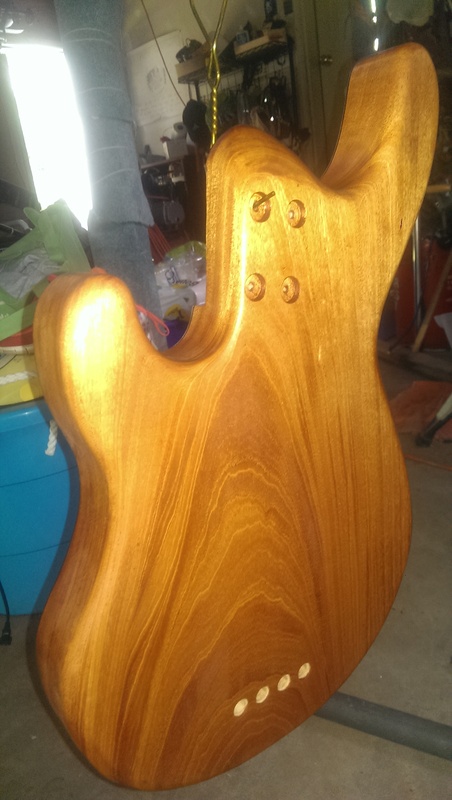
The mahogany on back has some great grain, no figuring, but that's ok (and as I'm posting this picture I see I missed the ferrule holes!):
IMAG1852_zpsabmbzrff.jpg


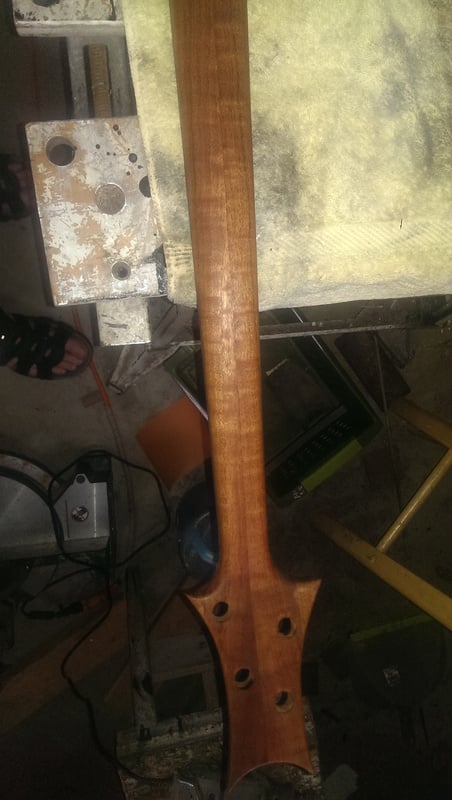
I knew there was some good figure hiding on the front, I didn't expect this much on the neck - it's hard to see in this picture, but it looks really nice:
IMAG1851_zpsk4iezr4e.jpg


The front looks great - plenty of figure there, in places I did and didn't expect it (you can see the glue right by the right side of the bridge - it's going to be tricky to get that out of there):
IMAG1850_zpswwezmhts.jpg
 
Tuesday is slipping away as a finish date, but that's ok.

I fixed the spot of glue on the body near the bridge this morning and I put another coat of tung oil on. I found a spot on the bridge itself that had glue on it, so once this coat dries I'll have to sand that back. I just can't imagine how/believe I missed this when I saw the spot on the body - it's right next to it! I guess I was so focused on the spot on the body I didn't see it? I don't know, brains work in weird ways I guess (or mine does).

The other thing is that the tung oil is taking a long time to dry. This is the first instrument I've made during the summer, so I'm usually finishing in my basement with a heater going. It's definitely hotter out in the garage than it usually is in the basement, but it's a lot more humid too. I guess the humidity is slowing down the drying process. In the basement it dries after 3 or 4 hours, in the garage it's taking more like 6 to 8 hours for a coat to dry. I have a dehumidifier down in the basement, maybe I'll do the next coat down there, but I'd rather have the stink outside.
 
I thought I should explain the "dry" spots - there were three or four spots on the mahogany that were not shiny like the rest of the instrument. I've been doing light sanding with 600 grit in between coats. This morning I got some 400 grit and sanded pretty aggressively on those spots to make them flat - if you ran your fingers over them they were rough - I guess it was just raised grain, even though it didn't feel like it exactly. Anyway, I think that did the trick, I might have to do a few more coats and knock it down again, but I'm getting there. I think Tuesday is back on for a completion date. I should be able to get 2 or 3 more coats today and 3 or 4 tomorrow, that will be plenty.
 
I made the decision that I had applied enough coats of tung oil and would just let it dry overnight and start the assembly this morning. I lost track, but I'm somewhere north of eight coats. After it sat for a few hours I was admiring my awesome work (ha!) when I saw that on the last coat of finish there was a drip on the headstock right by one of the tuner holes, in all my coats of finish this is the first drip. Ugh. I waited for it to dry and sanded it back to get rid of the drip and I've applied a bunch more coats on just the headstock (I got up twice last night so I could get some extra coats in), I can probably start assembling tonight. I didn't sand back to wood on that drip, but I wanted to make sure there was still plenty of coverage.

Usually when the tung oil is dry I have the whole mechanical and electronic assembly process ahead of me, which is hours long. In this case all I have to do is mount the tuners and slot the bridge, I figure that's about an hour's worth of work.

I had a little free time yesterday so I figured I'd put the buffer circuit together. I hadn't actually opened the box from Mouser until then. I started pulling out the components and found that the bag that was supposed to contain the FET was empty! I don't think I need a buffer circuit unless I want to be able to plug into anything, but since I have the parts I want to build it. Hopefully that won't be a big deal to get Mouser to send me what I bought :-)
 
I got the strings on at lunch today - filing down string slots in the ebony was painful. I still have a little ways to go to get the action where I want it. It turns out there are at least two versions of the DiBella Deep Talking Flatwounds - I had the black ones originally, I put them on and off the bass so many times while making it that two of them broke where they bend at the tuning peg so I bought another set for when it was done. Well that set is stainless, not black. Hmmm. I'll use them, but the black ones were definitely less bright. I have a problem where the E string is significantly less loud than the other three strings. I'll have to investigate, kinda makes me stomach a bit sick though as there's not a lot I can do here - I can see the saddle is rubbing on the string a bit, maybe that will do it. Back to work.
 
I'll get some better shots of the bass, cosmetically I guess it's done.

Aesthetically I am very pleased. I did a lot of things I haven't done before on this instrument and there are a few things that are not 100% perfect, but overall I'm pretty happy with the design and the way it looks. The finish is really nice, probably the best I've done.

It sounds amazing acoustically - very expressive and louder than I thought it would be. I'm sure it wouldn't be loud enough to play with an acoustic guitar, but I think it will be enough to play along with my wife on her uke, which is cool - we play together a lot, it will be nice to have another instrument besides my bass uke to play. It has a very fretless "mwah" sound when not plugged in, so fun to play around with that sound. When plugged in I have to try harder to get the mwah, it definitely sounds more electric than acoustic.

Due to the chambering and lack of a metal bridge the body is very light - the whole thing is super light! I started out the design with the strap button at the 12th fret, but as I adjusted things apparently that slipped back a bit, so there is some neck dive when I'm playing standing up. It's not that bad, but I'm not used to dealing with that while playing.

The bigger problems:

- When plugged in the strings get successively louder, the E string has very low volume and the G string is very loud comparatively. At first I thought that only one of the two transducers in the K&K system were working, but if I tap around the bridge I get equal sound out of both sides (BTW tapping on the top makes a HUGE sound!). I await the replacement FET for the buffer, I wonder if without a buffer the lower end is getting attenuated? I didn't notice this during my tests while building, but I don't think I played it enough to notice a volume difference. I have an ART preamp in the basement, I'll try that out today and see if the sound is more equal across the strings when using that (it has a variable input impedance knob, but I'm not sure how high it goes impedance wise). It's possible the K&K system is just not picking up the lower frequencies, but it is made specifically for bass so that seems unlikely. Acoustically all the strings sound equally loud so I don't think it's the ebony saddle attenuating low frequencies, it seems like all the strings are putting energy into the top. If the buffer or preamp doesn't help then I'll get a ribbon piezo and put it under the piece of ebony that is acting as the string saddle. Maybe I'll try calling K&K today and see what they say.

- I messed up on the bridge when filing for the A string, so the string spacing is a bit off. I need to go a bit deeper with the slots, but I don't know if it will be enough to move the slot over. Regardless I think I will make a new string saddle and I'll fix it then - I think I can make one that will hide the fact that the bridge is off center. With the way the walnut strip is in there now it's obvious that something is off.

- I'm getting a small amount of deviation on the top plate to the right of the sound hole (if you're looking at the bass from the front). I'm far from a structural engineer, but I think I'm pretty good at figuring out where stresses are going to be and how to mitigate them - it REALLY looks like the bridging should have handled this stress, I know I got a good glue joint, but I'll have to put a mirror in there and see if I can figure out what's going on, maybe the bridging didn't hold against the top. I am not sure it actually needs to be dealt with, but I feel like long term it's not good to have any deviation.

Like any instrument I've built, there will be tweaking, the issue that scares me the most is the volume variance between strings, but I have to take a deep breath and work through this logically.
 
You're going to need a buffer. Its odd to me that the piezo is pre-wired the way it is, I can only assume the system you're using was meant to be used with an external buffer or preamp.
 
  • Like
Reactions: Jisch
You're going to need a buffer. Its odd to me that the piezo is pre-wired the way it is, I can only assume the system you're using was meant to be used with an external buffer or preamp.
So the variance string to string is caused by the impedance mismatch? I haven't studied the impact of that mismatch (and thanks a lot for following along and providing input!).
 
Last edited:
I found this, I need to do more reading:
"Since a piezo looks essentially like a capacitor electrically, as it tries to drive lower and lower impedance loads, the lowest frequency it can produce (a.k.a. lower corner frequency or -3dB point) gets higher and higher. At some point you won't be hearing much lower string fundamental, only harmonics." This is exactly what I'm hearing, buffer circuit here I come!
 
  • Like
Reactions: scottyd
I believe so. Typically the input impedance of a preamp needs to be higher than the output impedance of the pickup. The piezo impedance is higher than the input impedance of your amp. The mismatch is similar to (but opposite of) like if you were plugging a guitar straight into a PA system without a DI box. The mismatch does weird stuff ;)

I'm sure someone on here MUCH smarter than I am can explain it much better. I have a good grasp of it in my own head but sometimes getting what is in my head out and explained to another is hard... Here is a good read on it Invalid Link Removed

You can build a simple buffer pretty easily.
 
  • Like
Reactions: Jisch
confirmed this is the volume issue - I have a preamp in my studio that has an input impedance knob on it - it only goes up to 3M so it's still far shy of the impedance of the piezos. As I turn that dial the E string gets louder and louder, I just need the buffer circuit. Hopefully my FET gets here today or tomorrow and I can get that built up.

The preamp works better than the SansAmp but a buffer will work even better, I presume.