• TalkBass has been independent since 1998. Add your voice.
    Create a free account to reply to discussions, view embedded media, and browse with fewer display ads.
    Join freeLog in
    Want zero display ads or expanded classifieds tools? Compare plans.

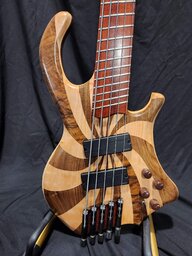
Four string fretless acoustic/electric (chambered)

Yep, that's me. Small world this cyberspace. :-D

Love that Bucksaw. Let me know how you like Bigelow - very techy in some spots, good climbs, just a great place to ride. I used to ride Arcadia a LOT many years ago as one of the regulars in our group lived in Norwich, CT and that was his choice when it was his turn to pick a spot. Love that place, I need to get back.
 
  • Like
Reactions: smithcreek
Back to bass building - one interesting thing that came up with the testing of this instrument: I've been plugging it in when possible just to make sure the K&K system is picking up enough vibration to be operational. I figured I'd be putting my SansAmp in front of this thing no matter what - just to have tone control without touching my amp, that way I can easily move between instruments.

On my first two plug in tests I plugged into my 30W Behringer practice amp with a 4 foot long cable. I love it as a practice amp when I'm just noodling around, it sounds good and it's not so loud as to be overwhelming. The bass sounds pretty good through it, I didn't A/B compare to one of my other electrics, but it seems about as loud as they are. The amp has an active and passive input, I was plugged into the active side, just because that's where the cable was already.

The last test, after gluing on the bridge, there were people sleeping in the house, so I went to the basement and plugged into my big rig (1500W Carvin head with 2x10 and 1x18). The bass sounded like complete crap - terrible scooped tone with only moderate low end and some high end coming out and even that was very low volume. I was terrified that the bridge had stopped any vibrations and I was going to have to remove the bridging on the back to get things back to where they were. Before I did that and as soon as people were awake I plugged it into the practice amp again and it still sounds great.

I didn't do further testing in the basement, but I have an Ashdown envelope filter in my signal chain downstairs along with probably 20' of cable, I am assuming this set up was not cool with the impedance of the K&K system. I didn't try it with the SansAmp, but I'm certain that (or plugging directly into the amp) will resolve this issue. I will probably do some more tests to verify, but if I can get good sound out of the practice amp, I am certain I can get it out of the big amp with a little messing around.

I'm going to try and get it all glued up this weekend and start the finishing process, which is much better than finishing the starting process. :-)
 
Back to bass building - one interesting thing that came up with the testing of this instrument: I've been plugging it in when possible just to make sure the K&K system is picking up enough vibration to be operational. I figured I'd be putting my SansAmp in front of this thing no matter what - just to have tone control without touching my amp, that way I can easily move between instruments.

On my first two plug in tests I plugged into my 30W Behringer practice amp with a 4 foot long cable. I love it as a practice amp when I'm just noodling around, it sounds good and it's not so loud as to be overwhelming. The bass sounds pretty good through it, I didn't A/B compare to one of my other electrics, but it seems about as loud as they are. The amp has an active and passive input, I was plugged into the active side, just because that's where the cable was already.

The last test, after gluing on the bridge, there were people sleeping in the house, so I went to the basement and plugged into my big rig (1500W Carvin head with 2x10 and 1x18). The bass sounded like complete crap - terrible scooped tone with only moderate low end and some high end coming out and even that was very low volume. I was terrified that the bridge had stopped any vibrations and I was going to have to remove the bridging on the back to get things back to where they were. Before I did that and as soon as people were awake I plugged it into the practice amp again and it still sounds great.

I didn't do further testing in the basement, but I have an Ashdown envelope filter in my signal chain downstairs along with probably 20' of cable, I am assuming this set up was not cool with the impedance of the K&K system. I didn't try it with the SansAmp, but I'm certain that (or plugging directly into the amp) will resolve this issue. I will probably do some more tests to verify, but if I can get good sound out of the practice amp, I am certain I can get it out of the big amp with a little messing around.

I'm going to try and get it all glued up this weekend and start the finishing process, which is much better than finishing the starting process. :)
Are you using a buffer?
 
I am not using a buffer, I do have the parts to build one (if needed). I haven't done too much investigation, but the K&K comes wired all the way through to a 1/4" jack that doubles as a strap pin, so even if I wanted to use a buffer I'd have to either break the connection or have an external buffer. If I understand buffers and impedance it doesn't make sense to have the buffer be a cable length away. So I guess that lead me to believe that no buffer was necessary for the K&K system. I'll take it down in the basement and try some different configurations to make sure that I can get something to work (SansAmp) before I glue the top on. I'd hate to put a battery in there, but if I have to, I have to.
 
I am not using a buffer, I do have the parts to build one (if needed). I haven't done too much investigation, but the K&K comes wired all the way through to a 1/4" jack that doubles as a strap pin, so even if I wanted to use a buffer I'd have to either break the connection or have an external buffer. If I understand buffers and impedance it doesn't make sense to have the buffer be a cable length away. So I guess that lead me to believe that no buffer was necessary for the K&K system. I'll take it down in the basement and try some different configurations to make sure that I can get something to work (SansAmp) before I glue the top on. I'd hate to put a battery in there, but if I have to, I have to.
I would build an external buffer you can put on your strap so you you don't have mess with the k&k, I like the tillman buffer for diy, whatever you do try for an input impedance of around 10meg
 
ok, that's a good alternative - external, but close by - then I can make the buffer decision later - I've seen them inside pill boxes, so it wouldn't be all that intrusive to be external to the bass. I have a design, I forget the name on it, it's a pretty simple circuit (really simple) and something like $10 worth of parts.
 
Slight update to the impedance question - I took the bass down to the big stack again and this time plugged it direct into the Carvin head with a 10' cord, without going through the Ashdown envelope filter - it sounds great. I suspect that Ashdown doesn't do a true bypass and can't deal with the impedance of the K&K system. I'll do the external buffer if I need to, but right now I don't think I need it.
 
Last edited:
Slight update to the impedance question - I took the bass down to the big stack again and this time plugged it direct into the Carvin head with a 10' cord, without going through the Ashdown envelope filter - it sounds great. I suspect that Ashdown doesn't do a true bypass and can't deal with the impedance of the K&K system. I'll do the external buffer if I need to, but right now I don't think I need it.
I think if you are going straight into the sans amp you will probably be ok, but if your going into other effects I would definately build a simple buffer pedal with a high input impedance. The worst thing that can happen is you're out 10$ and you have a pedal you don't need to use.
 
You can put this step down as one of those "I thought it would take 2 minutes, but it took an hour" steps. This laminate wood is so hard to cut, if you put too much pressure on it when cutting with the grain it just splits. With the bracing underneath and the limited glue area I needed to cut the inside edge pretty close to perfect (which is not easy). I found sharp scissors work great for cutting against the grain, cutting anything close to with the grain required a sharp razor knife and multiple passes. I'll get it glued up today, pretty excited about getting that done!

IMAG1827_zpsesyzkk7h.jpg
 
  • Like
Reactions: GKon
After an hour of trimming I got to this point (actually trimmed the outside a bit more after this shot):
IMAG1828_zpsnstvyedd.jpg


Then we get to this place. A buddy offered to loan me some spool clamps. I probably should have taken him up on that, I was scrambling to get enough clamps on, resorting to really long ones, it worked out ok, but could have been more elegant. I put everything in place while the neck was bolted on, then once I had everything held down, I took the neck off, I wanted to keep this a bolt on and not a glue on.
IMAG1829_zpsvgyzwfuk.jpg


I'll pull it out in a few hours and start finishing tomorrow.
 
  • Like
Reactions: MayaTambien
I worked on sanding a bit today, I'll be sanding all week. I used a 1/8" round over bit on the front, I think I'm going to go to a 1/4". With the 1/4" round over I think you'll be able to see the black laminate from the front and I'm not sure I'm ok with that or not.

While I was sanding I drop of my sweat landed on the top, the grain really popped, I can't wait to get some tung oil on it. It's funny that in all the time I've spent with this thing, I really haven't noticed the grain too much - I've just focused on other things I guess.

IMAG1835_zpsfwq3a9zx.jpg


IMAG1833_zps3l3vyk2c.jpg


IMAG1832_zpsiijbn6nj.jpg


IMAG1831_zpsfga16vox.jpg


IMAG1830_zpsessft13g.jpg
 
Thanks!

I stared at it and pretended to play it last night and I agree, I'm going to stick with the round over as it is. When I did my tests before, when the top was not rounded over, it was really uncomfortable to play as the sharp corner cut into my forearm. There is none of that discomfort now.

I need some cooler temps so I can continue to sand, it's 90 degrees and 98% humidity right now. I'll cover the thing in sweat if I try sanding now.

Oh and a question for the wood experts. I bought the neck and body wood for this from a friend who works in a custom wood shop, he said they were cutoffs they couldn't use, and indicated both pieces were mahogany. They work VERY differently. The neck wood is a lot harder than the body wood, and you can see the neck wood is a lot darker and more red than the body wood. The neck wood is more fragrant when you sand too. The body wood looks and feels like mahogany I have used before, I'm pretty confident that is mahogany - any ideas on the neck wood? I know there are different kinds of mahogany, but I have only had experience with the kind I used on the body (sorry I don't know what kind that is!).
 
Last edited:
On the mahogany question - the wood database has a Invalid Link Removed on the topic. I think the neck wood is either sapele or Santos mahogany (neither of which are true mahogany). There has been no tear out problems with the neck wood, so I guess it's more likely sapele. I'll have to go look for some samples.
 
I spent an hour or two sweating with the body in the garage last night (wow, that sounds like scene out of some twisted horror movie). It was really too hot and humid to be sanding, but I couldn't resist.

I have it mostly sanded to 320, I won't go any finer than that before finishing except on the fingerboard. I found a lot of scratches and tool marks that I had to go back to 120 to clear, but I think it's looking pretty good.

I should do round overs with the router last - after fixing some other problems I ruined the round over and had to re-do it by hand, it's not perfect everywhere - it's especially noticeable on the front where the round over is a small radius. I probably should have bought a new router bit (or been more careful?) the bit left a line on top that had to be sanded away, it didn't leave the line everywhere, but probably a 1/3rd of the way around the bass had this fine line. It appeared to be a very slight, but sanding that out was a pain and created some of the problems with the round over not looking consistent. I'm really trying to make everything perfect on this one, this is my achilles heel when building, I get close to the end and I just want to play it! I need to take a deep breath, look at everything very critically and try to avoid the "good enough" thought.

I've got another business trip this week, I'll get a few more hours of sanding during the week when I'm home - I need to go over the neck again, and then tung oil this weekend. The neck profile is thicker and rounder than any other bass I have, but I'm going to leave it like this, I like the way it feels, because it's a four I have no problem working my way around on it (at least while pretending to play with no strings on ;)). Worst case scenario I can take it off (the beauty of a bolt on!) and rework it later on.

If all goes well I'll have a new bass by Monday or Tuesday! What a great feeling.
 

Latest posts