• TalkBass has been independent since 1998. Add your voice.
    Create a free account to reply to discussions, view embedded media, and browse with fewer display ads.
    Join freeLog in
    Want zero display ads or expanded classifieds tools? Compare plans.

Double Bass French bow - thumb placement

Hi everyone.
I am playing german bow but wanted to try french one, to have comparison.
I am keeping second finger on the ferrule.
YouTube clips on french bow hold shows, to place thumb on the spot I marked green in attached photo.
However I find much more comfortable to place it on spot I marked blue - I am not putting thumb inside "U" curve, just pressing on the side and tip of my thumb is touching frog in blue spot.
I feel "blue" spot more comfortable - hand is in more natural and relaxed position. Also space between thumb and first finger is bigger which gives better "lever" to work with bow weight. (I place first finger at the end of pad)
Do you think this thumb placement is OK? (I can make photos of hand placing bow).
Or should I move thumb to "green" spot, which is less comfortable for me and provides tension in hand. Additional info - my fingers are not so long.
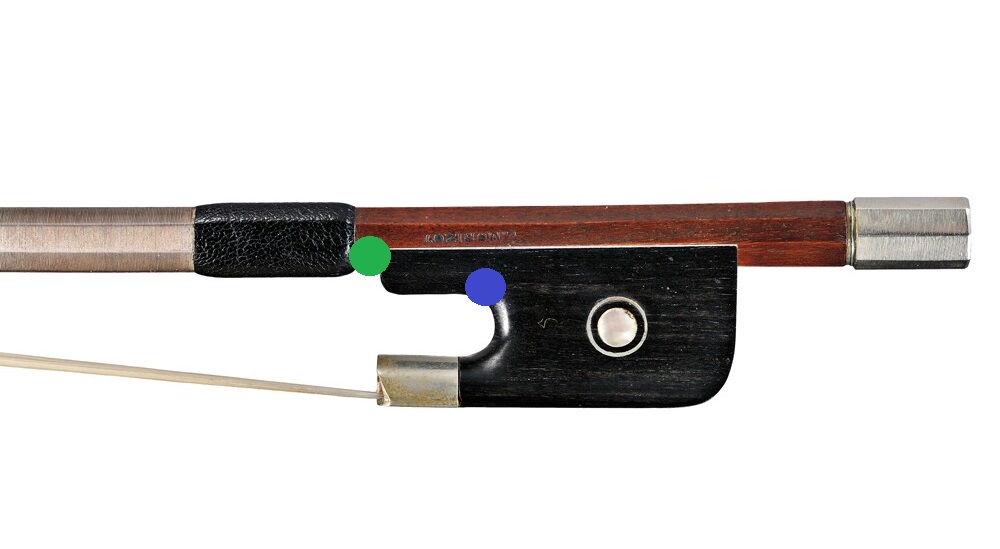
UjMvXx7.jpg
 
There is no should, but they are different schools.
Blue is considered "Italian" grip.
Two things are happening - having your hand further back on the frog puts you further from the balance point, increasing the weight felt in the tip relative to the frog. Also, having your thumb on the frog means your hand is more open, and maybe gripping less tightly.

The green dot is the French way.
The French bow was introduced to the States by French immigrants and, most notably, the Catalan bassist Antoni (Anton) Torello. The school he learned for holding the bow is the older Italian school that goes back to Bottesini.
image.jpg


Edit: here's a close-up from the Bottesini method book.
Screenshot_20160928-115457~2.png
 
Last edited:
I forgot to add that the French grip, being closer to the balance point of the bow may result in a lighter, dexterous and more balanced feel.
I find that holding the bow back in the frog gets a darker more open sound- maybe easier to get a bigger sound from the bass. (You could think of it as adding a few grams to the stick)
French hold tends to be a little more focused.

I should add that while I used to switch back and forth, I am only using the French grip now.
I think Hal Robinson switches back and forth.
I definitely don't want to give the idea that one is better than the other.
 
  • Like
Reactions: AndersLasson
@Jon Stefaniak
Thank you for answers. If Italian grip is not considered "incorrect" I will go for it, as I got more comfort playing with this grip. Maybe, when I got to higher level of bow play, I will consider sometimes switching to french variation to get different sound.
 
Thought I'd add this as well - an Italian bow blog that shows the wear marks on the frog of one of Petracchi's most used bows.

Link Removed

You can really see where the thumb goes and where the fingernail comes in contact with the frog in some of these pictures.
 
Regardless of where you position the thumb perhaps consider maintaining the following to ensure a comfortable relaxed flexible sensitive bow hold that will not tire -

(1) Position your 2nd finger opposite the end of your thumb
(2) Keep a long curve in your thumb and a cupped hand to relax the big thumb muscles
(3) Do most of the bending of fingers over the stick with the second line of knuckles (the thumb tip touching your finger tips looks like a snake's head when looking at your hand side on )
(4) Do not wrap your 1st finger around the stick, just hook it over (it both rotates the bow into the strings and lifts the point up to draw strokes at 90 degrees to each strings)
(5) Do not over or under extend your 1st finger ahead of your thumb, just enough to "hook" the relaxed weight of your arm down onto the strings without losing the cupped hand shape
(6) Throw the weight forward towards your 1st finger by raising your R elbow slightly to turn your hand in a few degrees (this will free up your R elbow to flex in the same direction as the bow points)
(7) The last pad of the curved pinkie just reaches over the stick.
(8) An imaginary line of power comes down to your 1st finger from your shoulder in the most natural way without dropping or pronating your wrist more than a little
(9) Only grip the bow strongly enough to support the arm weight without losing the bow hold shape, feeling the fingers take up a little slack as you drop the arm weight through the bow

If you treat the strings as springs, the hair and stick as springs, and your flexible bow hold as matching these springs then you should feel a natural connection to the sounds produced.

Others may have different ideas that I would be glad to hear, so please comment.

Cheers, DP
 
The weight of the hand and the arm weight coming into the strings is sufficient to hold the bow.

OK, I will try this. Now I have to push little with my thumb, without that tip of the bow is falling down. (I am playing in standing position, but this should not change the way I am holding the bow). Also this thumb pressure (to keep tip of the bow from falling) causes discomfort in thumb area after few minutes of playing.
 
All I have tried to suggest above is to use the RH as naturally and comfortably as possible so that pain and stiffness do not interfere with the freedom to express the music through stroking with the bow (think of it as a musical paint brush). A straight stiff thumb gives pain in the constricted big muscles around its base. Wrapping your index finger around the stick will bring the stick closer to your hand and reduce the flexibility and sensitivity that is available further out. Just hooking the end pad over far enough to have the stick in the (last) bend gives you the two way control that also lifts or drops the point of the bow. All the bow movements pivot around the end of your thumb.

Try this idea for what I call a natural relaxed cupped hand shape. With palm facing you open out your hand flat and spread your fingers and thumb (hand wide open). Then curl your finger tips and thumb tip towards each other until the thumb tip meets the two middle finger tips. Turn your hand side on and see the "snake's head" shape I talk of. Holding the bow stick up in your other hand then drop this hand shape over into the bow hold position, only using enough strength to hold the shape. Using arm weight only then drop the bow down onto the strings. Relax your pinkie and gently test the flexibility of your fingers and thumb against the flexibility of the stick, hair and string. There should be some available slack to take up in each direction before the bow jumps. This sensitivity will allow you to "pluck" the strings for note starts rather than crush them into life. The hook formed by your index finger and thumb will tighten as you weigh down but the curved thumb avoids discomfort and pain. Probably the most bow weight you ever need is where you press three strings down at once as the bow hair touches the stick when in the middle of its length.

I am not a trained German bow user however I feel that "cradling" the bow hold with a cupped hand and flexible sensitive fingers would allow the same freedom of movement and expression that I try for with the French bow.

Best wishes, DP
 
image.jpg
image.jpg

Here are two angles showing where I like to put my thumb and how to orient the stick. You'll notice I have the stick aligned inside my middle knuckles except on the index finger, which is extended forward slightly for better tip control.

I also use a rubber grip and a long thumbnail, which both give added contact without the need to squeeze.

image.jpg
image.jpg

Above are two possible wrist orientations. The first gives an enormous amount of flexibility but perhaps less stability. It's a typical violinists's hold, and works well for solo-type playing.

The second is much less flexible, tighter, and perhaps more controlled. It's commonly seen in orchestral settings.
 
What I have tried to put in words is very close to the enlarged Bottesini illustrations above. My thumb would have a long bend through all joints, not as straight. My hand would turn in a little more to throw weight forward towards my index finger and line up the elbow , a hinge joint, with the bow direction. This is achieved by rotating the elbow up and out, pivoting at the shoulder and index finger while keeping the forearm, wrist and curved fingers in a natural alignment. A line through Bottesini's big knuckles might show his hand parallel to the stick and less turned in towards the index finger. Dare I say this makes it more likely to bow "from the shoulder" and wrist because flexing the elbow will lift the bow off the strings. Conversely, to turn in too much by raising the elbow too high again forces you to bow "from the shoulder" and wrist.

Not seeing more of Paul's overall setup (seating position, bass-to-body relationship, height of elbow and degree of wrist pronation with shapes at both ends of the long bow stroke) I worry about what looks like a hypermobile thumb joint and one picture showing his hand turning in "too far".

I am an orchestral player/teacher who has trimmed down florid wrist and finger movements that are now guided by the demands of each string (sometimes each note) and the music. What I have described above works for me and I hope that each of us, given our individual bodies and hand shapes, finds success.

Best wishes, DP
 
What I have tried to put in words is very close to the enlarged Bottesini illustrations above. My thumb would have a long bend through all joints, not as straight. My hand would turn in a little more to throw weight forward towards my index finger and line up the elbow , a hinge joint, with the bow direction. This is achieved by rotating the elbow up and out, pivoting at the shoulder and index finger while keeping the forearm, wrist and curved fingers in a natural alignment. A line through Bottesini's big knuckles might show his hand parallel to the stick and less turned in towards the index finger. Dare I say this makes it more likely to bow "from the shoulder" and wrist because flexing the elbow will lift the bow off the strings. Conversely, to turn in too much by raising the elbow too high again forces you to bow "from the shoulder" and wrist.
Here's a nice shot of Torello's bow hold.
Anton_Torello_magazine.jpg

A bit different from Bottesini- more space between the first finger and the rest, leaning into the first finger. I know through the students of his students (Benfield, Scott) that this bowing is from the elbow.

However, the op already expressed his interest in continuing to hold the bow further back, with the thumb in the frog. So his bowing won't look like this exactly.
I would recommend checking out Petracchi and Bocini and other Italian players. It'll all look different depending on how you hold the bass.

Criticizing someone elses approach and talking about "florid" wrist movements in this case seems sort of ridiculous to me. This is Rabbath's bow arm. Petracchi plays with a lot of flexibility in the wrist as well. I wouldn't imply that they are above criticism or anything, just they both have amazing bow arms. Just my 2cents
 
Last edited:
I just watched David Desimpelaere play at the Bass thing in Prague. He has what I find to be a very unusual bow grip. Completely counter to what I was taught, but one of the best players I've ever seen.

Great playing!
My first thought was how much his bowing resembles Rinat Ibragimov's so I look him up, and sure enough, he was a student of Rinat's. Check out Luis Cabrera - very similar bowing
 
View attachment 958334
View attachment 958335

Here are two angles showing where I like to put my thumb and how to orient the stick. You'll notice I have the stick aligned inside my middle knuckles except on the index finger, which is extended forward slightly for better tip control.

I also use a rubber grip and a long thumbnail, which both give added contact without the need to squeeze.

View attachment 958336
View attachment 958337

Above are two possible wrist orientations. The first gives an enormous amount of flexibility but perhaps less stability. It's a typical violinists's hold, and works well for solo-type playing.

The second is much less flexible, tighter, and perhaps more controlled. It's commonly seen in orchestral settings.
I basically do what you do, with the exception being that in orchestral settings (if I'm playing overhand, which is rare these days in a section) I will sometimes put my thumb under the frog, particularly for heavier playing.
 
Looks like Bottesini's thumb is straight rather than curved or bent. I find it easier to keep the thumb straight.
View attachment 958334
View attachment 958335

Here are two angles showing where I like to put my thumb and how to orient the stick. You'll notice I have the stick aligned inside my middle knuckles except on the index finger, which is extended forward slightly for better tip control.

I also use a rubber grip and a long thumbnail, which both give added contact without the need to squeeze.

View attachment 958336
View attachment 958337

Above are two possible wrist orientations. The first gives an enormous amount of flexibility but perhaps less stability. It's a typical violinists's hold, and works well for solo-type playing.

The second is much less flexible, tighter, and perhaps more controlled. It's commonly seen in orchestral settings.
Does that rubber grip make it easier on the thumb?
 

Latest posts