• TalkBass has been independent since 1998. Add your voice.
    Create a free account to reply to discussions, view embedded media, and browse with fewer display ads.
    Join freeLog in
    Want zero display ads or expanded classifieds tools? Compare plans.

Fret leveler?

Hey guys. I was just wondering if I could get a bit of guidance on the subject of fret leveling tools.
First off, fret leveling is not something I have gotten very deep into so far, but as I like to do my own setup and maintenance, I find myself wanting to try my hand at leveling as well, since it can really make a great difference to an instruments playability. I have 2 cheaper import instruments that could use a leveling, one being a 24.75" guitar and the other a Squier Jazz Bass. I figured I will be willing to learn the process with these two instruments before implementing the procedure on other instruments.

My real question is mor or less how do I determine what type of leveling tools to use. I have seen leveling blocks/bars that are machine perfectly flat, and have also seen a few that are radiused at a specific radius. I know the fretboard leveled are radiused, but I have a seen a couple that were stated to be used as fret leveled as well.
I would like to get my feet wet in the fret tool department without spending a life savings if possible.

I know I will need a good fret crowning file as well, but have seen them that are quite affordable. A dedicated end dressing file may be a good idea as well, but I would love some input there as well as to what others are using with success.

I see tools at StewMac that look like they a well built and very purpose built, but many are one trick ponies and are quite expensive. I woould love to know if any of you guys have come across or created any multifaceted tools that you use regularly. I like tools that can save more than one purpose, but I also know that sometimes, you just gotta have that one correct tool for the job, and am totally eager to begin building my collection of those tools.

I have done a fair amount of research and learning as to the process of leveling frets and I feel that it is something that I should be successful at doing and it seems as though it can make an incredible improvement to an otherwise mediocre instrument. I hear some guys say that it is one of the first things they have done to any instrument of any build quality or price point.

 
I use my diamond stones. 3"x8" diamond encrusted steel plates that are dead flat. I mostly use my medium and fine stones but have used my coarse stone on some extreme cases. These are the same stones that I use to sharpen my chisels and plane blades. I think Stew Mac sells these but you can probably find them cheaper at woodworker supply places
 
the long flat bars with sticky sandpaper on them work for me, as i can get a perfectly straight string lie with them, then adjust the rod for just enough relief.

the short little levelers make it too easy to just run "up the hills and down the valleys" instead of removing those defects, the entire purpose of the exercise.
 
Leveling the frets is a great thing, but it is only a small step in a much larger job. Once you have leveled the frets, then you have to crown them, dress them, and finish them. You must also understand that the fretboard needs to be flat to start, and this usually starts with a neck jig to support the neck in proper position to start leveling first.
 
Level with a level. Heavy duty aluminum level ground dead flat. Use a table saw table that is verified flat. Attach PSA backed sandpaper to the table and grind the level. The new dedicated (pull the vials to eliminate any chance of using it for a level "in a pinch") tool is used with PSA backed sandpaper to level frets. The I beam shape of the level allows leveling in the lie of the strings with the strings on at tension.
 
Musiclogic said:
Leveling the frets is a great thing, but it is only a small step in a much larger job. Once you have leveled the frets, then you have to crown them, dress them, and finish them. You must also understand that the fretboard needs to be flat to start, and this usually starts with a neck jig to support the neck in proper position to start leveling first.

Yep I know that, that's why I was asking for recommendations on tools to buy or make. I am wanting to start building a much large collection of tools for the purposes of repair/maintenance, but also would like to build from scratch in the future, as my knowledge and understanding becomes more in depth with each aspect.
I love to work with my hands and I love to do work that requires precision and accuracy. I'm sure I'm not alone here among this group ;)
 
I love to work with my hands and I love to do work that requires precision and accuracy. I'm sure I'm not alone here among this group ;)
if you're a player too, then this stuff is indeed right up your alley, as you'll know when you "get it right".

look into neck jigs and the theory behind them;

you want the leveling to take into account the shape of the neck when it's actually strung up, which can be different than when the strings are off and the rod is loosened to take out the backbow. (remember, a straight neck when strung will spring into a big backbow when the strings are off.)

warps and humps can disappear when there's no tension from the strings or the truss rod, then reappear after all your lovely leveling work is done :mad:

i use a jig arrangement to force the unstrung neck back into the profile it had while strung, so my leveling efforts will actually be preserved when the strings go back on.

202dy is talking about using an i-beam shaped leveling bar to slip between the tuned strings and actually level the frets in their "natural state". i haven't tried that, but it makes a lot of sense and is a way of "sneaking around" all the headaches of trying to force the unstrung neck back into the profile it had while strung.
 
if you're a player too, then this stuff is indeed right up your alley, as you'll know when you "get it right".

look into neck jigs and the theory behind them;

you want the leveling to take into account the shape of the neck when it's actually strung up, which can be different than when the strings are off and the rod is loosened to take out the backbow. (remember, a straight neck when strung will spring into a big backbow when the strings are off.)

warps and humps can disappear when there's no tension from the strings or the truss rod, then reappear after all your lovely leveling work is done :mad:

i use a jig arrangement to force the unstrung neck back into the profile it had while strung, so my leveling efforts will actually be preserved when the strings go back on.

202dy is talking about using an i-beam shaped leveling bar to slip between the tuned strings and actually level the frets in their "natural state". i haven't tried that, but it makes a lot of sense and is a way of "sneaking around" all the headaches of trying to force the unstrung neck back into the profile it had while strung.


I use both methods, i.e. neck jig and I-beam and both are valid and useful. The neck jig is a bit more trouble to set up, but is reliable. The I-beam method is a bit more problematic for the first 2 frets because of the small clearance afforded by the nut. But it's still workable. Perhaps a little harder to follow the raduis of the board because of the interference of the strings though.

Whatever method you decide to use, it is important to ensure your leveller is truly flat. Wooden radiused cauls may start flat but may not stay that way (wood moves). Certainly the aluminum radiused blocks from Stewrt Macdonald are an exceedingly good tool, but a set of them to handle common radii will definitely break the bank for a lot of us.

I have used many kinds of crowning files over the years and currently use the diamond coated ones. They cut the cleanest requiring less finish work, and last for a very long time. Worth every penny in my book.

I found some small fine flat files locally that I use for shaping the fret ends. They have safe edges so I don't score the fboard. They are so cheap I buy them by the dozen. There must be a name for this small file, but I don't know it.

Then I use sandpapers and small foam-backed emeries to do the final cleanup and polish.

The major costs are in the diamond crowning files, the neck jig (if you use one) and the radiused aluminum blocks if you can afford them. The rest of the supplies are not at all costly.
 
long radius blocks never did it for me, what if the neck is a compound radius?

even when it's officially not, the process of leveling "in the string lie" from the narrow nut to the wider bridge makes for a subtle compounding effect.

i use the one big stewmac 24" sanding beam, which lets me do any radius i want, confident that the actual lengthwise profile under each string will be straight.

when refretting fender electrics with the super-round 7 1/4", i can use a little radius block to shape the board itself at the body end to 9 1/2" or 10" radius, then use the beam to "connect" the 7 1/4" at the nut with the wider radius at the other end to create a nice compound board.
 
I like the effect of the compound radius as well and it so easy to do with a sanding beam. I wonder if the only reason all boards aren't compound radiused is just that it is easier to manufacture a cylindrical section!
 
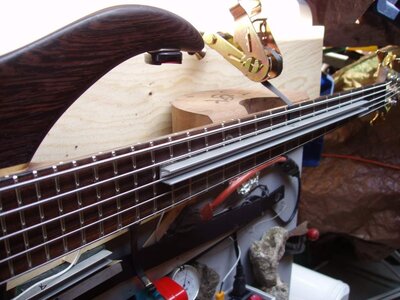
I use U-channel with PSA sandpaper strips, a la Bishop Cochran. I get the neck as straight as it can get with the strings tuned to pitch, and work under each string, tuned to pitch. The U-channel is about 1/16" thick, so I can get the first fret w/o having to lift the strings; in fact, the string tension helps to hold the tool down, over the first few frets.
 

Attachments

  • Cirrus neck.jpg
    Cirrus neck.jpg
    88.7 KB · Views: 113
  • Cirrus neck2.jpg
    Cirrus neck2.jpg
    97.8 KB · Views: 100
i dunno, they advertise those bars as being only straight to .008"; that, along with being lightweight aluminum, makes me think they wouldn't have the necessary precision, and would flex out of straightness anyway with any kind of pressure.

(they show the thing being used to true up balsa wood spars on a big model airplane, where that kind of tolerance is more than tight enough.)
 
i dunno, they advertise those bars as being only straight to .008"; that, along with being lightweight aluminum, makes me think they wouldn't have the necessary precision, and would flex out of straightness anyway with any kind of pressure.

(they show the thing being used to true up balsa wood spars on a big model airplane, where that kind of tolerance is more than tight enough.)

They're very rigid. I don't put much pressure on them, just a tad more than the weight of the bar itself. The straightness is fine for me. Someone doing this for a living might need more precision.
 
I use one of these:

plek5.jpg


If you don't have $100k lying around to invest in a Plek, I highly suggest using a neck jig of some sort. I've tested my previous work using the neck jig in the Plek, and it's pretty accurate. Be prepared to spend a lot of time figuring it all out: it takes a lot of skill, and every neck is different. Accuracy is paramount here, if you really want to do it right - you will hear buzzing if you're off by around .001" or so. Measurable, repeatable results are key, otherwise you're just flying blind.

I don't recommend using short leveling beams. They follow the dips and humps of the neck, and can cause as may problems as they solve. Also, definitely invest in some diamond crowning files (I like the curved ones from Stew-Mac). Stock up on lots of sandpaper, super fine steel wool, and a Dremel for polishing. It might also be a good idea to snag some Icy Hot for your sore muscles and joints. Trust me on this: I've been doing fretwork almost every day for the past three years running, and it will wear your body down.

It might also be a good idea to find yourself a really good tech that would be willing to teach you the ropes. Look into some reputable luthiery schools if you're really serious about wanting to do the job right. The bar for quality in the guitar tech industry is EXTREMELY low, and there's lots of hacks out there. Don't become one of them.
 
I may at some point get shorter leveling beams from Stewmac for guitar and banjo, but for a 24" levelling beam I use an old masonry level, bought at a garage sale for 1$ and trued at home on the same float glass my father has been using since the 70's. Sometimes these can be warped or nicked so badly that they can't be trued effectively or used for fretwork. I was lucky enough to find a dead straight one that still had original mill marks all along both surfaces (un or lightly-used). Aluminum is rather soft and easy to true & polish. Hit those yard sales! The money I didn't spend on a beam I used to buy the offset diamond crowning file from Stewmac, a really nice tool that saves a lot of time over the chainsaw- sharpening files I used to use (and occasionally mar the fb with). IMO, that's the one high dollar tool from them that is really worth the money. Most other setup tools can be improvised/repurposed/made. If you're just learning about this stuff, that's part of the fun!
 

Latest posts