Why would maple be brighter than rosewood?
It's a lighter colour!

TalkBass has been independent since 1998. Add your voice.
Create a free account to reply to discussions, view embedded media, and browse with fewer display ads.
Join free Log in
Want zero display ads or expanded classifieds tools? Compare plans.
Why would maple be brighter than rosewood?
I do realize that the basses in the video I linked to doesn't have the exact same electronics equipped, still the tone that comes out of them sounds pretty much as you would expect from the kind of wood they are made of, and in my opinion it is still one of the best videos out there if you want to hear the difference one could expect from different wood types.
You should really never, ever ask an engineer questions like this. Because the answer you will always get to a "does ...... make a difference ?" question, is - Yes, it does. In the engineer's world of sub-microscopic minutiae, and measurements in parts-per-trillion, absolutely everything makes a difference. Even the act of measuring something makes a difference (can you say Heisenberg Uncertainty Principle?). So, since I'm a retired engineer, my answer is - of course - yes, it does. The question you're really asking, though, is "does it make enough difference to matter?" And the answer to that question, is that it's mostly subjective. As you can see by the answers you've gotten already... Does it really, truly, matter to you? To me, it doesn't make enough of a difference to matter. Any slight difference would be overwhelmed by things that make a much larger difference - like strings. Personally, I would be much more concerned about how the neck feels in my hand, than what the fret board is made of. Any possible tonal difference can be fixed by the tone controls on the bass and the amp. That, after all, is what they're there for...
I've pretty much played them all (several different kinds of maple, several different kinds of rosewood, pau ferro, ebony, maccassar ebony, the blackest of blackity-black pure jet black ebony ( seller said it was Gaboon - I'm not so sure, but I haven't seen any like it for 30 years now!) , ziricote, padouk, bocote, purpleheart, cocobolo, bubinga, zebrawood, snakewood, wenge, walnut, grenadillo, kingwood...) but my favorite fretboard "wood" is [Invalid or Expired Link Removed] (aka 'xxx paper phenolic")


OK, so the string is not touching the wood, only the fret. But at least part of the energy/vibration passes into the material in which the fret is anchored—the wood of the fretboard.Take your current bass. Fret a note. Closely look and notice the the string sits between the 2 frets and does not touch the wood (unless you are He-man, Master Of The Universe). Can the material itself make a difference on the way the bass resonates? Sure, maybe a tiny bit, but certainly not as much as the body or the rest of the neck wood.


OK, so the string is not touching the wood, only the fret. But at least part of the energy/vibration passes into the material in which the fret is anchored—the wood of the fretboard.
Those who claim that fretboard material has only "maybe a tiny bit" of effect on how the bass resonates should test this claim by trying a fretboard made of dried mud. Or cardboard. Or balsa wood.


I would just go for it. The other guys are right, you will notice a bit of a difference when playing alone, and the humbuckers probably will pair nicely with the maple fret board tone, but in a live band mix it won't really be noticeable. It'll look cool too!I have a Fender Blacktop bass with a P-Bass neck. I love the tone but I prefer the J-Bass neck. I have a Jazz neck on my Precision. I want to replace the neck on the Blacktop and found a pretty good price on one but the fretboard is maple. I know the purported differences in tone between rosewood and maple.
Has anyone ever switched and how noticeable was the change? I think the maple might complement the humbuckers on the Blacktop. Any ideas? I know it's subjective and I won't know unless I try. Just looking for experiences.


The best video I've seen is on YouTube by a guy named Andreas Brink under "rosewood vs maple fretboard ". Same bass,strings,amp settings etc., ONLY the neck is changed out.

Once again.
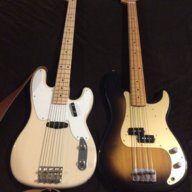
I can't hear a difference: