• TalkBass has been independent since 1998. Add your voice.
    Create a free account to reply to discussions, view embedded media, and browse with fewer display ads.
    Join freeLog in
    Want zero display ads or expanded classifieds tools? Compare plans.

Fretboard radiusing?

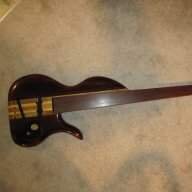
I am refinishing a fretless 4 string wishbass (in my avatar). I need to smooth out old string wear marks and do a little leveling on the fretboard. I have some woodworking skill, and have been doing lots of sanding and reshaping of the body, but the fretboard is a little intimidating as I could quickly ruin the playability.

I am looking to borrow a fretboard sander if anyone in the Seattle/Tacoma area is willing to lend one. Alternatively, where can I purchase one for cheap? Or is this an inexpensive job for a pro?

This is my first fretless and my first refinish, so I have no idea what radius would be appropriate. Any advice from all of you with much more experience than I have would be very much appreciated.
 
Stewmac and other places have the tools, not terribly pricey, some stuff can be found more cheaply.
How about:
cheapish:
Invalid Link Removed
not so cheap, but the perfect tool:
Invalid Link Removed
 
  • Like
Reactions: BassChuck
I've also found a whole bunch of decent quality luthier tools at reasonable prices on auction sites lately. I'm currently GASing for a particular Japanese fretwork file set. ;)
 
Thank you for the link. Do you have any advice on what radius to order?

I don't play fretless, but for fretted radius is a personal choice. typically many people feel a smaller radius is more comfortable on the hand and a larger flat radius is easier to play fast passages on. I like a compoud radius of about 9 inches at the nut and 16 or so at the end of the fretboard.
 
Yeah, it's one of those things you have to figure out your own preference for, or learn to live with what you have. I personally don't like too wide too flat (my BTB6 is waaay too both for my tastes, but good exercise!), but I can adapt to most radii. :) I don't prefer the extremely small radius of some uprights, either, though. Nobody can figure out what you like for you.

 
You might want to figure out where you're starting from (existing radius) - changing radius can mean removing a lot of wood.
 
And yes, if you find the right shop, it shouldn't be too expensive. Folks that handle classical strings would be the real pros, I would think.
 
  • Like
Reactions: warrplayer
By coincidence I have just re-dressed mine today. I just used a piece of structural foam (200 x 75 x 75) as a sanding block. I was going to use the fingerboard to sand out the radius into the foam, but in the end I didn't bother - I just went with a flat block and trusted my hands to feel it. I started with 240 to get the most of the grooves out (took about 20 minutes) then about 5 minutes each with 340, 400 and 600 followed by a buff and a good soak in lemon oil. Provided you use long strokes and don't dwell too long in one place you will be fine.

WRT radius, I sanded almost flat under each string 'path' then blended these tracks together to form a pseudo-compound radius. I couldn't tell you what the radius at each end is but it feels like about 9 at the nut and about 12 at the body end. Don't forget to get the neck straight before you start (I just loosened the truss rod) and support it properly all along its length during the process - you don't want a concave F/B at the end of it. Good Luck!
 
Last edited:
  • Like
Reactions: bholder
Thank you for the link. Do you have any advice on what radius to order?

Order the block that is the correct radius for your fingerboard. Unless you want to dramatically change the bass and, even then, that may not work and is not recommended, especially for a first job.

If you know somebody with a woodshop they can fire off a radius block in a minute and can probably do it with scrap wood for free. Stew-mac would be my next recommendation.
 
Order the block that is the correct radius for your fingerboard. Unless you want to dramatically change the bass and, even then, that may not work and is not recommended, especially for a first job.

If you know somebody with a woodshop they can fire off a radius block in a minute and can probably do it with scrap wood for free. Stew-mac would be my next recommendation.

I agree. Even a small change in radius (say 11" to 12") can end up with a lot of sanding. My recommendation for an order to StewMac would be a radius sanding black to match the radius of your bass, a set of understring radius gauges (VERY handy) and a "fret rocker" super for finding high frets on a fretted bass. Not exactly free, but very much worth the price in my opinion.

I just dressed the Ebony fingerboard on my G&L L2500 fretless and it came out really great with my StewMac sanding block and a bunch of different grades of sandpaper (from about 120 to 600). It is lined and somehow the white line filler had worked up a bit and the neck developed a very slight "bump" about the 15th fret location. Result was some buzzing (mostly noticeable unplugged only on certain high notes). A little sanding with the block working down to fine paper and treatment with Fret Doctor to finish it off and that thing is simply amazing now. Smooth and sweet and looking like new!
 
Since I forgot to add, and I know the OP is going to ask, you can determine your radius with a piece of string. There are clear directions in the Jerzy Drozd setup guide found in the stickies.
Oooh, thanks! gotta bookmark that right next to the Gary Willis setup link. :D
 
Since I forgot to add, and I know the OP is going to ask, you can determine your radius with a piece of string. There are clear directions in the Jerzy Drozd setup guide found in the stickies.
Ok, I read and searched through the setup guide, and all sorts of templates for determining fretboard radius, but nothing about a piece of string I could find. One of the other ones (stickied on the setup board), perhaps?
 
Last edited:
Ok, I read and searched through the setup guide, and all sorts of templates for determining fretboard radius, but nothing about a piece of string I could find. One of the other ones (stickied on the setup board), perhaps?

I checked Jerzy's guide and didn't see it either... now I have no clue where I read this.
 
Do you recall what the technique was? Perhaps measuring the "straight" width of the fingerboard, then measuring "around the curve" and comparing lengths? That ought to be sufficient, with a little math, if the measurements can be done accurately enough. I don't know the math offhand, but it's just geometry, right? ;)
 
I was pretty sure it involved wrapping a string around your 12th fret and taking a measurement to give the radius. I got gauges years ago, I would've read this some time before then so my memory is a little foggy.
No prob, that sounds close to what I'm thinking, I'll stew on it a bit, just wondering. Pickguardian offers free downloadable radius scale templates, fwiw. :)