• TalkBass has been independent since 1998. Add your voice.
    Create a free account to reply to discussions, view embedded media, and browse with fewer display ads.
    Join freeLog in
    Want zero display ads or expanded classifieds tools? Compare plans.

Fretless above the 12th

Actually, an upright fingerboard, in most cases, covers a higher range than most bass guitars. My upright’s fingerboard goes up to D two octaves above notated middle C, which is an octave higher than my fender basses.

Double basses sound an octave below an electric bass though, so technically the notes are indeed lower. on note range...remember that 24 fret basses do exist alot these days.
 
  • Like
Reactions: iqi616 and DJ Bebop
Double basses sound an octave below an electric bass though, so technically the notes are indeed lower. on note range
Huh? A string electric based tune to standard E equivalent to a E1 on the piano 41 Hertz is not lower than a standard double bass with no C extension also E tuned to E1 at 41 Hz

That's totally misinformation to say that double basses are tuned lower than electric bass, The upper harmonics may be more amplitude on electric basses but their fundamental notes are the same.
 
Huh? A string electric based tune to standard E equivalent to a E1 on the piano 41 Hertz is not lower than a standard double bass with no C extension also E tuned to E1 at 41 Hz

That's totally misinformation to say that double basses are tuned lower than electric bass, The upper harmonics may be more amplitude on electric basses but their fundamental notes are the same.

Happy to be wrong here, i think i got it mixed up with both instruments playing an octave below the staff. my b
 
  • Like
Reactions: iqi616
First off check your intonation off with tuner.The most efficient way(IMO) is to play note(C for example)and play all the notes in Cmaj and C min and use your ears and correct your finger tips accordingly.For fretless you have to have good ears and technique of the left hand to play "in tune".
 
  • Like
Reactions: iqi616
I haven’t spent enough time on my fretless basses (5 string Gecko and a Brice 6, both unlined) recently so I am rusty, and even more so above the 12’th fret. Interestingly, Alain Caron has fretboard dots from the 12’th “fret” uopwards on all the pictures I’ve seen of him and his Fretless F basses. If Alain feels it helpful for him, there should be no shame in lined or position markers. If I ever get the itch to buy another Fretless I’ll probably give in and go this route.
 
  • Like
Reactions: iqi616 and DJ Bebop
I haven’t spent enough time on my fretless basses (5 string Gecko and a Brice 6, both unlined) recently so I am rusty, and even more so above the 12’th fret. Interestingly, Alain Caron has fretboard dots from the 12’th “fret” uopwards on all the pictures I’ve seen of him and his Fretless F basses. If Alain feels it helpful for him, there should be no shame in lined or position markers. If I ever get the itch to buy another Fretless I’ll probably give in and go this route.

I said this in another thread.

But I saw Edgar Meyer the other night, and at one point he spent a few minutes trying to position his bass in the spotlight properly. Eventually he got it right and told the audience 'I need to be able to see the little dot way up there, you'll understand why soon'. And then ripped one the most incredible pieces of bass music I've ever heard.

So if a small visual cue is good enough for Edgar Meyer, well..
 
I love all the ideas and posts here, but please @White Beard, don't make me go back to tuning by ear! I've got about $400 worth of fancy tuners now, even still have my old Boss TU-12H, and I do not relish the idea of returning to manual tuning in the near future. My band in the 70's was never even close to in tune with each other, and probably none of us were in tune with ourselves either.
 
  • Haha
  • Like
Reactions: iqi616 and DJ Bebop
“I don't always play in tune, so I've been told!”

1779117403088.jpeg
 
The magic solution everyone learning fretless bass needs: Muscle memory. It's both magic and totally completely real. Otherwise nobody would be able to sing in tune. Just as a singer trains his or her vocal muscles, you simply have to train your hands and ears to do it, and get your brain out of the way.

Practice blindfolded, or at least with your eyes closed, and practice shifting positions. This will develop your muscle memory and your ears. Listening is critical. Learning to shift positions is great for fretted too- and you may find it's actually easier on fretless- because if you miss a shift on fretted, it's totally obvious, and every note after it is off until you shift again. On fretless by contrast, once you learn to adjust on the fly by ear, you can be 'close enough', and by rolling your finger or minor adjustment, you can hit the intended notes. Yep the notes are closer together up the neck, but it also means the adjustment you need to make if you're off a bit is smaller and easier to achieve- if you practice it.

Find music that requires a lot of shifting to practice with- you'll be surprised how quickly you just 'magically' find the right notes, or close enough more often then not. Steely Dan's Rikki Don't Lose that Number is a good one, it's all over the neck, with a lot of I-V interval jumping - which even within the same position can be a challenge on fretless. Josie is another good one, because it has double stops up the neck- getting those in tune really pushes your ear/hand coordination- but it's so rewarding once you get it.

Relying on visual indicators may actually hold you back from developing this skill, because you might never gain the confidence in your hands and arms being able to work directly with your ears without having to think about it. If you intend to play fretless live, make sure you can year yourself well. I rely on the side dots a bit live if I'm having issues hearing myself well, but it's actually way easier and way more fun to just trust the muscle memory and my ears.

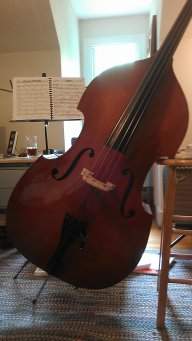
I'll admit I started on violin as a wee lad, then switched to cello when I was big enough to play one, then added double bass in high school. You might think that gives me a leg up on fretless electric, but I still need to work at it, especially since I have basses with scale lengths from 25" to 42". But the good news is that it's totally doable if you practice it - and learn to trust it (it being muscle memory). Each time I switch instruments, it takes a minute to adjust, but I know that I can do it, and that confidence alone allows me to get my conscious brain out of the way and just play.

Someone earlier in the thread said they just wing it and hope. It's actually not a bad strategy! It's really the only way violinists, cellists, double bassists play fretless instruments with no lines or even side dots.
 
Someone earlier in the thread said they just wing it and hope. It's actually not a bad strategy! It's really the only way violinists, cellists, double bassists play fretless instruments with no lines or even side dots.
🤔

That was me 👍
I did play violin in school before I decided I wanted to be a “Rock Star”.
Now I'm back to playing fretless again, electric and upright.

I stand by my early comment.

🤣
 
  • Like
Reactions: JdoubleH and iqi616
🤔

That was me 👍
I did play violin in school before I decided I wanted to be a “Rock Star”.
Now I'm back to playing fretless again, electric and upright.

I stand by my early comment.

🤣
I'm right there with you. They say most people can only hear a bad note if outside 6 cents of the tone. My band will be called "Seven Cent Solution."
 
Study this video, paying close attention to left hand position and where he plays relative to the fret. Then learn and practice the exercises until you can do them eyes shut in your sleep. Great technique on fretted translates. Great technique on fretless helps you on fretted, where you can admittedly get away with more slop.

Edit: there's a book with all the exercises written out. It seems to have questionable copies all over the Internet. But study that video.


I can relate to his comments about learning to sight read after already learning to play by ear but I'm glad I learnt by ear first - it seems to be easier than the other way round.
 
  • Like
Reactions: DJ Bebop
I can relate to his comments about learning to sight read after already learning to play by ear but I'm glad I learnt by ear first - it seems to be easier than the other way round.
I used to teach and I would tell my students they should spend time just playing with it and finding sounds they like. When they felt the need to grow beyond that that's when we would get to work on fundamentals. No need to kill the enthusiasm with forced drills to start. But when you're ready, reading, theory, and technique studies are how you step up your game. Some never need to get there. For others it's fulfilling.
 
I used to teach and I would tell my students they should spend time just playing with it and finding sounds they like. When they felt the need to grow beyond that that's when we would get to work on fundamentals. No need to kill the enthusiasm with forced drills to start. But when you're ready, reading, theory, and technique studies are how you step up your game. Some never need to get there. For others it's fulfilling.
I'll probably never teach but if I did that would be my approach. I would like the student to be able to play from the dots because it's a very useful skill but not be chained to them which means it's a secondary skill.

I used to play trad folk music and I met quite a few violinists at ceilidhs who would have loved to join in and play fiddle but were unable to function without the "dots". Some would bring tune books but often the tune being played was in a different key or was a different version or wasn't in the book - or simply had a different name; one of my band's tunes was known as "Not the Happy Clown" because the bloke who collected it didn't find out the name but he knew it definitely wasn't "The Happy Clown"!
 
  • Haha
Reactions: DJ Bebop

Latest posts