• TalkBass has been independent since 1998. Add your voice.
    Create a free account to reply to discussions, view embedded media, and browse with fewer display ads.
    Join freeLog in
    Want zero display ads or expanded classifieds tools? Compare plans.

Fretless Bass Technique and Harmonics

Unspoken511

Guest
Jan 22, 2012
52
1
Mr. Manring and Mr. Lawson,
You two are my two favorite fretless players, probably my two favorite bass players, ever, and I had two questions to ask you.
The first is, what do you recommend as far as techniques to learn and practice for the fretless? By that I mean, what should I do to work on intonation, speed, accuracy, etc.
My other question is, How do you incorporate Harmonics into your playing, and make them ring out better? I can play them, kind of, but I never really know how to add them into a basslines, especially when improvising, and I love the melodies and sounds you're able to make.
Thanks!
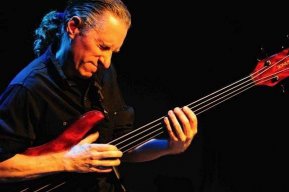
 
Thank you, Unspoken511.

In my opinion, the important thing with the fretless is always to practice with an intonation reference of some kind. An electronic tuner is great (I like the ones made by Intellitouch), but it's good to use other references in addition, such as playing along with recordings or MIDI sequences. One of the best tools for this is a looper.

For harmonics, I think it's helpful to understand as much as you can about how they work and an acoustics textbook is a good bet for this. My favorite is "On the Sensations of Tone" by Hermann Helmholtz , but it may be a bit much for some folks! Individual instruments have varying capacities for harmonics, so if you want to incorporate a lot of harmonics into your playing you may need to make sure you have a bass that will work for what you hope to achieve.
 
hey!

sorry it's taken me so long to reply (I've been holed up working on an epic project - more on that elsewhere :) )

Thanks so much for the kind words. I'm so glad our music connects with you in that way. It's a huge encouragement.

As for fretless playing, I have two suggestions that may be useful.

first one is to NOT practice correcting your intonation... the problem with correcting while you practice is that you get good at correcting, not playing in tune. Muscle memory is trained by repetition. So, play slowly, when you hit a note that's out of tune, stop, and play the line again, slow it RIGHT down, as slow as you need to to get the note right. Remove all the vibrato, no slides, nothing to cover it. That way, you learn to play in tune, and any changes to the pitch that you do by sliding/hammering/vibrato are there because they make the music 'even better' not because it needs fixing.

The second point is related, in that it's about control... playing 'correctly' - however you define it to get your pitch-absolute for the first point above - is only one aspect of making meaningful music. Fretless gives you the option to intentionally hit things sharp or flat, and bring them into the centre of the note, to bend and shape notes the way a singer does. To drag the tail of a note down, or up. To play the 'notes between notes'. Microtonal music is a fairly specialist field, but having flexible, varied CONTROL over how you approach the notion of pitch (and time, timbre, phrasing, note length etc) is where the expressive quality of your playing comes to life. Being 'correct' is the bit that everyone HAS to do to get a stake in the game. But it's not where the magic happens. Learning the grammar and syntax of a language doesn't give you great ideas, it just allows you to communicate great ideas when you have them in response to experience, study, learning, listening, debate, discussion... The musical parallels are pretty clear.

So do work on your intonation, but THEN focus on what to do with it. know the notes, know what happens when you approach that note in 5/6/7 different ways, how your right hand attack changes the shape of the note, how stopping it early affects the phrasing... that's where the magic is more likely to occur. :)

most of all, enjoy and keep your eye on the goal - meaningful self expression through music!

Steve
 
Steve makes some great points here! Intonation really is an interesting subject in that it's both objective and subjective. I like to start by choosing to think of it as objective, black-and-white, right or wrong. Then as I get a handle on that I like to move into the more subjective, open-ended, expressive approach.