• TalkBass has been independent since 1998. Add your voice.
    Create a free account to reply to discussions, view embedded media, and browse with fewer display ads.
    Join freeLog in
    Want zero display ads or expanded classifieds tools? Compare plans.

Fretless: Lines or No Lines?? Which is Least Annoying??

Lines or No Lines, that is the question!

  • Lines

    Votes: 68 44.2%
  • No Lines

    Votes: 86 55.8%

  • Total voters
    154
Originally posted by Bruce Lindfield


If you get to rely on the lines for correct intonation - what do you do when you are sight-reading a part or just following a chord chart?

Where do you look?


My two cents would be, the point of having a lined fretless is not necessarily to *rely* on lines but to be *helped by* them--that is, to use the lines as aids, along with any and everything else that will help you to play well (ears, muscle memory, whatever). If smell would help, I'd use that too.

As far as reading goes, it always helps to read ahead several bars if you can. Also to review the chart before you start playing if time allows. This is something you can do on break between sets, or before the gig. You won't always be able to memorize the whole tune, but just getting familiar with the shape of the tune and paying special attention to tricky spots will help you when you have to read the tune later.

In other words, cheat.;)

In a reading scenario, I tend to split my visual attention between neck and sheet music. BTW, it's not necessarily a great thing to be visually attached to the sheet music either. IMO, the less you need to rely on staring at the paper, the better off you are. You might find, for example, that after a few passes, you've got the A part of a standard down cold, but you're still wrestling with the bridge. In that situation, you might play better and more freely if you can look away from the paper for the A and just touch base with it when you need to.

 
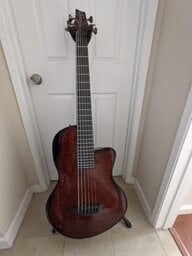
Note the fret lines. :cool:

Another thing to consider re: intonation. Even though your bass has fret lines, you still need to determine where in proximity to the line the note is actualy in tune.

If your bass was a conversion from a fretted bass, for example, the lines are not at the exact point of proper intonation, as allowance is made for the hieght of the fret. The point is most likely just ahead of the line.

Getting to the point of being able to play fretless with good intonation can be acheived more quickly by making best use of visual clues and muscle memory.

You still need to rely on your ears for confirmation of proper intonation.
 
Originally posted by Richard Lindsey


My two cents would be, the point of having a lined fretless is not necessarily to *rely* on lines but to be *helped by* them--that is, to use the lines as aids, along with any and everything else that will help you to play well (ears, muscle memory, whatever). If smell would help, I'd use that too.

As far as reading goes, it always helps to read ahead several bars if you can. Also to review the chart before you start playing if time allows. This is something you can do on break between sets, or before the gig. You won't always be able to memorize the whole tune, but just getting familiar with the shape of the tune and paying special attention to tricky spots will help you when you have to read the tune later.

In other words, cheat.;)

In a reading scenario, I tend to split my visual attention between neck and sheet music. BTW, it's not necessarily a great thing to be visually attached to the sheet music either. IMO, the less you need to rely on staring at the paper, the better off you are. You might find, for example, that after a few passes, you've got the A part of a standard down cold, but you're still wrestling with the bridge. In that situation, you might play better and more freely if you can look away from the paper for the A and just touch base with it when you need to.

I suppose, the point I was making was that - surely it's better to get to the point where you don't need to look at the neck at all - so you can look at written parts or signals from fellow players, the audience etc. In which case the lines/dot markers become irrelevant?

The DB tutors I talked to, also said that the advantage of looking out ahead of you rather than at the neck, was that you then tended to project more sound in the right direction and are more aware of what is going on as I said.
 
Originally posted by Bruce Lindfield


I suppose, the point I was making was that - surely it's better to get to the point where you don't need to look at the neck at all - so you can look at written parts or signals from fellow players, the audience etc. In which case the lines/dot markers become irrelevant?

The DB tutors I talked to, also said that the advantage of looking out ahead of you rather than at the neck, was that you then tended to project more sound in the right direction and are more aware of what is going on as I said.

I can't recall seeing a bassist, even a DBist, who *never* looks at his/her left hand, though I'm sure they exist (e.g., blind ones). I think that may be a slightly unrealistic goal for most of us in the real world. To me, more realistic is to get to the point where you're not unduly *tethered* to, or completely dependent on, constantly looking at the neck. But as has been said, if having a look now and then will help you do your job, what's wrong with that? Whatever helps, is good.

And as far as what the DB tutors told you goes, I think I would take that with a small grain of salt; it sounds a bit more mythical than actual to me. It's hard to see how the position of your head would effect the distribution of sound into a playing space, especially with an EUB. It's true that it's important--essential--to be aware of what's going on around you, but that awareness can be hindered just as much by excessive focus on the paper in front of you as by excessive focus on your left hand. Why would focusing totally on the paper be preferable to focusing totally on the LH? One type of obliviousness is not much of an improvement on the other.
 
Originally posted by Richard Lindsey


It's true that it's important--essential--to be aware of what's going on around you, but that awareness can be hindered just as much by excessive focus on the paper in front of you as by excessive focus on your left hand. Why would focusing totally on the paper be preferable to focusing totally on the LH? One type of obliviousness is not much of an improvement on the other.

Well they weren't saying to focus on the paper at all, but were saying you should be looking around - I found times where I was playing hard stuff - original tunes with written bass lines - that varied time signature, for example and I really had to concentrate on that, so had no time to look at my left hand and actually found it easier, after doing it for a while.

My point is that when I focus on looking at my left hand as well as sneaking a peak at music or chord chart and signals from band leader etc - then my playing suffers.

My feeling was that it would be preferable to get away from looking at the neck at all and that's why people say lines/position markers are just a distraction?
 
Originally posted by Bruce Lindfield


My feeling was that it would be preferable to get away from looking at the neck at all and that's why people say lines/position markers are just a distraction?

I don't think so. Why give up something that might help? And honestly, if you're going by DBists, I've heard very few DB players (or fretless BGists, either, most certainly including myself) whose intonation I thought left little or no room for improvement. Maybe some of them should look at their left hands more often than they do (yikes, don't hurt me!). My feeling is that *never* looking at your left hand might sometimes even hurt your playing, at least for some people, especially in some situations where you can't hear yourself well (and we've all been there). Again, I think the more realistic goal is simply not to become too dependent on it, and to use it when you think it would help. Or simply when you don't kmow where else to look!:bassist:
 
While the purist in me says that no lines is more cool, let's get real. The point is to sound good an play in tune. Lines help if you don't play fretless all the time. I agree that you need to use your ears, but going without lines is like forcing yourself to play with your eyes shut all the time. What is gained by doing that? Why handicap yourself?
 
I don't think that there is really any harm in having a lined fretless. If you want it to "look cool" than make sure that the markers are just a slightly lighter/darker shade than the fretboard wood. If you don't want to stare at the fretboard... don't do it! haha. It's going to be the same as the bass that doesn't have the lines if you don't look at it. But there will be a part where you're like "that doesn't sound right" and you'll look down for a moment and adjust. I'd say go with the lines.
 
Originally posted by DonZ
Craig, did you buy that from Scott Pazera ?


I forgot all about this thread. My parting shot
will be this: 400 years
of instruments without fret lines..hmmm.

And 4,000 years without indoor plumbing.....:D
 
Since I play violin and upright bass, unlined seems a little more natural for me. Plus you get more respect. ;) But then again, lined fretless is definitely more Jaco. (get dot markers too!)