I took a couple lessions 20 years ago and was told to stretch all four fingers across 4 frets. Bought another bass 7 years ago and tried again. If I stretch hard I can only get 4 fingers across 3 frets. Free lessons online say the same, 4 fingers, 4 frets. Any advice for no space between fingers?

Enjoy the benefits of a premium membership!
Upgrade Account
-
TalkBass has been independent since 1998. Add your voice.
Create a free account to reply to discussions, view embedded media, and browse with fewer display ads.
Join free Log in
Want zero display ads or expanded classifieds tools? Compare plans.
You are using an out of date browser. It may not display this or other websites correctly.
You should upgrade or use an alternative browser.
You should upgrade or use an alternative browser.
frets
- Thread starter christopher123
- Start date
More options
Who Replied?


My bass teacher at music school tells me to ALWAYS keep my hand in an open position with 1 finger per fret, so that they are always spanning 4 frets with 4 fingers no matter where i shift my hand.
but... when I play with my band, I usually "slack off" so to speak and really don't care about it as much. It does help my technique when I practice that way though.
I would just practice pinky exercises or scales very slowly. and always stretch your fingers before you play!!! it REALLY helps!
but... when I play with my band, I usually "slack off" so to speak and really don't care about it as much. It does help my technique when I practice that way though.
I would just practice pinky exercises or scales very slowly. and always stretch your fingers before you play!!! it REALLY helps!


here we go, meaning what?
Meaning here we go with 10 pages of debate as to the subtle nuances of which fingering technique is better than another.
It is subjective to a degree, however the "one finger per fret" rule is generally a good idea, where applicable, obvious example being a chromatic ascending or descending line.
In a nutshell, I've found it best to use a finger technique that minimises shifts in hand position and use of the finger that best facilitates the playabilty of the next one, and so on. It is something that can only be properly explained with visual demonstration; using all four fingers on your left hand is a must. A large part of the concept if efficiency, with minimum movement achieving maximum results.
This topic is an area where the old adage "A picture says a thousand words" really applies.
And yeah, +1 to onlyclave when they said 1-2-4. It is typically a better technique due to the scale of the bass vs. average finger/hand sizes.

The stretch or span of the human hand will vary, as it will at certain times of the day depending on your job. For example at the end of your working day if your job is hand or finger intensive you can expect your span to be less as your hands will be tight and so forth.
The one finger one fret is the way to play, but remember you can move your hand to facilitate this, even if just slightly rather than risk the damage or strain of stretching.
As has been stated economy of movement... does not mean no movement at all.
Also +1 with onlyclave 1-2-4 as alternative.
The one finger one fret is the way to play, but remember you can move your hand to facilitate this, even if just slightly rather than risk the damage or strain of stretching.
As has been stated economy of movement... does not mean no movement at all.
Also +1 with onlyclave 1-2-4 as alternative.
Some peoples' hands just wont stretch far enough; I'm in that camp. My pinky is plenty strong enough, but could never do a four fret stretch that sounded clean enough and didn't hurt like heck in the open to seventh position. If you have the stretch of 1-2-3-4, by all means, work on it, but for the rest of us small handed mere mortals, 1-2-4 is perfectly fine to use. 

. If you have the stretch of 1-2-3-4, by all means, work on it, but for the rest of us small handed mere mortals, 1-2-4 is perfectly fine to use.
+1
I use 1-2-4 most of the time, sometimes for a certain interval, I'll pivot on the thumb, still using 1-2-4 until I get my index finger to 6th or 7th fret
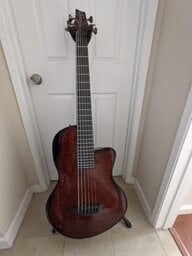
In general, i prefer 1-2-3-4 on an EBG, sometimes going to 1-2-4 in the lower positions. 1-2-3-4 has some real advantages, but you have to be careful not to murder your hands. If 1-2-3-4 throughout is killing your hands, maybe another approach should be considered.
If you look at your hand when it's in good playing position (that is, thumb behind the neck, more or less, and fingers curved over the fingerboard), you'll see that the stretch you can get between your middle finger and your ring finger is less than the stretch you get between index and middle or even ring and pinkie. For that reason, I think many people will find it easier to use 1-2-4 in low positions and switch to 1-2-3-4 in higher positions. I have, I think, something like normal hands for a 6' guy, not particularly large, and I sometimes find 1-2-3-4 uncomfortable in 1st position. So I'll skip the ring ringer if I need to. I imagine this could be even more the case for those of you who have 35" or even 36" scale instruments.
If you look at your hand when it's in good playing position (that is, thumb behind the neck, more or less, and fingers curved over the fingerboard), you'll see that the stretch you can get between your middle finger and your ring finger is less than the stretch you get between index and middle or even ring and pinkie. For that reason, I think many people will find it easier to use 1-2-4 in low positions and switch to 1-2-3-4 in higher positions. I have, I think, something like normal hands for a 6' guy, not particularly large, and I sometimes find 1-2-3-4 uncomfortable in 1st position. So I'll skip the ring ringer if I need to. I imagine this could be even more the case for those of you who have 35" or even 36" scale instruments.

In addition to 1-2-4 fingering in the lower frets, I also move my left hand hand to reach , just keeping my thumb anchored on the back of the neck to easily return to position.
Being able to stretch a certain amount is important, but for average hand sizes on average bass necks, stretching across those first four frets is too painful to be very strict about. Any efficiency you gain from 1-2-3-4 fingering goes out the window if your hand is cramping up and your forearm is burning from the effort to maintain the reach.
What ever lets you fret the note cleanly, comfortably, and without strain is good.
Being able to stretch a certain amount is important, but for average hand sizes on average bass necks, stretching across those first four frets is too painful to be very strict about. Any efficiency you gain from 1-2-3-4 fingering goes out the window if your hand is cramping up and your forearm is burning from the effort to maintain the reach.
What ever lets you fret the note cleanly, comfortably, and without strain is good.

Alvaro Martín Gómez A.
TalkBass' resident Bongo + cowbell player
In addition to 1-2-4 fingering in the lower frets, I also move my left hand hand to reach , just keeping my thumb anchored on the back of the neck to easily return to position.
This is a good point too, and it's facilitated by keeping your thumb more or less behind the neck rather than curled up around it.

Jim Carr
Dr. Jim
- Jan 21, 2006
- 16,223
- 7,613
- 76
- Disclosures
- fEARful Kool-Aid dispensing liberal academic card-carrying union member Musicians Local 72-147
There is something about the General Instruction Forum that just makes this happen all by itself, isn't there?


