• TalkBass has been independent since 1998. Add your voice.
    Create a free account to reply to discussions, view embedded media, and browse with fewer display ads.
    Join freeLog in
    Want zero display ads or expanded classifieds tools? Compare plans.

From 4, to 5 or 6?

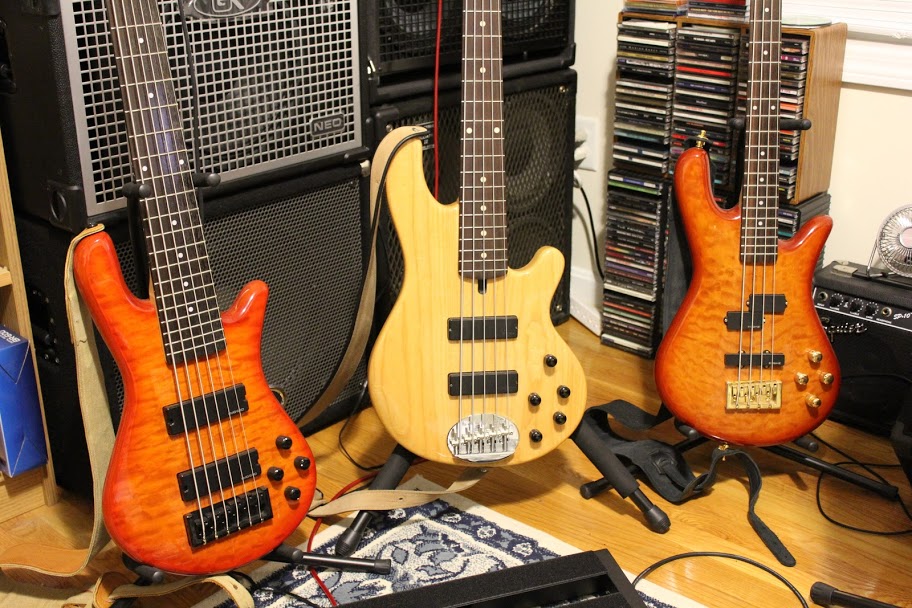
6 5 4

Why limit yourself :D

IMG_0007.jpg
Like you, I believe in having 4s, 5s, and 6s, but as I said before, Victor, Jaco and Marcus all primarily play 4s, and they've never sounded limited to me. :)

But if you are a bassist who plays many different styles and types of gigs, it's great to be able to have some choices and use the "right" tool for the job.

[Invalid or Expired Link Removed]

(Not pictured: Fodera Emperor 5, Fbass VF5, Fbass AC6-fretted, Fbass AC6-Upright, Alleva Coppolo Custom 5).
 
This is apt. Since you're tuning in BDAD, do you find yourself physically or mentally reaching for the imaginary G or C string? If G, then a 5 might be in order. Otherwise, I don't see how different a 5 or 6 will be for the music you play.
Actually, I've never tuned a 4 string bass BEAD. What I was trying to say is I reached to play a string that wasn't on my bass, so I decided to go ahead and give an extended range bass a try.

Nathan East, who is known for his tasty tone and playing style, plays a 5 string bass as a default, but swaps it out for a 6 string bass on songs he has solos.

I can think of 5 reasons to have a C string:

(1) Solos
(2) Chords
(3) Harmonics
(4) To play runs across the neck rather than up and down it.
(5) To play closer to the nut for better intonation on a fretless.

Any ONE of these reasons is reason enough to play a 6, or a 5 string EADGC.

But a lot of players don't like to slap on a 6 string bass. That's a lot of strings to keep quiet with just your left hand, plus many players don't like plucking a G string when it sits between two other strings, so that is a good reason not to have a C string.
 
I'm in the same boat. Been playing BEAD exclusively for the past 3 years. But I was/am getting tired of going to the 20th fret or higher. So I decided to go for a 5... After going to several stores looking for 5s, I played a Dingwall. It was eyeopening. So I started to look at the Dingwall forum and started to feel that their 6 strings look better. Also, I want to get more into tapping and chording. And one of my favourite bassplayers rocks a 6. I have read several threads about it, I even started one here. And although most people will discourage the 6 and advocate the 5, I decided on a 6 after playing a bunch of a friend of mine.

Why?
More range, soloing, chording, less shifting, the C doesn't get in my way and most important: there is nothing you can do on a 5 you can't do on a 6!

A lot of people say 6s are heavier, but there are light 6strings for sure!

Hope I helped!
Good luck
 
Tom7...11 basses, really? I mean thats awesome, but, really?
How did you afford it? None of them are cheapies, and most are high end.
Whatever your job is, Id like to make the money to be able to do that
Thanks. That is an outdated photo and I need to take another. I have a new Fodera and 3 new Fbasses that should be featured as well.

... So should I go all out for a 6 string or should I go 5?

Opinions and experiences welcomed.

There are two other things that haven't been discussed yet that you need to think about when considering 5 vs. 6.

#1: Tone.

Believe it or not, there is an audible difference in tone between 6s and 4s made of the exact same woods and pickups.

The mass of the heel of the neck where it meets the body is (of course) very large on a 6er in comparison to a 4 string bass. This affects the vibration and consequently the tone.

To compensate, bass makers like George Furlanetto (of Fbass) place the pickups differently on 6s than they do 4s and 5s. The combination sounds great I think (here's a clip featuring David Hughes playing his 6 string Fbass), but the tone is different than your 4, and you need to research that before buying.

#2: Scale length.

For decades the standard for basses was 4 strings, and 34 inches in scale length (the distance between the nut and the bridge).

When bass makers started putting B strings on basses, many bassists complained about how floppy and weak sounding the B strings were, so many makers extended the length of the bass to tighten up the B string, and 35 inch scale length basses became fairly common.

However, 35 inch scale length basses have a couple of draw backs as well. First, the distance between frets is wider which causes more hand fatigue. And second, making the bass longer doesn't just tighten the B string, it tightens ALL the strings.

Many players actually like the tightening of the BEADG strings, but if you are going to have a C string... an over tight C string sounds tinny and un-bass-like.

In other words, 35 inches is great for a B, but not so good for a C, so if you are going to get a 6 string bass, or are considering stringing a 5 string EADGC, then you probably ought to shy away from 35 inch basses.

Because you didn't answer the questions I asked awhile ago, I don't know what to advise you on 6 vs. 5 strings.

For example, some players hate to slap a bass with a C string in the way, but if slapping isn't what you do, that's a non factor.

And I've played entire gigs where I never used the B string and could have gone with a lighter bass and saved my shoulder and back a bit.

Because I play many different genres of music, with several bands and situations, I play with many styles and different basses so I can have the right tool for the job.

While I personally prefer 6 strings, often the specific tone (and / or look) of a 5 or a 4 string bass is the better fit.

Seriously, you need to take some time to answer for yourself the questions I've been asking. That process will help you figure out for yourself what would be the better fit for you.
 
Victor Wooten played in Vancouver on Dec 4. I attended the show & had a fantastic time watching him in action. During this show, he played his Fodera Yin Yang 5 exclusively, with the exception of a few songs where he used a fretless.
I've been wondering for years if Vic would starting doing this.

On the Carter Beauford DVD Vic plays a 6er in the studio, and his go-to fretless has been a 5er strung EADGC.

Carter's Monarch with JJ pickups is strung ADGC so he can have a C string for his tapping and soloing...

Vic is just so fond of C strings for soloing that I've wondered if he'd eventually go to a fretted bass strung EADGC.

That's very interesting; thanks for the update.
 
Like you, I believe in having 4s, 5s, and 6s, but as I said before, Victor, Jaco and Marcus all primarily play 4s, and they've never sounded limited to me. :)

But if you are a bassist who plays many different styles and types of gigs, it's great to be able to have some choices and use the "right" tool for the job.

[Invalid or Expired Link Removed]

(Not pictured: Fodera Emperor 5, Fbass VF5, Fbass AC6-fretted, Fbass AC6-Upright, Alleva Coppolo Custom 5).

I was not really implying using a 4 String was limiting, I meant why use only a 4 string when you have the other choices, at least try a 5 or 6, if it is not for you then you can always flip it. As for 6 String tone and 35 inch scale I don't agree 100% - I can make the 6 string sound as I want, and the 35 inch scale introduces no additional fatigue for me, I have fairly large hands - so they both play very nice.

Nice collection of Basses, I have 8 others not pictured, but I play 4 of my basses most of the time, so I am going to thin the hurd soon. I have a new Lakland P5 coming, once that lands - then I am selling off some of the others, none as fancy as yours. The three pictured did not set me back more than $1200.
 
I was not really implying using a 4 String was limiting, I meant why use only a 4 string when you have the other choices, at least try a 5 or 6, if it is not for you then you can always flip it.
Ah, I see. Sorry. :-)

As for 6 String tone and 35 inch scale I don't agree 100% - I can make the 6 string sound as I want, and the 35 inch scale introduces no additional fatigue for me, I have fairly large hands - so they both play very nice.
Interesting. I have large hands too, and I can feel the difference between 35- and 34-inch scale basses in the 3rd hour of playing more than the first.

But that does depend on the style of music. If I'm reading and playing with horns, I tend to play nearer the nut and that makes it worse. If I'm not reading and playing with guitars & keyboards, I tend to hang out more around the 5th and 7th frets and don't feel the difference much there.

But fatigue or not, I definitely am wary of the C string on 35-inch scale length basses. Of course this depends on the type of strings used as well, but 34 and 34.5 inch basses work better for me.

As for the difference in tone between 6s and 4s, that was actually first pointed out to me by George Furlanetto, the guy who makes Fbasses. Mind you I'm not saying 6s sound worse, just different. My BN6 (string Fbass) is my bass I usually bring if I can only bring 1 bass, so I definitely love its tone.

Nice collection of Basses, I have 8 others not pictured, but I play 4 of my basses most of the time, so I am going to thin the hurd soon.
I'm in the process of doing the same (thinning the herd). This is hard for me because (and I know this is silly) I tend to get emotionally attached to basses and hate giving them up, but that seems to be the only reason for me to hang on to some basses at the moment.

Now that I've lived with some basses awhile, I have a clearer idea what they do and don't do, and am adjusting the "collection" to hit certain goals a bit better.

I have a new Lakland P5 coming, once that lands - then I am selling off some of the others, none as fancy as yours. The three pictured did not set me back more than $1200.
A New Lakland P5? Nice. I've never seen a Lakland that didn't impress me.

I guess I feel like you do about using extended range basses: why not? If your playing can use 'em, then they are good to have around.
 
Because you didn't answer the questions I asked awhile ago, I don't know what to advise you on 6 vs. 5 strings.

For example, some players hate to slap a bass with a C string in the way, but if slapping isn't what you do, that's a non factor.

And I've played entire gigs where I never used the B string and could have gone with a lighter bass and saved my shoulder and back a bit.

Because I play many different genres of music, with several bands and situations, I play with many styles and different basses so I can have the right tool for the job.

While I personally prefer 6 strings, often the specific tone (and / or look) of a 5 or a 4 string bass is the better fit.

Seriously, you need to take some time to answer for yourself the questions I've been asking. That process will help you figure out for yourself what would be the better fit for you.

I don't slap. But, I want to learn (properly).
 
I don't slap. But, I want to learn (properly).
I see.

Well, the time has arrived and I feel my little Squier needs to be shelved while I play in my current metal/sludge/whatever project. I have already tuned down and bought a B string but it doesn't sound that great on my current bass. BDAD is current tuning on the count of some current material is drop D and I throw in some B string goodness when I can.

So should I go all out for a 6 string or should I go 5?

Opinions and experiences welcomed.
Because it sounds like you want to retire your 4 string bass rather than continue to use it, and because of your style of music, you would probably be happiest with a 5 string bass as your next purchase, something that could take over where your Squire left off, and let you snap a G string without a C getting in the way.

If you do end up getting a 5er, I'd recommend you get one with 19mm string spacing at the bridge. First, that is the string spacing standard for most 4 string basses so it will be familiar, but also if you are going to slap, the extra space can be nice.

Of course, many guys slap with narrow spacing just fine, that was just a suggestion.

The talkbass classifieds would be where I'd go to look for the next purchase too. New is of course great, but it is a buyer's market right now for used basses, and I tend to trust TBers more than any ole ebayer.

Good luck and let us know what you decide to do and act upon.
 
Something surprised me last night when I was online looking through the classifieds. (don't really have the spread right now though)

Lakland. I didn't know used 55-01's sold for so cheap. I kinda dismissed Lakland thinking I could never afford them. Then I see a used one for $500. I was immediately intrigued. Too bad there isn't any shops that sell them locally. I definitely want to go somewhere with a bunch of different manufacturers and just try bass after bass.

Lakland, Peavey, LTD, Schecter, Spector, Fender, Ibanez, and Carvin. These are companies on my radar right now. Too bad there isn't one shop with all of them. Also, most of these brands would be on the used for me to be able to aford it. I still want to give a 6 string a whirl though. You never know what you are missing until you try it.
 
I use an Ibanez BTB 6er. I basically never use the c for anything but screwing around. There's just something about the way a 6 feels. It feels much more natural to me, and I'm all about how a bass feels to play. I would get whatever feels best, even if you might not use that c, it's certainly not hurting anything.
 
Something surprised me last night when I was online looking through the classifieds. (don't really have the spread right now though)

Lakland. I didn't know used 55-01's sold for so cheap. I kinda dismissed Lakland thinking I could never afford them. Then I see a used one for $500. I was immediately intrigued. Too bad there isn't any shops that sell them locally. I definitely want to go somewhere with a bunch of different manufacturers and just try bass after bass.

If you're willing to spend a bit more the Lakland 55-02 is a much better bass than the 55-01 is in tonality. They're harder to find than the 55-01, but they do turn up on craigslist and here in the classfieds from time to time.
 

Latest posts