• TalkBass has been independent since 1998. Add your voice.
    Create a free account to reply to discussions, view embedded media, and browse with fewer display ads.
    Join freeLog in
    Want zero display ads or expanded classifieds tools? Compare plans.

Future Impact now available!! WAS: deep impact reissue!!! interested?

It's been a LONG time since I've checked in on this thread and I'm slowly working on getting caught up on when I have the time/motivation (currently on page 176), so I apologize if this has already been asked and answered: Does anyone know if the Impact has specific MIDI commands for Program up, Bank Up, and Bank Down? I'm finally digging in and getting a patch programmed on my HXFX to control the FI. The Program Down command is in the FI's user guide, but I'm curious if these additional controls are out there.

Special thanks go to @Chace90 for sharing some settings to get me started on a patch on the HXFX. When recalled, it turns on the Impact and switches to my most used sound. From there, the top three footswitches send commands for specific sounds on the Impact, and switching back to my main HXFX patch automatically turns the Impact off. I'm also working on a second HXFX patch totally dedicated FI control, where all 6 footswitches are used to control the FI... on/off commands and bank/program control (which is why I'm asking about the commands above.) :)

And I FINALLY started digging into the FI Editor, which is proving to be quite addictive. I should have done that LONG ago. So many synth patches I want to create... I can see myself losing hours and hours to the Editor. ha ha

Here's the latest version of my FI board, since it's been so long!

Main signal chain: Future Impact > Symmetry > HXFX > Qstrip
HXFX Loop 1: Octabvre
HXFX Loop 2: Changes based on mood/need, currently the Bass Envelope Phaser :cool:
Dunlop DVP4 programmed as HXFX expression controller

5sg.
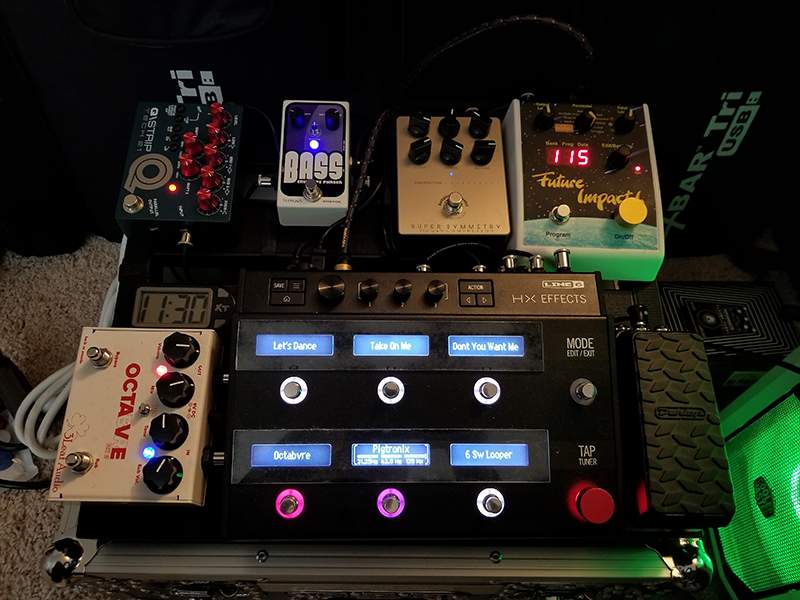
20181222_112936_SM.jpg
 
Phew, it took a couple of days but I’ve finally read this entire thread!

I’ve just this evening submitted the following suggestion to @Andras Szalay:

I had an idea regarding a way to have the parameter and edit knob be used to get the full range (0-127) using the 3-digit display. My implementation suggestion is as follows:

Have the display just show the patch number (two digits).

Whenever the parameter knob is moved it will then flip to a 3-digit display showing the current value of that parameter (0-127). After a fixed period of no knob movement (say 3 seconds), the display returns to showing the 2-digit patch number.

Similarly with the edit knob, as soon as it is moved, the display shows three digits representing the current parameter value (0-127) and begins moving up or down in increments of 1, depending on which direction it is turned. Again, after a time delay with no knob movement, the display returns to showing the 2-digit patch number.

The above suggestion could possibly be added as an option in the boot menu so that users could choose between it and the current implemention.

I also emailed Gabor earlier in the week asking if any of these features will make it into the new update (the ones with * are ones I forgot to include but would love to see implemented if possible):

Oscillator hard sync.

Linear FM.

A drag-and-drop interface for organising patches.

Ability for the editor to read patches from the pedal.

Audio-rate and really slow LFO.

Pitch-tracking LFO speed.

Optional wave reset of oscillators upon a trigger so that all start at a zero crossing.

A lower minimum cutoff frequency for the “new freq” filter.

Negative envelope depth.

Modulation of individual oscillators (rather than just all together).

Multiple LFOs.

Optional free-running LFOs (currently the LFO seems to always restart when a new note is played; it’d be nice to have both options).

Legato/multitrigger switch.

Multiple LFO waveforms (saw, reverse saw, square, sine, sample and hold).

Ring mod.

Phaser.

VCF envelope sustain parameter

*envelope reset upon note-on detection.

*ability to route multiple parameters to the mod wheel (CC #4) at once via a matrix so that more complex modulation can be introduced.
 
Last edited:
Phew, it took a couple of days but I’ve finally read this entire thread!

I’ve just this evening submitted the following suggestion to @Andras Szalay:

I had an idea regarding a way to have the parameter and edit knob be used to get the full range (0-127) using the 3-digit display. My implementation suggestion is as follows:

Have the display just show the patch number (two digits).

Whenever the parameter knob is moved it will then flip to a 3-digit display showing the current value of that parameter (0-127). After a fixed period of no knob movement (say 3 seconds), the display returns to showing the 2-digit patch number.

Similarly with the edit knob, as soon as it is moved, the display shows three digits representing the current parameter value (0-127) and begins moving up or down in increments of 1, depending on which direction it is turned. Again, after a time delay with no knob movement, the display returns to showing the 2-digit patch number.

The above suggestion could possibly be added as an option in the boot menu so that users could choose between it and the current implemention.

I also emailed Gabor earlier in the week asking if any of these features will make it into the new update (the ones with * are ones I forgot to include but would love to see implemented if possible):

Oscillator hard sync.

Linear FM.

A drag-and-drop interface for organising patches.

Ability for the editor to read patches from the pedal.

Audio-rate and really slow LFO.

Pitch-tracking LFO speed.

Optional wave reset of oscillators upon a trigger so that all start at a zero crossing.

A lower minimum cutoff frequency for the “new freq” filter.

Negative envelope depth.

Modulation of individual oscillators (rather than just all together).

Multiple LFOs.

Optional free-running LFOs (currently the LFO seems to always restart when a new note is played; it’d be nice to have both options).

Legato/multitrigger switch.

Multiple LFO waveforms (saw, reverse saw, square, sine, sample and hold).

Ring mod.

Phaser.

VCF envelope sustain parameter

*envelope reset upon note-on detection.


Lots of excellent suggestions for improvement.
 
In the examples that @Andras Szalay posted earlier of the new envelope routing possibilities, the pitches stepped in semitones; will stepless pitch movement also be possible when envelopes are applied to oscillator pitch?
 
I’ve not had time to write any new patches today or work on those suggested to me in the other thread as I spent the afternoon checking out the Enzo, of which I’ve posted a mini review in its thread. Hopefully I’ll have inspiration to write some tomorrow and share them.
 
Another another feature request which maybe ties in with my parameter knob request: having absolute, pass-through and relative modes for any pedals sending midi CCs (selectable from the boot menu).

A pass-through mode would be great when say using a pedal to sweep the cutoff as it’d avoid sudden leaps in values. Changes would only kick in once the preset value was reached.
 
And I FINALLY started digging into the FI Editor, which is proving to be quite addictive. I should have done that LONG ago. So many synth patches I want to create... I can see myself losing hours and hours to the Editor. ha ha

Do you mean you’ve only ever been using the stock presets? Or do you mean that you’ve uploaded new patches to the pedal before but have never tweaked parameters within the editor?

If the former, check out the new patches I uploaded this week in the patch sharing thread.
 
Do you mean you’ve only ever been using the stock presets? Or do you mean that you’ve uploaded new patches to the pedal before but have never tweaked parameters within the editor?

If the former, check out the new patches I uploaded this week in the patch sharing thread.

I've tried and tweaked some of the stock presets, but have never gotten into the editor because I've never had a huge need. I've mainly been using my FI for an 80's band I sub for, and their bassist created patches that we loaded onto my FI.

A couple of those patches also happened to work quite well for my main band too, but we're starting to add more songs that are well suited for the FI, so I'm finding more excuses to explore the editor. Now that I've tried it, I'm looking forward to really digging in and creating my own patches for those songs and more. I'll also be checking out that patch share folder of course, and will contribute what I can.

There are quite a few patches I'd like to create, but I think my first stop will be some of the sounds from Jamiroquai's Automaton album. I've been listening to a lot of Rush again lately as well, and seeing if I can cop Geddy's synth sound for Subdivisions is on the list as well. :cool:

5sg.
 
Last edited:
  • Like
Reactions: Kubicki Fan
Just added this feature request to the list for @Andras Szalay to consider:

ability to route multiple parameters to the mod wheel (CC #1) at once via a matrix so that more complex modulation can be introduced.
 
Could you please explain a bit more on how the current implementation functions like ADS (I'm specifically talking about the filter envelope as opposed to the amp envelope). Does the filter frequency not currently control both the start frequency and the rest frequency (the frequency which the filter settles at after the decay phase has finished)? That is, start and rest frequency are always the same as each other. Ideally, I'd like to be able to set different starting and resting frequencies (which I usually do on my hardware synth with the aid of a sustain parameter control).

From a theoretical point you are right, the starting point of the attack and the end point of the decay are the same, unlike on a mini Moog, where the starting point of the attack is lower or equal to the end point of the decay. However, this matters only for sounds that are fading in very slowly, which is not typical at all for bass guitar.

Andras Szalay
 
From a theoretical point you are right, the starting point of the attack and the end point of the decay are the same, unlike on a mini Moog, where the starting point of the attack is lower or equal to the end point of the decay. However, this matters only for sounds that are fading in very slowly, which is not typical at all for bass guitar.

Andras Szalay

I would like to use such sounds for basses and do so on keyboard bass sounds quite regularly. Or ones where the sound rises quickly from a very low cutoff point and decays quickly to a point higher than the original cutoff to achieve a “bwow” kind of sound but without the sound then disappearing into the low frequencies. Or if I want to apply a delayed filter sweep via LFO after the decay stage has completed, again without it sweeping down too far into the low frequencies.

If using the FI with a keyboard, then this becomes even more useful.

If it is possible to add this parameter then it would be most welcome (not just from me). At least then one has the option to use it or not, as the case may be.

Best wishes
 
I would like to use such sounds for basses and do so on keyboard bass sounds quite regularly. Or ones where the sound rises quickly from a very low cutoff point and decays quickly to a point higher than the original cutoff to achieve a “bwow” kind of sound but without the sound then disappearing into the low frequencies. Or if I want to apply a delayed filter sweep via LFO after the decay stage has completed, again without it sweeping down too far into the low frequencies.

If using the FI with a keyboard, then this becomes even more useful.

If it is possible to add this parameter then it would be most welcome (not just from me). At least then one has the option to use it or not, as the case may be.

Best wishes

As a further consideration - in the new update, is filter envelope a source that can be routed to the pitch of an oscillator? If so then there’s another good reason to implement a filter sustain stage, namely that one might wish to have two oscillators start in unison but then end a fixed interval apart (eg, a fifth). This could be achieved with the filter EG routed to the pitch of one oscillator but only if there’s a sustain stage, otherwise the pitch would always fall back to its starting frequency at the end of the decay stage. (This is also handy for shaping oscillator hard sync sounds...)
 
  • Like
Reactions: maisbass
As a further consideration - in the new update, is filter envelope a source that can be routed to the pitch of an oscillator? If so then there’s another good reason to implement a filter sustain stage, namely that one might wish to have two oscillators start in unison but then end a fixed interval apart (eg, a fifth). This could be achieved with the filter EG routed to the pitch of one oscillator but only if there’s a sustain stage, otherwise the pitch would always fall back to its starting frequency at the end of the decay stage. (This is also handy for shaping oscillator hard sync sounds...)

You can do that easily with the Flexi Controllers.

Andras Szalay
 
Hi folks

A quick question regarding MIDI expression control and noise.
I'm using a Behringer FCB1010 with the two expression pedals set up to control the cutoff and volume. In a live setting this works perfectly. But we're recording a track at the moment, and I've found that in a studio setting there is an audible 'creak' as the pedals are rocked back and forth. If you move the pedals very slowly you can isolate each high-pitched click - they sound like artifacts or something. Has anyone else encountered this? I'm trying to work out if its the behringer or the FI.

Cheers!