
Enjoy the benefits of a premium membership!
Upgrade Account
-
TalkBass has been independent since 1998. Add your voice.
Create a free account to reply to discussions, view embedded media, and browse with fewer display ads.
Join free Log in
Want zero display ads or expanded classifieds tools? Compare plans.
You are using an out of date browser. It may not display this or other websites correctly.
You should upgrade or use an alternative browser.
You should upgrade or use an alternative browser.
G&L L2500 micro-tilt feature...how to adjust properly?
- Thread starter songwriter21
- Start date
More options
Who Replied?


Turnaround
Commercial User
Well I've yet to find a Sadowsky that needed a shim. And I've handled hundreds. I believe Roger was commenting on the use of shims in general.Because of the rest of my quote. An instrument costing that much should be able to set up any way you want, without modifications.
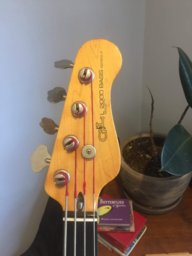
Forgive me for dredging this up again but I searched before making my neck tilt adjustment and came upon this thread. Here's the deal: My Neck relief was perfect 18/1000 on 1981 L-2000 three bolt neck, my E bridge saddle was all the way to the deck with string height of 8/64th" [too high]. On any other bass I would have no choice but to introduce a thin shim in the pocket to change the neck angle. Instead, I loosened the strings, loosened the three neck bolts, gave neck tilt screw a half turn in and retightened the next screws; everything changed for the better same as a shim would have done. Now the action is low [5/64th"] and bass plays fast and low. Saddles are now up enough to allow downward adjustment. In simple English the micro tilt takes the place of a shim. I can understand how some of you would say a full shim is better than a single point of lift like the tilt screw but I'll go with Leo on this one. What's not to like about this great feature?the problem I see with many basses is that they run out of saddle travel and bottom out often before a good action can be achieved'; this happens to incorrectly cut/shallow saddle slots. usually happens on the G saddle for some reason.
that's another story.
in a bad case of this, a shim would fix that but the thought of a shim just turns me off for some reason. especially on a well made bass like a G&L.
Agreed on your post. When i adjust the micro tilt feature i set the saddles just off the deck, maybe two threads showing, then i lay a straight edge on the neck and rest one end over the saddles then tilt until it touches. Works every time for me and i own 3 such equipped basses. Tilt neck rules!
Exactly, This is a pro moveAgreed on your post. When i adjust the micro tilt feature i set the saddles just off the deck, maybe two threads showing, then i lay a straight edge on the neck and rest one end over the saddles then tilt until it touches. Works every time for me and i own 3 such equipped basses. Tilt neck rules!

Yeah, I have an 83’ L2K with same 3 bolt neck and tilt screw, a great design, don’t know why they dropped it. I don’t really get the whole 6 neck bolt thing, the three bolts are rock solid in a tight pocket, and I’ve adjusted the neck tilt once in 35 years. Those early L2K are tanks, no worries, and tone monsters.
Agreed on your post. When i adjust the micro tilt feature i set the saddles just off the deck, maybe two threads showing, then i lay a straight edge on the neck and rest one end over the saddles then tilt until it touches. Works every time for me and i own 3 such equipped basses. Tilt neck rules!
I also do it that way, except in the case that having the saddles that low leaves me with an insufficient break over angle... In that case, I'll raise the saddles up to have just enough break angle, and adjust the micro-tilt to that... It doesn't happen often, but I have had it happen before...
Yeah, I have an 83’ L2K with same 3 bolt neck and tilt screw, a great design, don’t know why they dropped it. I don’t really get the whole 6 neck bolt thing, the three bolts are rock solid in a tight pocket, and I’ve adjusted the neck tilt once in 35 years. Those early L2K are tanks, no worries, and tone monsters.
Yeah, I've seen 3 bolt necks that didn't seem all that solid, but the 3 bolt on my '83 L2K is solid as a rock - no worries about that thing going anywhere...
Hi all! Got here by trying to adress a problem, although this thread is concerned with addressing another problem.
Common denominator is the "micro-tilt" though. After reading through the thread i decided to sound off on some misconceptions and maybe help out a little.
Im a Guitar player first of all, but as far as i can tell this feature origins from the bolt on electric guitar. However the principle is the same and thus the general discussion is similar.
How you like it or not, or what the reason for it was, weather it was introduced as a feature, as a means of lowering production costs, as a means of avoiding other adjustment problems is not in any way related to how it works and concerns about using it. It is what it is, and does what it does to remedy some problems, but can also cause others.
First, i have a Master degree in mechanical engineering. There is no special science for instruments, they all work within the framework of normal science, being mechanics, solid mechanics, vibration, and so on. I mention this with due cause.
Firstly its there for adjusting neck tilt, in order to get decent string height and decent tailpiece adjustment. Thats it. For floyd rose or gothoh style 2 pin pivot systems with plenty recess, it is just another adjustment. Same for les paul type solutions. Where it is preferred, is with fender type of solutions where the tedious saddle lowering introduces a secondary problem, protruding allen screws uncomfortable for the hand and less pressure on the saddles, sometimes causing them to move and not transferring sound as good, causing a lack of sustain. So in fender style tailpieces, it solves a problem weather it be a fender tremolo or mounted bass tailpiece, the principle is the same.
In short. If your tailpiece can get the string height, or action as some calls it, without causing secondary problems, you can use that instead of the micro-tilt for the same desired effect. If it feels and sounds the same, use whatever is most convenient.
Now how about shims? Obviously you want them for the exact reason as micro tilt, since they both tilt the neck. However, using shims is way more work so this is something you decide upon and stick with. If adjusting tailpiece will get the action right without causing other problems, you do that and avoid shims.
Can the micro tilt introduce problems? YES!! In part from how its done, what materials and so on. But also from the principle in itself. It is important to get that. It is a principle. It will do what it will do, in any amount. But it will be there. There is no need for data to support reasoning. I dont need to measure 100 buckets of water, before and after i add more water, to know that the water level will rise. It can be proven mathematically.
Regular joint is a pressure joint. 4 screws are pressuring 2 surfaces together so the stay locked with friction parallel to the joint and pressure in the normal, i.e the screw direction. This differs and a well carved pocket is there to provide extra support. The pressure is evenly distributed and contact is good.
With micro tilt, it becomes, in part a mechanical framework. Since wood is not hard, it will deform and deviate from that model but instead of an even pressure on the entire surface in the pocket bottom, there is instead a pressure focus on the frontal part of the pocket and the allen screw housing. This provides poor sideways stability, and a decent pocket is needed. But most of all, it introduces an extra medium in the chain of sound transfer, lowering vibration throughput, hence, in theory lowering sustain. The more severe tilt, and the harder the wood, the less contact from neck to body.
In front there will be a strip of same contact as a normal joint, only less area, and in the back there will be the reduced contact area of the allen support plate on the neck, and the allen housing in the heel, transferred via the metal parts of the allen screw arrangement to the reduced areas. This is avoided with shims, and is the theoretical reason to go with shims instead.
This will inhibit vibration travel. I do not intend, nor do i need to prove this, any more than 2+2=4 or Gauss theorem or the water bucket experiment. It is widely accepted concepts. Any change in medium will cause part reflection of the energy in the vibrations. This can be used to cause a standing wave and amplification in some applications, but it is obvious that different frequencies will not produce this phenomena in the same structure, and is thus useless and unwanted for an instrument, which is all about producing different frequencies.
Now, my problem was a seemingly unresponsive guitar, Peavey generation S2. As the problem was still there when unplugged, its not an electronics issue. Still there are many probable causes, the odd Kahler falcon, floyd rose licence tremolo being one. But also, a micro tilt system. I will try alter it and see if i can notice any difference and get back here. Sustain is affected by a lot of factors and if the micro tilt is severe in an otherwise resonant setup, it will hamper it. The effect is the same, but level of it may differ between bass and guitar. My guess is that guitars are more sensitive.
Now, i havent touched it, but this guitar had previous owners. I will check, adjust and get back here.
Common denominator is the "micro-tilt" though. After reading through the thread i decided to sound off on some misconceptions and maybe help out a little.
Im a Guitar player first of all, but as far as i can tell this feature origins from the bolt on electric guitar. However the principle is the same and thus the general discussion is similar.
How you like it or not, or what the reason for it was, weather it was introduced as a feature, as a means of lowering production costs, as a means of avoiding other adjustment problems is not in any way related to how it works and concerns about using it. It is what it is, and does what it does to remedy some problems, but can also cause others.
First, i have a Master degree in mechanical engineering. There is no special science for instruments, they all work within the framework of normal science, being mechanics, solid mechanics, vibration, and so on. I mention this with due cause.
Firstly its there for adjusting neck tilt, in order to get decent string height and decent tailpiece adjustment. Thats it. For floyd rose or gothoh style 2 pin pivot systems with plenty recess, it is just another adjustment. Same for les paul type solutions. Where it is preferred, is with fender type of solutions where the tedious saddle lowering introduces a secondary problem, protruding allen screws uncomfortable for the hand and less pressure on the saddles, sometimes causing them to move and not transferring sound as good, causing a lack of sustain. So in fender style tailpieces, it solves a problem weather it be a fender tremolo or mounted bass tailpiece, the principle is the same.
In short. If your tailpiece can get the string height, or action as some calls it, without causing secondary problems, you can use that instead of the micro-tilt for the same desired effect. If it feels and sounds the same, use whatever is most convenient.
Now how about shims? Obviously you want them for the exact reason as micro tilt, since they both tilt the neck. However, using shims is way more work so this is something you decide upon and stick with. If adjusting tailpiece will get the action right without causing other problems, you do that and avoid shims.
Can the micro tilt introduce problems? YES!! In part from how its done, what materials and so on. But also from the principle in itself. It is important to get that. It is a principle. It will do what it will do, in any amount. But it will be there. There is no need for data to support reasoning. I dont need to measure 100 buckets of water, before and after i add more water, to know that the water level will rise. It can be proven mathematically.
Regular joint is a pressure joint. 4 screws are pressuring 2 surfaces together so the stay locked with friction parallel to the joint and pressure in the normal, i.e the screw direction. This differs and a well carved pocket is there to provide extra support. The pressure is evenly distributed and contact is good.
With micro tilt, it becomes, in part a mechanical framework. Since wood is not hard, it will deform and deviate from that model but instead of an even pressure on the entire surface in the pocket bottom, there is instead a pressure focus on the frontal part of the pocket and the allen screw housing. This provides poor sideways stability, and a decent pocket is needed. But most of all, it introduces an extra medium in the chain of sound transfer, lowering vibration throughput, hence, in theory lowering sustain. The more severe tilt, and the harder the wood, the less contact from neck to body.
In front there will be a strip of same contact as a normal joint, only less area, and in the back there will be the reduced contact area of the allen support plate on the neck, and the allen housing in the heel, transferred via the metal parts of the allen screw arrangement to the reduced areas. This is avoided with shims, and is the theoretical reason to go with shims instead.
This will inhibit vibration travel. I do not intend, nor do i need to prove this, any more than 2+2=4 or Gauss theorem or the water bucket experiment. It is widely accepted concepts. Any change in medium will cause part reflection of the energy in the vibrations. This can be used to cause a standing wave and amplification in some applications, but it is obvious that different frequencies will not produce this phenomena in the same structure, and is thus useless and unwanted for an instrument, which is all about producing different frequencies.
Now, my problem was a seemingly unresponsive guitar, Peavey generation S2. As the problem was still there when unplugged, its not an electronics issue. Still there are many probable causes, the odd Kahler falcon, floyd rose licence tremolo being one. But also, a micro tilt system. I will try alter it and see if i can notice any difference and get back here. Sustain is affected by a lot of factors and if the micro tilt is severe in an otherwise resonant setup, it will hamper it. The effect is the same, but level of it may differ between bass and guitar. My guess is that guitars are more sensitive.
Now, i havent touched it, but this guitar had previous owners. I will check, adjust and get back here.
Of course the data exists. It is your job to find it. Assertions that have no data are merely opinion. Opinion without supporting data is worthless.
The micro-tilt mechanism was invented to eliminate shimming. In a way it was an attempt to make it easier for the uninitiated to make the change on their own. It certainly makes the process quicker for the tech. But as it required extra machining, it could never be asserted that it was a time saver on the production line. However, the mechanism is a rousing mechanical success. But it fell out of favor because Fender used it on their three bolt necks. Fender, during this time period was not producing the greatest quality. The neck pockets were over sized, probably due to poor machining techniques and the need to replace worn machinery and tooling. Necks slipped around in the pockets. Unfortunately, all of this happened around the time they went to the three bolt neck. The three bolt design got the blame. The micro-tilt mechanism was the baby that got thrown out with the bath water. But it had absolutely nothing to do with the mechanical problem of a loose pocket.
Interestingly, G&L, another Leo Fender company used the three bolt design with the micro-tilt in their first guitars. None of these guitars exhibit any of the problems that the Fender guitars did. A rousing success.
Changing geometry and changing saddle heights are two very different operations performed during setup. Geometry will allow for better range when changing saddle height. Adjusting the saddles may not be able to overcome geometry. Hence, shimming or utilizing a micro-tilt mechanism.
Nonono. I made a lengthy reply just now on the topic. "Assertions that have no data are merely opinion." No, it is not. There are no "data" in mathematical proofs, you do not gather them or measure them. There are principles, and principles that can be derived from others. Also there are axioms. Data does not exist as such until they are collected, hence they do not exist pre findings. Estimations of such data can still be made with great probability, and sometimes as logical facts. As for you to go on about "It is a simple thing to twist a screw driver and estimate tension by feel.". Why dont you just tell the whole manufacturing industry they got it wrong then? It might be good enough for some cases sure, but as a principle FunkHead is correct. Also sustain is, by principle, affected. How much should vary greatly from case to case. I have read some posts now how people cured their acoustically dead instrument by nullifying the micro tilt. I will try and see if it solve my problem and get back in the forum. Regards
I have an 83’ L2k with neck tilt that I literally never had to use. If the neck isn’t bowed beyond the adjustable range of the bridge, you should never have to use it either. Mine is a three bolt pocket, in theory less stable and solid than more bolts, but mine is rock solid, nice tight pocket, no neck movement. Leo got it right. The whole sustain issue is overblown in my opinion, not that it’s a problem for G&L’s anyway. That bridge is a solid chunk of steel once you lock the saddles down. Sustain for what? Unless you are doing some kind of ambient pedal note, big whup.
I have an 83’ L2k with neck tilt that I literally never had to use. If the neck isn’t bowed beyond the adjustable range of the bridge, you should never have to use it either. Mine is a three bolt pocket, in theory less stable and solid than more bolts, but mine is rock solid, nice tight pocket, no neck movement. Leo got it right. The whole sustain issue is overblown in my opinion, not that it’s a problem for G&L’s anyway. That bridge is a solid chunk of steel once you lock the saddles down. Sustain for what? Unless you are doing some kind of ambient pedal note, big whup.
Sustain problem is much worse for guitar. Lower frequencies travels better in structures and a vibrating heavy string dissipates more energy than a light string. Plus sustain is more useful in guitar playing. So for most bass playing this might not be noticeable or matter as you say.
to make this simple, think of the micro tilt like you would a neck shim. Here is the drill:Hey All,
I've only seen a few threads regarding when this company had this feature, before they ruled it out in 1998. I'm getting a '97, and it has the little hole through the black neck plate. I'm guessing this is the same thing as what Peavey had on a lot of their models? I had a few Peavey G-V's with this, and it was a great feature, if done properly. You can look up Peavey manuals, which explained to me how to use the micro-tilt by loosening strings and neck bolts before adjusting. Now, the Peavey's had five bolts, and the G&L has six. I'd like to take advantage of this, as I like really low action. Some have said that the tilt doesn't do anything, and I think they didn't realize that you have to loosen strings and bolts for it to take effect. I thought it was pointless, too, when I didn't know how to adjust this on my first Peavey, but a future one...wow! I can't find much online as to how to properly loosen what bolts to what degree, or anything regarding this long-gone feature, and G&L aren't the greatest with responding to emails (from my memory). Do any of you out there have this feature on your vintage G&L, with the six-bolt attachment?
Thanks,
Ben
1]set your neck relief to spec or your preferred state using truss rod
2]set string action using bridge saddle adjustments.
3]IF you are attempting #2 and need lower string action BUT your saddles are already to the deck, THEN use the micro tilt to raise the heel of the neck in the neck pocket so you can raise those saddles to get some adjustability back. Just loosen the bottom [the ones nearest the bridge] neck screws and engage the micro tilt until it lifts the neck heel a tiny bit. [a little movement here goes a LONG WAY]
4]NOW go back and re attempt #2
correctOkay, Just humor me here>>>>
I set up my bass perfectly to my standards. I adjust the truss Rod to just a tiny bit of relief. My nut is spot on. Then I get the saddles precisely where I like them. I have a very tiny bit of Buzz which is exactly the way I like it.
So>>> Why in the world would I want to bother with Micro-Tilt??????
I wouldn't!!!! There's absolutely no reason to!!
The original problem that micro tilt was supposed to solve, as far as i can tell, was to avoid the saddles to bottom out or being too low. Too low was mainly a concern with fender type saddles, where the adjustment screws would protrude much and become uncomfortable for the hand, plus lessen the downward pressure of the saddle, sometimes causing them to move around, or lose sustain. With a well adjusted instrument and saddles who dont become a hassle when you adjust them, microtilt is pointless and may cause loss of sustain and/or change tone characteristics.correct
I adjusted my Peavey Generation S2 electric guitar, and there was a bit mircotilt to it, but almost none. I de-tilted it so its regular flat 4 screw and tightened. It became better, especially the higher notes rings longer and stronger. The pocket is not tight to the sides, no problem sliding a paper there, so thats hampering too.
This guitar has a well recessed floyd with 2 point adjustment, so there is absolutely no use whatsoever for the microtilt. Just a feature they threw in, or more probably, already made for the non-floyd versions.
Dont mircro-tilt unless you have a problem already.
The original problem that micro tilt was supposed to solve, as far as i can tell, was to avoid the saddles to bottom out or being too low. Too low was mainly a concern with fender type saddles, where the adjustment screws would protrude much and become uncomfortable for the hand, plus lessen the downward pressure of the saddle, sometimes causing them to move around, or lose sustain. With a well adjusted instrument and saddles who dont become a hassle when you adjust them, microtilt is pointless and may cause loss of sustain and/or change tone characteristics.
I adjusted my Peavey Generation S2 electric guitar, and there was a bit mircotilt to it, but almost none. I de-tilted it so its regular flat 4 screw and tightened. It became better, especially the higher notes rings longer and stronger. The pocket is not tight to the sides, no problem sliding a paper there, so thats hampering too.
This guitar has a well recessed floyd with 2 point adjustment, so there is absolutely no use whatsoever for the microtilt. Just a feature they threw in, or more probably, already made for the non-floyd versions.
Dont mircro-tilt unless you have a problem already.
Actually I had two choices on my G&L L2000 with "bottomed out" saddles.
1] install a neck shim
2]use the micro tilt function already on the bass
I chose number 2 and find it to work as Leo intended


