
Enjoy the benefits of a premium membership!
Upgrade Account
-
TalkBass has been independent since 1998. Add your voice.
Create a free account to reply to discussions, view embedded media, and browse with fewer display ads.
Join free Log in
Want zero display ads or expanded classifieds tools? Compare plans.
You are using an out of date browser. It may not display this or other websites correctly.
You should upgrade or use an alternative browser.
You should upgrade or use an alternative browser.
Gain or master?
- Thread starter Strane
- Start date
More options
Who Replied?


In general, the gain controls the amount of signal that is pushed though the preamp. Depending on how that amp is designed it could give you nice sounding overdrive/distortion or sound not so good. For example, Darkglass amps are known for their distortion sounds. I get a nice OD out of my Mesa by pushing the gain. On my old SWR head the preamp did not sound so good when pushed too hard.
You won’t harm the amp by pushing the gain. But only you can tell how your rig sounds when you push the gain so I’ll leave that up to you. You will probably need to lower that master to keep the volume in check.
You won’t harm the amp by pushing the gain. But only you can tell how your rig sounds when you push the gain so I’ll leave that up to you. You will probably need to lower that master to keep the volume in check.
Depends on the amp.
Typically, lower gain and higher master is probably going to be cleaner (less overdrive/distortion) than the other way around. There's nothing wrong with either approach, just depends on what sounds you want to get out.
How does it sound to you?
Typically, lower gain and higher master is probably going to be cleaner (less overdrive/distortion) than the other way around. There's nothing wrong with either approach, just depends on what sounds you want to get out.
How does it sound to you?
Last edited:

Sounds like you are talking about EQ, not gain. Your gain is a knob adjustment (if you have one) for adjusting how hot your preamp signal is. You can't scoop gain. You can scoop EQ.Is it right to push gain all straight as long as it doesn't clip? I usually scoop the gain much more than the master and I'm not sure if that is okay.
Does it affect to the sound? and if it does, in what way?
Thnx in advance.

I'm thinking "scoop" is a misnomer as he's also taking about "scooping" the master.Sounds like you are talking about EQ, not gain. Your gain is a knob adjustment (if you have one) for adjusting how hot your preamp signal is. You can't scoop gain. You can scoop EQ.

Never heard of scooping volume. What is all straight?
Please rephrase the question.
Gain is the signal in. You can keep it low and clean or high and strong, or extra high and driven into distortion. Your choice.
Volume is the loud of the signal.Though the gain does make the signal loud also.
Please rephrase the question.
Gain is the signal in. You can keep it low and clean or high and strong, or extra high and driven into distortion. Your choice.
Volume is the loud of the signal.Though the gain does make the signal loud also.

Depends on the amp. I have an Eden head where for optimal results you want the gain set when the limit light flicker on and off playing your loudest lowest note. Then you adjust the master volume to suit. This provides the hottest signal to the power stage.Is it right to push gain all straight as long as it doesn't clip? I usually scoop the gain much more than the master and I'm not sure if that is okay.
Does it affect to the sound? and if it does, in what way?
Thnx in advance.
Some amps can have tonal changes depending on level of gain and master levels.
Best bet for proper or optimal settings, read the owners manual or call customer support.

Gain for dirt.
Master for clean.
As a rule of thumb.
Master for clean.
As a rule of thumb.

the way i've understood it, gain is the volume going INTO your amp. volume is the volume coming OUT of your amp.

It might also depend on your line level. Is there a preamp before the amp or is it a passive bass without super hot pu's?

FullumMusic
Commercial User
- Oct 13, 2022
- 2,008
- 5,683
- Disclosures
- Audio/Music software developer, contracted with a company you've heard of and deving my own stuff.
I think there might be some confusion going on here because the OP is using some terminology that sounds more like EQ than Gain parameters. Maybe language gap or just not used to talking technical stuff?
To try to cover all the variables, generally speaking:
- Gain boosts the signal at the input of the amp. This gets it to a usable level for all the other components after the gain in the pre-amp (EQ, Compression, etc.), and for the power amp.
You can turn the gain up as much as you want. If you want a clean tone, don't let it clip. You can also let the gain clip if you like the overdrive and distortion it creates. It won't hurt the amp or the speaker. It's just distorting the signal.
*Note, on some amps clipping sounds better than others, and some it sounds bad. That's up to you to decide on your amp.
- EQ (equalization) will boost or cut the levels of certain frequency bands. This is useful for emphasizing different parts of your bass's tone, or to compensate for how your amp sounds in different rooms, or compensate for how your amp sounds in different mixes with other instruments.
In general, don't turn all the EQ bands all the way up for more volume. If you need more volume, either turn up the gain or the master volume. Turning up all your EQ bands is essentially the same as turning up your volume, but not good practice.
- Master Volume or Master Level is how much you're turning up the power amp that's actually driving your speakers. Use the Gain and EQ to get the tone you want. Use the Master Volume to make the speaker louder or quieter.
The Master Volume doesn't care where the Gain is set. The gain boosts the signal, and the master just makes whatever that signal is louder.
----
- So, start with your EQ "flat", meaning no boost and no cut. That's usually at 12:00 or halfway between minimum and maximum on most amps, or labeled 0dB.
- Then turn your gain up until it starts clipping, and then pull it back until it stops clipping and sounds good to you. (Or let it clip if you want distortion.)
- Now adjust the EQ until it sounds good to you. Again, if they're all boosted, put them back down to flat and make the amp louder.
- Lastly, just use the Master Volume to adjust the volume louder or quieter as needed.
This isn't the only proper way to set your amp up, but it's a reliable way.
And if you find you need to turn the gain all the way up, and the EQ all the way up, and the volume all the way up, you need a louder amp or more speakers or both.
To try to cover all the variables, generally speaking:
- Gain boosts the signal at the input of the amp. This gets it to a usable level for all the other components after the gain in the pre-amp (EQ, Compression, etc.), and for the power amp.
You can turn the gain up as much as you want. If you want a clean tone, don't let it clip. You can also let the gain clip if you like the overdrive and distortion it creates. It won't hurt the amp or the speaker. It's just distorting the signal.
*Note, on some amps clipping sounds better than others, and some it sounds bad. That's up to you to decide on your amp.
- EQ (equalization) will boost or cut the levels of certain frequency bands. This is useful for emphasizing different parts of your bass's tone, or to compensate for how your amp sounds in different rooms, or compensate for how your amp sounds in different mixes with other instruments.
In general, don't turn all the EQ bands all the way up for more volume. If you need more volume, either turn up the gain or the master volume. Turning up all your EQ bands is essentially the same as turning up your volume, but not good practice.
- Master Volume or Master Level is how much you're turning up the power amp that's actually driving your speakers. Use the Gain and EQ to get the tone you want. Use the Master Volume to make the speaker louder or quieter.
The Master Volume doesn't care where the Gain is set. The gain boosts the signal, and the master just makes whatever that signal is louder.
----
- So, start with your EQ "flat", meaning no boost and no cut. That's usually at 12:00 or halfway between minimum and maximum on most amps, or labeled 0dB.
- Then turn your gain up until it starts clipping, and then pull it back until it stops clipping and sounds good to you. (Or let it clip if you want distortion.)
- Now adjust the EQ until it sounds good to you. Again, if they're all boosted, put them back down to flat and make the amp louder.
- Lastly, just use the Master Volume to adjust the volume louder or quieter as needed.
This isn't the only proper way to set your amp up, but it's a reliable way.
And if you find you need to turn the gain all the way up, and the EQ all the way up, and the volume all the way up, you need a louder amp or more speakers or both.
Gain refers to how much a signal gets amplified.
i.e. it would be the difference between the level of a signal going in vs the level going out of an amplification circuit.
As a general rule, you want to set the lowest gain level you need if you want a clean signal.
Adjusting gain does adjust your sound, most notably the eventual distortion of the signal. Of course many musicians take advantage of this. Nowadays this doesn't need to be done on the mixing level because of pedals and amps that will provide it as an 'effect'.
Competent sound engineers will have additional considerations.
Heck, for me, a mere bassist - I just set a tone that I like and let sound guys do their thing if applicable.
i.e. it would be the difference between the level of a signal going in vs the level going out of an amplification circuit.
As a general rule, you want to set the lowest gain level you need if you want a clean signal.
Adjusting gain does adjust your sound, most notably the eventual distortion of the signal. Of course many musicians take advantage of this. Nowadays this doesn't need to be done on the mixing level because of pedals and amps that will provide it as an 'effect'.
Competent sound engineers will have additional considerations.
Heck, for me, a mere bassist - I just set a tone that I like and let sound guys do their thing if applicable.

Some designs are... designed to let you use the gain control as a character control. More gain = more dirt. If you want the cleanest tone distortion-wise, max the master volume and turn the gain up until you get the volume you want.
Other designs instead do not overdrive gracefully, and in these designs, the gain control should be set in order to maximise SNR (signal-to-noise ratio) - the stronger signal you have earlier on in the chain, the less noise you amplify. These designs usually feature a clip light, and you are supposed to set the gain where the clip light barely turns on the hardest peaks (and then turn it down slightly, perhaps).
To tell the truth, maximising SNR on guitar or bass matters relatively little (it does matter, especially for high-gain guitar tones, but not much for how to set gain-master volume controls); electric guitars and basses are inherently noisy, especially if equipped with single coils. A guitar or bass's self-noise is bound to be higher than that of an amplifier.
By the way, there are also designs that are closer to the first type that feature a clip light, rather confusingly, and you might be tempted to set the gain as in the second case; one such design is the Ampeg SVT3-PRO II, where you actually lose out on a variety of mildly overdriven tones if you keep the clip light off.
Other designs instead do not overdrive gracefully, and in these designs, the gain control should be set in order to maximise SNR (signal-to-noise ratio) - the stronger signal you have earlier on in the chain, the less noise you amplify. These designs usually feature a clip light, and you are supposed to set the gain where the clip light barely turns on the hardest peaks (and then turn it down slightly, perhaps).
To tell the truth, maximising SNR on guitar or bass matters relatively little (it does matter, especially for high-gain guitar tones, but not much for how to set gain-master volume controls); electric guitars and basses are inherently noisy, especially if equipped with single coils. A guitar or bass's self-noise is bound to be higher than that of an amplifier.
By the way, there are also designs that are closer to the first type that feature a clip light, rather confusingly, and you might be tempted to set the gain as in the second case; one such design is the Ampeg SVT3-PRO II, where you actually lose out on a variety of mildly overdriven tones if you keep the clip light off.
Exactly.I'm thinking "scoop" is a misnomer as he's also taking about "scooping" the master.

Most amp manuals say to roll on the gain to where it just starts to clip, then back off a bit to where it doesn't. Where the actual gain setting is will vary by bass. As others have stated, if you want more breakup/distortion, you can let it clip a bit more.
Having said that, for years I set the gain at noon and adjusted the master for volume, not sure why, out of habit I guess. But a few months ago I watched Bob Gallian (of GK amps) demo his amps and he was clear that you should roll the gain as far as you can without clipping, and in their demo (using a Jazz bass) they had the gain dimed, and he said 'a stock Jazz won't distort or clip this gain'. Since then, I started using more gain (I can get to about 75-90% gain depending on the bass I'm using), and using less Master. The two things I've noticed are (1) the tone is a little fuller - still clean (I don't use dirt), but a bit phatter, if you will, and (2) the amp has way more volume headroom than I previously thought. With the gain at noon, I'd typically run the master at noon to 1:00 for a gig. With the gain rolled on more, I'm only running the master at 9:00, and it's just as loud.
Having said that, for years I set the gain at noon and adjusted the master for volume, not sure why, out of habit I guess. But a few months ago I watched Bob Gallian (of GK amps) demo his amps and he was clear that you should roll the gain as far as you can without clipping, and in their demo (using a Jazz bass) they had the gain dimed, and he said 'a stock Jazz won't distort or clip this gain'. Since then, I started using more gain (I can get to about 75-90% gain depending on the bass I'm using), and using less Master. The two things I've noticed are (1) the tone is a little fuller - still clean (I don't use dirt), but a bit phatter, if you will, and (2) the amp has way more volume headroom than I previously thought. With the gain at noon, I'd typically run the master at noon to 1:00 for a gig. With the gain rolled on more, I'm only running the master at 9:00, and it's just as loud.
This is a quick and dirty generalization that I mostly agree with. There are of course many pieces of the puzzle and it should be somewhat obvious that each one affects the chain as a whole.Gain for dirt.
Master for clean.
As a rule of thumb.
The gain setting as, many mention, is how much attenuation on the input. Volume or master typically attenuates the output. Usually they are deceptively marked with positive numbers that increase with the resulting signal amplitude.
Changing the gain will alter the saturation of the signal. Different amps will sound "better" at different parts of that curve. Play with it. It's going to be affected by the signal chain ahead of the amp with pedals, dif pickups, etc. after you dial in the sound you like, use the master to attenuate the output to an appropriate, or desired, volume.
More simply, more gain tends to be a "fatter" signal which also pushes more "volume" into the output stage. More master, more loud.
Last edited:
It's a passive Fender P-BassIt might also depend on your line level. Is there a preamp before the amp or is it a passive bass without super hot pu's?

It's a Baskin Robbins thing.Never heard of scooping volume. What is all straight?
Please rephrase the question.
Gain is the signal in. You can keep it low and clean or high and strong, or extra high and driven into distortion. Your choice.
Volume is the loud of the signal.Though the gain does make the signal loud also.
"I want one scoop of strawberry, two of vanilla, 3 scoops of chocolate - Damn it, just give the whole bucket." Full on distortion at that point - in the toilet. That's why it's called dirt.
On a related note -- Sometimes the more scoops on your pie will result in gain - gaining more weight.

Last edited:



For your future reference, the term "scoop" usually refers to a type of equalization (EQ) where the bass is set at least somewhat high and the treble is similarly set at least somewhat high, but the mids are set somewhat low. If using a graphic equalizer, this will result in the sliders taking on the general shape of a smile (as opposed to a frown) such as can be seen here (though the sliders don’t have to be this far up on the ends or that far down in the middle). This EQ setting here is perhaps a little dramatic, but clearly illustrates a mid scoop (also, the bottom of the scoop doesn’t have to be right in the middle — you can adjust the location and curve of the scoop somewhat to taste):
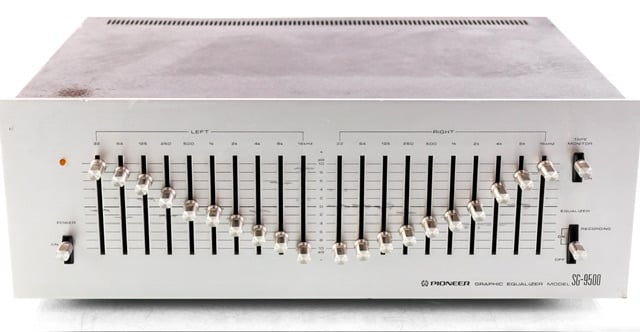
If you’re talking about just pushing all the sliders up, I wouldn’t do that. If you want a flat EQ, set all the sliders to their middle position vertically (there will probably be a detent in the middle of each sliders’ range to let you know right when you’re in the middle), and then get any signal boost you want from your preamp and any output volume you want to come through the speakers [or other output] via the volume knob on your amp (possibly labeled Master Volume). You could put all the sliders up a notch or two (if all the sliders are set at the same vertical level, you’ll maintain a flat EQ), but the general recommendation, especially for recording, is not to boost EQ sliders unnecessarily (absolutely add boost if/where you need it, but be aware that too much boost via the EQ can cause negative effects to your signal [ultimately, use your ear to judge, and make your own call though, but that can take some experience to get comfortable with]).
Hope that helps some!
If you’re talking about just pushing all the sliders up, I wouldn’t do that. If you want a flat EQ, set all the sliders to their middle position vertically (there will probably be a detent in the middle of each sliders’ range to let you know right when you’re in the middle), and then get any signal boost you want from your preamp and any output volume you want to come through the speakers [or other output] via the volume knob on your amp (possibly labeled Master Volume). You could put all the sliders up a notch or two (if all the sliders are set at the same vertical level, you’ll maintain a flat EQ), but the general recommendation, especially for recording, is not to boost EQ sliders unnecessarily (absolutely add boost if/where you need it, but be aware that too much boost via the EQ can cause negative effects to your signal [ultimately, use your ear to judge, and make your own call though, but that can take some experience to get comfortable with]).
Hope that helps some!
Last edited:

I think everyone answered your question well enough, but that depends on what you mean by, “push gain all straight,” and “scoop the gain?” What does “straight” and “scoop” mean in this scenario?Is it right to push gain all straight as long as it doesn't clip? I usually scoop the gain much more than the master and I'm not sure if that is okay.
Does it affect to the sound? and if it does, in what way?
Thnx in advance.
Latest posts
-
 Future Impact now available!! WAS: deep impact reissue!!! interested?
- Latest: Andras Szalay
-
 I didn't need it but I bought it anyway new (to me) cab day...
- Latest: S-Bigbottom
-

-

