• TalkBass has been independent since 1998. Add your voice.
    Create a free account to reply to discussions, view embedded media, and browse with fewer display ads.
    Join freeLog in
    Want zero display ads or expanded classifieds tools? Compare plans.

Getting my first 5 string, give me your advice!

In all fairness to the OP. Your judgment of his desire to play along with music is like saying that anyone who enjoys video games should go out and play football, basketball, go to war, etc.....
Not everyone has the desire to play for people, to people or with people. Some of us just enjoy the bass.

It't true playing and communicating and creating with others is a part of music that you don't have to be interested in. However, while yes there do exist a few solo pieces for bass a bass is really not a solo instrument. A good part of the fun of bass playing is the power it gives you to communicate and control what other people play. Being shy is OK, lots of bass players are like that. But eventually you understand the value of a performance and how the person you seem to be on stage is not quite the person you really are. It's show business, you know.

However if you really do only want a solo career, I'd suggest studying piano.
 
  • Like
Reactions: Passive Jay
All good advice, although it is a bit overwhelming in context to what the OP was looking at. When I first started messing around with 5 stringers, I had a very similar outlook that the OP has. Taught me a lot about the fret-board and patterns and relationships between the notes.

I personally still prefer 4 over 5 because I would rather just have a second BEAD if I needed it, or a DGCF, or so forth. Enjoy the new bass. If you are really committed to going to the 5's, give it a good shot. If RS keeps you playing, rock on. If you just enjoy playing that and don't have a desire to join a band/jam session so be it.

What I would say, keep it tuned to the standard BEADG, and try to transpose on the fly songs in C or C#, ie, playing higher up on the neck with the B string vs down-tuning the E to D. Just learning how to do that will teach you quite a bit about notes if you are interested in learning it.

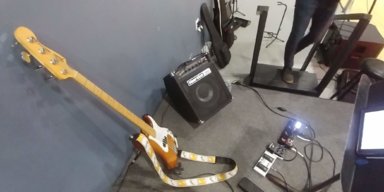
Get a camouflage strap for it, it would really go well with it ;)

got a green one. it has strings looped into the hole where you hook it into the guitar, i have no clue what it is for.
 
Oh I almost forgot, one last thing I noticed on your video, you don't seem to use the floating thumb technique for muting, although I am not sure how much you would use it for that song. A running joke for a lot of guys that use a 5'er is that B is a thumb rest similar to how you anchor your thumb on your pickup. That is essentially the floating thumb. So perhaps when you are playing songs tuned in E, try to get comfortable resting your thumb on that B, and in time learn to use it as you move on to the ADG strings.

Keep up the good work.
 
  • Like
Reactions: Passive Jay
A five string is absolutely essential if you have a gig where the same songs get played in a variety of keys week to week, or even if you just need the ballsy low notes they afford.

A five string is a waste of time and money if you don't have any practical use for the extra range.

A five isn't better than a four, it's just different.

I love a drop D on a four string, but you get the same thing on a 5 if you play where you'd find G on a four. They are both awesome, but they are different too.
 
  • Like
Reactions: Passive Jay
as I mentioned I only play tab and have no experience with any of this. So the third fret on the B would be the same as an open drop D? but what about if it is not an open note? I am guessing I am going to have to learn the different notes on the fretboard to get any use out of the 5th string
You should learn your fretboard first. Before buying a 5 string or anything for that matter. Knowing your fretboard is very important.
 
Man, this is going to come across as TAB bashing. It's not. BUT! You need lessons badly. If you don't understand the difference between a low B string or just using the 5th string as an alternate open D you need some theory lessons. You need to know the notes on the board. Leaning on TAB alone is like claiming this makes you an artist.
View attachment 2802157

I learned from tabs for so long and it's really taking me some time to overcome the bad habits that developed as a result.

That comment made me literally LOL. Such a perfect analogy.
 
This is my third attempt. How'd I do? It does look pretty good to me.

connect-the-dots-a.jpg
 
The nice thing about a 5 string is it can still be used it as a 4, so to speak, having some deeper heavier notes when playing in E with "standard" guitars. (or whatever they are dropped to) Ideally, a 5 string would be playing with a 7 string guitar band. You can drop your G string a half step and use all your standard shapes as well when playing with 7 string guitars, that way the B string is just not a single note pedaling string, if the guitars do the same. They're fun. Just my opinion. Good Luck!, Enjoy :)
 
Last edited:
  • Like
Reactions: Passive Jay
Hey PJ, you’ve got some serious bass-playing hands there, unlike my stumpy sausages...

You’ve already received a lot of good info from good players here, but I’d like to add that you might want to work on relaxing your hands a bit. I could be wrong but it looks like your plucking hand remains under high stress and unnecessary tension throughout the video. From a mechanics perspective you’ll want to watch advanced player’s hands and work on your own hand action. Takes time but will pay off in the long run. lfmn16 mentioned finding a way to get lessons and I second that notion. But at minimum think about the physical part of instrument manipulation and try to keep those fabulous fingers more relaxed. Your playing will come along and you’ll avoid long term consequences. Good luck and have fun!
 
Tune your new low string to standard B so you can
get use to it. Get a book or teacher and learn note names.
Tab is for cheaters.

I started with tabs, no doubt my playing grew in leaps and bounds when I stopped using them, but I still check them from time to time if I need to get the basics of something quickly.
 
  • Like
Reactions: Spidey2112
Please learn some music theory and how to read music, take some lessons from a qualified teacher. You won't regret it.

Thank you for saying this. I was going to say something similar.

With so may useful lessons on Youtube, etc. there is no excuse for not learning the bassics - The names of the notes, a few scales and when to use them.
 
  • Like
Reactions: Jeff Scott
Rocksmith actually teaches most of what you guys are suggesting, I am just poopy/lazy about learning it. For the most part I would try to learn what it was trying to teach me a couple times, and then say shag it and go back to "Learn a song" mode and play something. I have a very poor memory so sometimes it is hard for me to learn stuff, I have about 500 songs on rocksmith and at least 100-200 of those I can play at least ok, but I do not have a single one memorized. If you sat me down outside of rocksmith and asked me to play you something I would be at a loss, but its not rocksmiths fault, its mine.
 
Rocksmith actually teaches most of what you guys are suggesting, I am just poopy/lazy about learning it. For the most part I would try to learn what it was trying to teach me a couple times, and then say shag it and go back to "Learn a song" mode and play something. I have a very poor memory so sometimes it is hard for me to learn stuff, I have about 500 songs on rocksmith and at least 100-200 of those I can play at least ok, but I do not have a single one memorized. If you sat me down outside of rocksmith and asked me to play you something I would be at a loss, but its not rocksmiths fault, its mine.

Learning the basics - - scales and when to apply them - - actually reduces the time needed to learn tunes and the effort needed to memorize them. Tunes are not made up of random notes. Tunes are often built around a key (A, E, etc.) coupled with a scale (major, minor, etc). Once you are comfortable with those concepts and have them under your fingers, tunes will start to make more sense. You will come to understand why certain chords and notes are used (or not) and how they relate to each other in a given tune. This "whittling down" of notes will reduce learning and memorization time for you.
 
  • Like
Reactions: Spidey2112