• TalkBass has been independent since 1998. Add your voice.
    Create a free account to reply to discussions, view embedded media, and browse with fewer display ads.
    Join freeLog in
    Want zero display ads or expanded classifieds tools? Compare plans.

Getting the Facts about Ski Jumps

I really appreciate all the good information here. I have an old Fender MIM Jazz bass with a slight ski-jump issue. I do my own setups but paid a local shop to do a setup thinking they may be able to get it set up better than I can. They charged me fifty bucks. When I got it home, I found that I had to readjust it right back to the way it was when I took it to them. I wanted to talk to the actual tech to explain the problem when I dropped it off there, but that was not possible. I regret that I did not communicate better with the shop. I wasted fifty bucks.

Rather than sink more money into a bass that is not worth all that much, I decided that I will try to fix it myself with all the good advice found here.

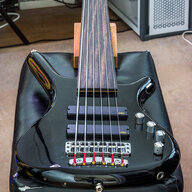
As an expedient to make the bass a little more useful for now until I get around to trying my own hand at improving the situation, I bought a new, made in China fretless neck from Ebay for $90. I did not expect a lot for that price, but the neck seems to be very well made. I may learn something about setting up a fretless as well as fixing a ski jump in the process.

Thanks to all for sharing knowledge, advice, and wisdom here!
 
I have 2 fretless (1 bolt-on and 1 neckthrough) and 2 fretted (1 bolt-on and 1 neckthrough). I discovered this wonderful thread after using the @Bruce Johnson method for flattening the fretless string paths. There was a limit to how flat they could be due to neck kink. I have used @Turnaround suggestions for saddle adjustments to compensate as best as possible.

The same works for the fretted bolt-on. All instruments are between 9 and 30 years old.

I think if I ever buy another bass, it will be at least 20 years old so that I can evaluate the neck condition. Thank you @Turnaround for starting this thread.

@djmay , you have a link for Bruce's thread about flattening the fretless string paths?
 
  • Like
Reactions: DJ Bebop
@djmay , you have a link for Bruce's thread about flattening the fretless string paths?

Post 65 starts the practical. The concepts from the beginning are enlightening .
 

Post 65 starts the practical. The concepts from the beginning are enlightening .

I appreciate you pointing out where it gets practical, but hey it's Bruce, so I will read the entire thread! Thank You! :hyper:
 
  • Like
Reactions: Bruce Johnson
Did the Pros ever reach a definitive conclusion on whether or not partial shim in a neck bucket are likely to cause a 12ft kink/ski jump?

Full disclosure: I started reading this thread from the beginning and got to page 8 of 24 before I just became completely overwhelmed.
It's amazing that you peeps are doing this stuff, but as a simple player rather than skilled luthier or engineer, it's felt a bit like attending a four hour lecture from the top scientist at Cern - I can respect the brilliance, but my ability to keep up has been vastly out stripped 😆
 
  • Like
Reactions: Rev_Slinky
Did the Pros ever reach a definitive conclusion on whether or not partial shim in a neck bucket are likely to cause a 12ft kink/ski jump?

Full disclosure: I started reading this thread from the beginning and got to page 8 of 24 before I just became completely overwhelmed.
It's amazing that you peeps are doing this stuff, but as a simple player rather than skilled luthier or engineer, it's felt a bit like attending a four hour lecture from the top scientist at Cern - I can respect the brilliance, but my ability to keep up has been vastly out stripped 😆
Shims, partial or full, play no part in a ski jump. The ski jump isn't even in the area of the shim; it is up the neck in the 12th fret area. The cause is from oversize strings and/or internal stresses the wood has built up prior to its harvest.
 
Last edited:
As sissy kathy said, a shim is not the cause of a ski jump, nor does it contribute to the formation of one. The kink is formed when the stress from the pull of the strings is more than the neck can handle. High tension strings can contribute the the deformation, but the fundamental problem is that there is not enough rigidity in the neck for the tension involved. I very stiff wood will resist kinking, but These days high quality wood that will resist the strain is getting more expensive and harder to find.. That can be countered by adding stiffening material to the neck from about the 9th fret through to the end of the heel.

It's worth noting that if you leave too much relief (bow) in the neck for an extended period, the chance of a ski jump developing becomes more likely.