

Enjoy the benefits of a premium membership!
Upgrade Account
-
TalkBass has been independent since 1998. Add your voice.
Create a free account to reply to discussions, view embedded media, and browse with fewer display ads.
Join free Log in
Want zero display ads or expanded classifieds tools? Compare plans.
You are using an out of date browser. It may not display this or other websites correctly.
You should upgrade or use an alternative browser.
You should upgrade or use an alternative browser.
Getting the Facts about Ski Jumps
- Thread starter Turnaround
- Start date
More options
Who Replied?
Ok here's the data on a '69 Fender Jazz. There's a mild kink beyond the 12 th fret with the largest deviation from flat occurring between the 13 th and 14th fret. From the fret tops the kink is measuring just over 6 thousandths. The link is actually a lot worse than that since in the past the condition was treated by filing down the upper frets to the point here there is very little fret left at the end of the board.
As Bruce found (in an earlier thread), the board was flat from the first fret to the twelfth, and flat again from the fourteenth to the end. The deviation was localized to the area between the. 12th and 14th.
As Bruce found (in an earlier thread), the board was flat from the first fret to the twelfth, and flat again from the fourteenth to the end. The deviation was localized to the area between the. 12th and 14th.


A couple of rectangular carbon fiber bars, from the 8th or 10th to say, the 15th fret would solve this.
Not a pro luthier of any sort, but I wanted to add an anecdote which may be useful. My '75 Jazz (three bolt) had a ski jump from 14th fret. Not really bad but certainly noticeable. Really low action was impossible. I had a look at the tilt adjustment and found it was tilting the neck. I undid the adjustment at the neck plate and bolted the plate down so that the neck was making full contact with the body, flush like. Three weeks later the ski jump is all but gone. I can barely see it when sighting down the neck.


The bars wod have to go past the 15th fret in order to extend the stiff point on either side of the "weak spot". 9th fret to heel sort of thing.A couple of rectangular carbon fiber bars, from the 8th or 10th to say, the 15th fret would solve this.
It might solve the 12-15 fret kink, but it could also just move the stress point further along the neck where it's even thinner and weaker, resulting in a kink at the 7th fret.
Solve one problem, create another.
Full length stiffenig rods (if to be used at all) seem the most logical to me. If they could be tapered in a similar fashion as the neck would, the same 'strength ratio' of the wood would be maintained.
I think I am going to try the 7075 bars suggested by Bruce. Even the fiber wedge suggested becomes more epoxy (ie plastic) than carbon, so an actual rod is more appealling to me. We've been buying 7075 for our bridges and tuners, so I'll see if the source can do up these stiffening rods for our OEM to put into the necks of our 5ers, that will be made in late Feb/early March.
.

anecdotal experience of a complete amateur: working with a bolt-on 4-screw neck, i believe i over-tightened the neck screws to the point where a twist in the heel was created in a manner similar to what the 6-bolt g&l bass mentioned previously suffered. two unproven beliefs regarding this anecdote: i suspect the neck and body screw holes may not have been perfectly aligned. also, loosening the screws completely and then slowly tightening them in a star pattern without making them super-tight eliminated the issue.

Not a pro luthier of any sort, but I wanted to add an anecdote which may be useful. My '75 Jazz (three bolt) had a ski jump from 14th fret. Not really bad but certainly noticeable. Really low action was impossible. I had a look at the tilt adjustment and found it was tilting the neck. I undid the adjustment at the neck plate and bolted the plate down so that the neck was making full contact with the body, flush like. Three weeks later the ski jump is all but gone. I can barely see it when sighting down the neck.
Per earlier posts and my own experience, we've found that a single end-of-pocket shim can result in some deformation of the neck heel, the severity of which may be dependent on the mounting screw configuration. I can certainly see how a tilt adjustment (when engaged) would do the same in some situations.
Riis

Here's an example of the use of vertical aluminum plates to stiffen a neck. This is one of my cartridge style truss rod assemblies, which I build for other pro Luthiers. This one is sized for a guitar neck and has heel-access adjustment with a spoke wheel head. It's basically one of my standard single-rod double-acting truss rods, but it's encased in a long tapered wedge of maple, aluminum and epoxy. The whole assembly gets fitted and glued into a wedge-shaped pocket in the neck.
You can see how the aluminum plates follow the wedge shape. They are 3/8" deep around the 1st fret, tapering to 5/8" deep at the heel. That gets the reinforcement down deep into the neck in that 12th fret zone. That area gets the maximum stiffness. Note the slots cut in the plates in the 1st fret to 5th fret zone. They make the 1st-5th zone weaker so it will be able to bend into a proper relief curve and be fine tuned with the truss rod. These plates are cut from 0.075" thick 6061 aluminum alloy.
I don't want to divert this thread into a discussion of truss rods, but I wanted to show you one of the ways that a new neck can be reinforced so that it will never develop a 12th fret kink.
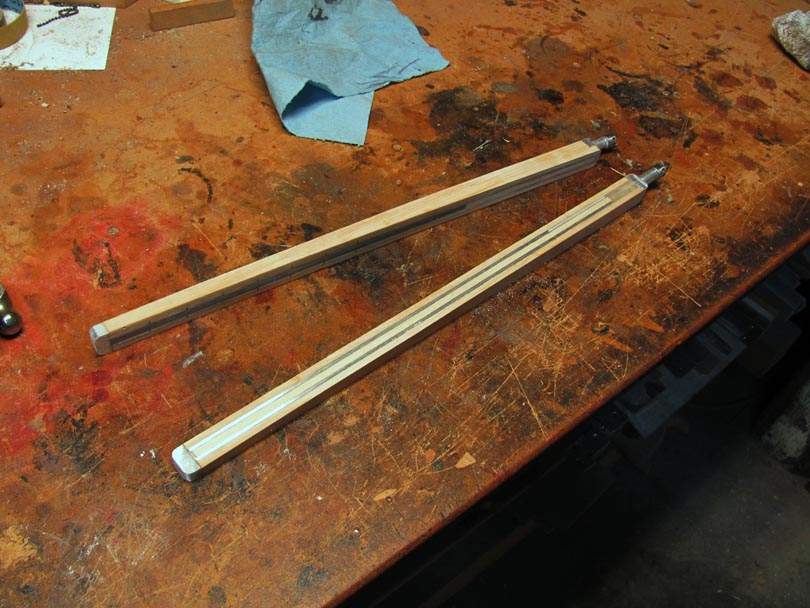
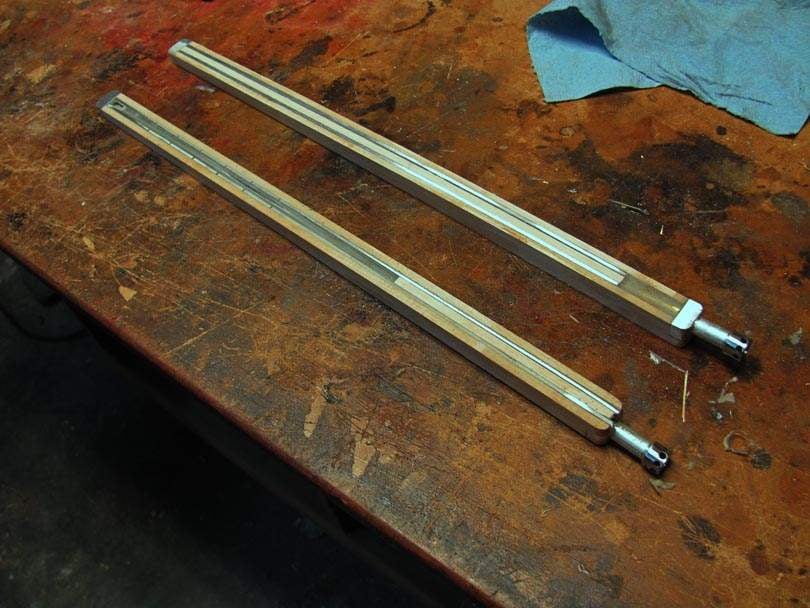
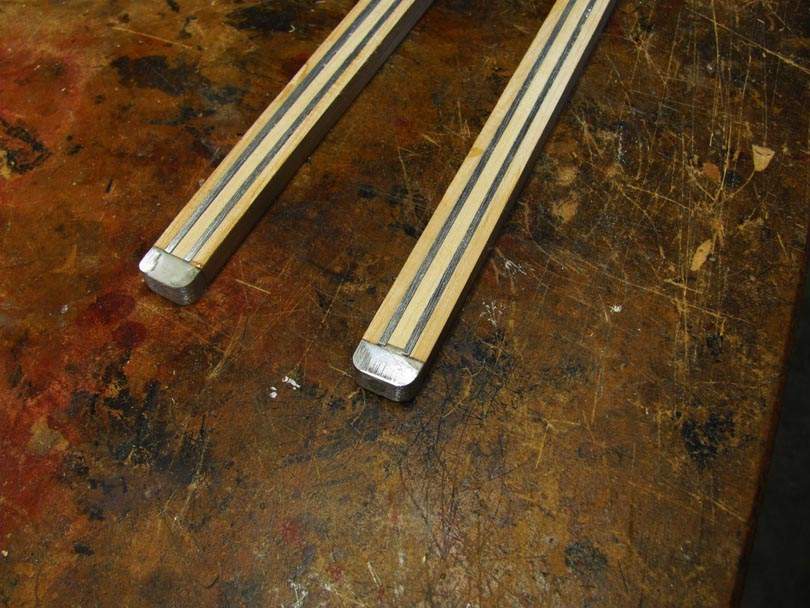
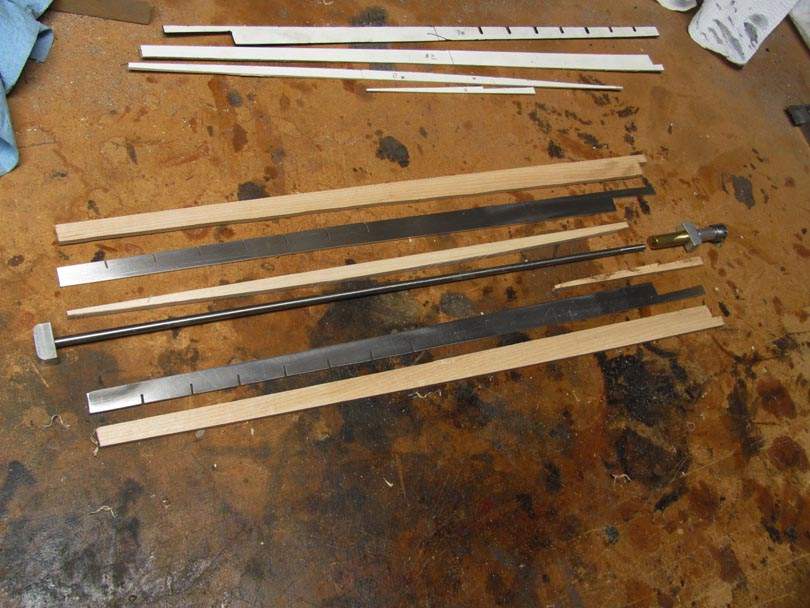
You can see how the aluminum plates follow the wedge shape. They are 3/8" deep around the 1st fret, tapering to 5/8" deep at the heel. That gets the reinforcement down deep into the neck in that 12th fret zone. That area gets the maximum stiffness. Note the slots cut in the plates in the 1st fret to 5th fret zone. They make the 1st-5th zone weaker so it will be able to bend into a proper relief curve and be fine tuned with the truss rod. These plates are cut from 0.075" thick 6061 aluminum alloy.
I don't want to divert this thread into a discussion of truss rods, but I wanted to show you one of the ways that a new neck can be reinforced so that it will never develop a 12th fret kink.
Last edited:
Nice bit of engineering, that. I'm not sure many have considered the truss rod as a means of dealing with ski jumps, since it is pretty well understood that the rod has no effect in that area. But you have designed a solution that expands on the idea of the truss rod to address the issue. Bravo.
Just to clarify, in this cartridge truss rod assembly the truss rod itself doesn't prevent the ski jump stretching. It's the two aluminum stiffener plates that do that job. I just built them into one unit.
When I do my normal truss rod installations directly into the neck, I put in the carbon fiber "back strap" to prevent the ski jump stretching. That's a small bundle of carbon fiber stranding that is set into epoxy in a groove down below the truss rod. It starts at the 5th fret and ends at the heel. I've been putting that back strap into all of my bass necks and most of my clients' necks for a long time. About 400 necks, I guess. So far, I've never had a neck with that back strap develop a ski jump.
The aluminum plates are just an alternate way to reinforce that area, while stiffening he neck overall. The point of the cartridge assembly is to make it easier for my clients to install the whole unit. My normal single-rod double-acting truss rod is fairly complicated to install.
When I do my normal truss rod installations directly into the neck, I put in the carbon fiber "back strap" to prevent the ski jump stretching. That's a small bundle of carbon fiber stranding that is set into epoxy in a groove down below the truss rod. It starts at the 5th fret and ends at the heel. I've been putting that back strap into all of my bass necks and most of my clients' necks for a long time. About 400 necks, I guess. So far, I've never had a neck with that back strap develop a ski jump.
The aluminum plates are just an alternate way to reinforce that area, while stiffening he neck overall. The point of the cartridge assembly is to make it easier for my clients to install the whole unit. My normal single-rod double-acting truss rod is fairly complicated to install.
Last edited:

question for any of you guys equipped to do a job like this. what would it cost to remove the board on an old fender neck, true the neck, then install a new rosewood board/frets. the neck is ski jumped and it starts at around the 12th fret. the neck has already been refretted and had the board in the upper register planed and is now super thin. i dont know if all of the ski jump wasnt able to be planed out at the time of the original refret or if it re-kinked, but the frets had to be leveled to compensate for the flip from the 12-20 frets and the upper register now looks like a gibson fretless wonder. even with that, the action cant be slammed to that 2 to 3/64ths on the G string type action i prefer. trying to pull the frets and planing out this flip would blow right through the fretboard.

Damn that stinks. I have an early G&L that I bought. When I got it it had a horrible ski jump in it and a twist. I took a chance and sent the neck to that guy in Texas Warpedneck.com. he was able to get most of it out and 6 months later it is still holding. It is not perfect but I didn't want to go the planing route because the neck has that beautiful dark Rosewood fingerboard and tons of figuring in the neck. Almost impossible to replace it too,so i had to try.
I'd be interested in knowing what the cost is too. Just for future reference.
I'd be interested in knowing what the cost is too. Just for future reference.

if the heat fix is holding, you should be able to then look at leveling or at worst refretting to get it back to perfect without losing too much wood. you certainly shouldn't lose any "figuring", that's not even an issue.I took a chance and sent the neck to that guy in Texas Warpedneck.com. he was able to get most of it out and 6 months later it is still holding. It is not perfect but I didn't want to go the planing route because the neck has that beautiful dark Rosewood fingerboard and tons of figuring in the neck.
so turns out im going to send my neck to erik at warpedneck.com to have him heat treat this ski jump and then refret it. we'll see how it goes
if the heat fix is holding, you should be able to then look at leveling or at worst refretting to get it back to perfect without losing too much wood. you certainly shouldn't lose any "figuring", that's not even an issue.
That is an excellent point. I am not real certain around here whom I would trust. Pretty thin on qualified luthiers here. I felt the heat fix was a crap shoot at best but it was worth taking a gamble on. I feel I got lucky that it made the neck playable again and it now takes a pretty good set up. I would like it a touch lower but it is not high by any means.
I probably mentioned this earlier in this thread, but my concern about the heat straightening is this: A Ski-Jump bend in a neck isn't usually a case of warpage. That is, it doesn't happen by itself because the board had some internal stresses that pull it crooked as it drys out. I can see how heat straightening can fix warpage; apply heat to soften the fibers, relieving the internal stress and allowing the other side to stretch and flatten it out.
But a Ski-Jump condition is different from warpage; it's caused by over-stress. The neck is too weak in that zone and when string load is applied, the wood fibers on the back of the neck are stressed right near their limit. Over some time, they permanently stretch, and the kink forms.
So yes, you can soften the wood with heat and bend it back straight again. But you aren't making it any stronger than it was. Softening the fibers and compressing them may actually make them weaker. When you apply the same string load again, what's going to stop it from continuing to stretch and kink? It's the same neck with the same load, and it did it before.
To me, repairing a neck with a Ski-Jump means not just bending or cutting it back to straight, but also adding some kind of reinforcement to make it stronger. What's the point in straightening the kink if it's still weak, and you plan on putting it back in the same load condition?
But a Ski-Jump condition is different from warpage; it's caused by over-stress. The neck is too weak in that zone and when string load is applied, the wood fibers on the back of the neck are stressed right near their limit. Over some time, they permanently stretch, and the kink forms.
So yes, you can soften the wood with heat and bend it back straight again. But you aren't making it any stronger than it was. Softening the fibers and compressing them may actually make them weaker. When you apply the same string load again, what's going to stop it from continuing to stretch and kink? It's the same neck with the same load, and it did it before.
To me, repairing a neck with a Ski-Jump means not just bending or cutting it back to straight, but also adding some kind of reinforcement to make it stronger. What's the point in straightening the kink if it's still weak, and you plan on putting it back in the same load condition?
I think you are probably correct in what you say, it is what you do! I think some sort of stiffening in the weak area would be the ultimate fix for it. How would you go about such a thing? Bore a couple of holes longitudinally in the neck from the heel and insert a stiffener of some type?
Only thing I can say is mine has held for 6 months now without any shift back. It may in the future but time will tell.
I am interested in a permanent fix as long as it does not involve planning the board or something of the sort.
Only thing I can say is mine has held for 6 months now without any shift back. It may in the future but time will tell.
I am interested in a permanent fix as long as it does not involve planning the board or something of the sort.
If it's a skunk stripe neck (like most Fenders), the reinforcement isn't that hard to do. Set up the neck in a milling machine and mill out part of the skunk stripe, from about the 6th fret to where it ends at the heel. Mill the slot only about 1/4" deep, right to the full width of the stripe, not touching the maple. Then lay in four strands of carbon fiber 6K TOW (the raw carbon fiber thread) in hard epoxy, with a fitted strip of matching wood to replace the skunk stripe. Trim and smooth the stripe to match, and touch up the finish. This puts a very strong tension strap right along the back of the neck, where it's needed.
If it's not a skunk stripe neck, the reinforcement is trickier. If the fingerboard has to be replaced anyway, I'd mill two 1/4" wide slots down from the top, on either side of the truss rod. Same length as above, from the 6th to near the heel; depth down to within 1/4" of the back. Then fill the slots with maple strips, with the epoxy and carbon fiber strands down in the bottom. As above, the carbon fiber needs to be down deep in the neck, right along the back.
If there's no skunk stripe, and the fingerboard isn't to be removed, that's harder. If the look is acceptable, I'd recommend making a partial skunk stripe. Mill the slot in the back of the neck and fill it with maple, or a contrasting wood. Same thing, carbon fiber stranding directly underneath it.
It may be possible to drill deep holes in from the heel end, but that would be difficult and risky.
If it's not a skunk stripe neck, the reinforcement is trickier. If the fingerboard has to be replaced anyway, I'd mill two 1/4" wide slots down from the top, on either side of the truss rod. Same length as above, from the 6th to near the heel; depth down to within 1/4" of the back. Then fill the slots with maple strips, with the epoxy and carbon fiber strands down in the bottom. As above, the carbon fiber needs to be down deep in the neck, right along the back.
If there's no skunk stripe, and the fingerboard isn't to be removed, that's harder. If the look is acceptable, I'd recommend making a partial skunk stripe. Mill the slot in the back of the neck and fill it with maple, or a contrasting wood. Same thing, carbon fiber stranding directly underneath it.
It may be possible to drill deep holes in from the heel end, but that would be difficult and risky.

If it's not a skunk stripe neck, the reinforcement is trickier. If the fingerboard has to be replaced anyway, I'd mill two 1/4" wide slots down from the top, on either side of the truss rod. Same length as above, from the 6th to near the heel; depth down to within 1/4" of the back. Then fill the slots with maple strips, with the epoxy and carbon fiber strands down in the bottom. As above, the carbon fiber needs to be down deep in the neck, right along the back.
What about if it's a neck-through? Same solution?


