
pretty easy to add layers to carbon fibre. you just need to introduce a carbon guy to your builder.I looked more into it and seems the problem is that if you get a graphite neck that isn't a perfect fit (and what is?) you cannot easily rework it. I've watched enough builder videos to know that you need to be able to rework necks, almost all the time, to get a perfect neck/body fit. Otherwise you are in shim territory. That is not a place I want to live.
So I'll stick with my wood necks. Maybe someday my household #D printer will be able to barf out a perfect totally composite bass for me, if I live that long. Place your bets.....

Enjoy the benefits of a premium membership!
Upgrade Account
-
TalkBass has been independent since 1998. Add your voice.
Create a free account to reply to discussions, view embedded media, and browse with fewer display ads.
Join free Log in
Want zero display ads or expanded classifieds tools? Compare plans.
You are using an out of date browser. It may not display this or other websites correctly.
You should upgrade or use an alternative browser.
You should upgrade or use an alternative browser.
Graphite Necks Being Made For Popular Basses
- Thread starter Mr Joshua
- Start date
More options
Who Replied?I know a lawyer who waz involved with the negotiation. Fender did get in touch but they decided Status weren't making enough for it to be worth the expense of following through with enforcement.IThe properly licensed Status necks were beautiful, when they were make years ago. But I wouldn't support this particular operation, or trust it with my money.

How can you tell if someone's a cyclist? Don't worry, they'll tell you!cool. i love carbon fibre (i cycle) but imho it would generate a terrible weight imbalance.
are they hollow or fully filled? mostly resin? would be curious. in thr cycling world carbon fibre is hollow for very light weight.
Jkjkjkjk
Hey it is what is is lol.How can you tell if someone's a cyclist? Don't worry, they'll tell you!
Jkjkjkjk
I would say it saves money on gas… but man bikes ain’t cheap. I shake my head at 100k trucks for the cost… then i look at my bikes and go… “oh $h!t”

Oh I feel ya, I used to race cat 5 fifteen years agoHey it is what is is lol.
I would say it saves money on gas… but man bikes ain’t cheap. I shake my head at 100k trucks for the cost… then i look at my bikes and go… “oh $h!t”
nice. but the joke IS supposed to be about Harvard grads.Oh I feel ya, I used to race cat 5 fifteen years ago

As a former bicycle mechanic, and current carbon fiber neck enthusiast, I'd like to clarify something which was brought up:
Typically, carbon fiber necks are not used for their incredible lightweight-to-strength ratio, as they are on bicycle frames, boats, race cars, etc.
They are usually built in a way that keeps them sturdy and reliable, but either tend to be somewhat thick-walled by comparison or molded over some kind of core.
Bike frames are rather thin walled for sure. I was able to cut through a few trashed ones back in the day and was always shocked at how strong the stuff was, while still being laid up thin like that.
But in necks, I'd either feel the heel or headstock thickness when screws needed to be installed and it was laid up thicker.
I've dealt with MANY of the various carbon necks over the years and not one of them was scary light. Most are either similar in weight to wood (Status for sure) or heavier (Moses or Peavey G Bass).
When I would bring my basses into the bike shop back in the day, the bike guys would ask about the weight, which is why the questions above struck a chord with me. I'd hand them the bass and they'd be like "...oh, okay" and hand it back.
Typically, carbon fiber necks are not used for their incredible lightweight-to-strength ratio, as they are on bicycle frames, boats, race cars, etc.
They are usually built in a way that keeps them sturdy and reliable, but either tend to be somewhat thick-walled by comparison or molded over some kind of core.
Bike frames are rather thin walled for sure. I was able to cut through a few trashed ones back in the day and was always shocked at how strong the stuff was, while still being laid up thin like that.
But in necks, I'd either feel the heel or headstock thickness when screws needed to be installed and it was laid up thicker.
I've dealt with MANY of the various carbon necks over the years and not one of them was scary light. Most are either similar in weight to wood (Status for sure) or heavier (Moses or Peavey G Bass).
When I would bring my basses into the bike shop back in the day, the bike guys would ask about the weight, which is why the questions above struck a chord with me. I'd hand them the bass and they'd be like "...oh, okay" and hand it back.

JazznFunk
Supporting Member
Yep, and as a former bicycle mechanic and racer as well from the late 90s, there was a reason why Cannondale was nicknamed 'Crack-N-Fail' in the early years of their frames. When done incorrectly, carbon fiber can be a liability. People also thought it was indestructible, but when you nerf it over a rock and break into the weave, you're done. I also remember the earliest generation of SPIN carbon fiber wheels. Looked cool... not light at all though. Spinergy started to get things right.As a former bicycle mechanic, and current carbon fiber neck enthusiast, I'd like to clarify something which was brought up:
Typically, carbon fiber necks are not used for their incredible lightweight-to-strength ratio, as they are on bicycle frames, boats, race cars, etc.
They are usually built in a way that keeps them sturdy and reliable, but either tend to be somewhat thick-walled by comparison or molded over some kind of core.
Bike frames are rather thin walled for sure. I was able to cut through a few trashed ones back in the day and was always shocked at how strong the stuff was, while still being laid up thin like that.
But in necks, I'd either feel the heel or headstock thickness when screws needed to be installed and it was laid up thicker.
I've dealt with MANY of the various carbon necks over the years and not one of them was scary light. Most are either similar in weight to wood (Status for sure) or heavier (Moses or Peavey G Bass).
When I would bring my basses into the bike shop back in the day, the bike guys would ask about the weight, which is why the questions above struck a chord with me. I'd hand them the bass and they'd be like "...oh, okay" and hand it back.
I wonder why this is? I would think you could make a carbon bass neck stiff and light?As a former bicycle mechanic, and current carbon fiber neck enthusiast, I'd like to clarify something which was brought up:
Typically, carbon fiber necks are not used for their incredible lightweight-to-strength ratio, as they are on bicycle frames, boats, race cars, etc.
They are usually built in a way that keeps them sturdy and reliable, but either tend to be somewhat thick-walled by comparison or molded over some kind of core.
Bike frames are rather thin walled for sure. I was able to cut through a few trashed ones back in the day and was always shocked at how strong the stuff was, while still being laid up thin like that.
But in necks, I'd either feel the heel or headstock thickness when screws needed to be installed and it was laid up thicker.
I've dealt with MANY of the various carbon necks over the years and not one of them was scary light. Most are either similar in weight to wood (Status for sure) or heavier (Moses or Peavey G Bass).
When I would bring my basses into the bike shop back in the day, the bike guys would ask about the weight, which is why the questions above struck a chord with me. I'd hand them the bass and they'd be like "...oh, okay" and hand it back.
Yeah, I mean, there are some fully hollow and crazy light carbon instruments out there (BassLab, Status Stealth II), but my guess is, they started making the necks for structural rigidity purposes, not so much weight reduction.
PERSONALLY, I'm fine with the weight of most of the necks, if that is what is keeping them solid and reliable. If thinner walls meant more fickle weather adjustments or more worry of pulling it out of tune when really digging into it, then I would be against it completely.
But if they were just as strong and half the weight, I would be okay with that.
I'd have to at least assume it's the need for them to be under constant tension that requires a thicker "spine", if you will. A bicycle doesn't really rest under a huge amount of pressure. It's designed to be strong when ridden (while still retaining a supple and responsive feel, in most cases), but isn't under pulling pressure in any way near a bass neck would be, when it sits idle.
PERSONALLY, I'm fine with the weight of most of the necks, if that is what is keeping them solid and reliable. If thinner walls meant more fickle weather adjustments or more worry of pulling it out of tune when really digging into it, then I would be against it completely.
But if they were just as strong and half the weight, I would be okay with that.
I'd have to at least assume it's the need for them to be under constant tension that requires a thicker "spine", if you will. A bicycle doesn't really rest under a huge amount of pressure. It's designed to be strong when ridden (while still retaining a supple and responsive feel, in most cases), but isn't under pulling pressure in any way near a bass neck would be, when it sits idle.
I've had graphite necks by Moses, Status, Peavey - and also full composite instruments by Miller, Status, and Basslab... and for me the whole point is the tuning stability. Once the strings have stretched, they stay in tune for weeks or months regardless of the weather. Light weight is a bonus, though I'm fine with any bass under 7.5 pounds. BassLab has been the clear winner for me, with perfect super low action ("on the other other side of the frets", as JAE would say...)
I don't think they are solid. If we assume there is 50% carbon fibers and 50% resin in the mix with densities about 1.8 and 1.2 respectively, that would give more than double the weight of a maple neck which is about 0.7 g/cm^3 dense.cool. i love carbon fibre (i cycle) but imho it would generate a terrible weight imbalance.
are they hollow or fully filled? mostly resin? would be curious. in thr cycling world carbon fibre is hollow for very light weight.
you would get this… there is a weight weenie bass movement also.As a former bicycle mechanic, and current carbon fiber neck enthusiast, I'd like to clarify something which was brought up:
Typically, carbon fiber necks are not used for their incredible lightweight-to-strength ratio, as they are on bicycle frames, boats, race cars, etc.
They are usually built in a way that keeps them sturdy and reliable, but either tend to be somewhat thick-walled by comparison or molded over some kind of core.
Bike frames are rather thin walled for sure. I was able to cut through a few trashed ones back in the day and was always shocked at how strong the stuff was, while still being laid up thin like that.
But in necks, I'd either feel the heel or headstock thickness when screws needed to be installed and it was laid up thicker.
I've dealt with MANY of the various carbon necks over the years and not one of them was scary light. Most are either similar in weight to wood (Status for sure) or heavier (Moses or Peavey G Bass).
When I would bring my basses into the bike shop back in the day, the bike guys would ask about the weight, which is why the questions above struck a chord with me. I'd hand them the bass and they'd be like "...oh, okay" and hand it back.

carbon came a long way though. early days people had no clue. then they went too stiff. then they went aero but… i digress. wrong forum. carry on.Yep, and as a former bicycle mechanic and racer as well from the late 90s, there was a reason why Cannondale was nicknamed 'Crack-N-Fail' in the early years of their frames. When done incorrectly, carbon fiber can be a liability. People also thought it was indestructible, but when you nerf it over a rock and break into the weave, you're done. I also remember the earliest generation of SPIN carbon fiber wheels. Looked cool... not light at all though. Spinergy started to get things right.
(i have a factor 02 vam and it is incredible).
i am no pro. but carbon fibre has many variations each with desirable or less desirable properties. think cheap(er) heavier, more flexible… vs light, expensive, more brittle high modulus carbon fibre.I wonder why this is? I would think you could make a carbon bass neck stiff and light?
the cheapest temu china garbage can be newspaper and fiberglass style filler finished with a cosmetic carbon outer layer.
the best stuff is a mix of high and low modulus carbon fibre to give the physical performance properties intended by the engineer. it is not as simple as low modulus bad, hi modulus good.
i know little about bass neck engineering but i can imagine that you want a layup of carbon that will resist twisting, yet have some flex in one plane for the truss rod to do its job. but the flex needs to be uniform to prevent hockey sticking.
the headstock will need to resist any flex, yet be a thickness at the right locations to tolerate drilling and mounting screws. that is tuners and string tree retainer. resin needs to tolerate drilling/screws without cracking… so it cant be too brittle.
i am guessing the body is a single mould/piece and the headstock is separate and they are bonded together.
guessing the body is hollow, headstock solid.
they could likely make it super light but a hollow headstock would be a complex layup/vacuum bag setup i am guessing ($$$). they need sufficient material for screws, and one would hate to use a non standard tuner and oops you drilled into thinner resin not intended for a screw hole.
plus ideally they would be equal weight to wood as to not throw off a bass balance. too light would be a mess.
Last edited:
A bicycle doesn't really rest under a huge amount of pressure. It's designed to be strong when ridden (while still retaining a supple and responsive feel, in most cases), but isn't under pulling pressure in any way near a bass neck would be, when it sits idle.
certain parts of a bike rest under a lot of strain for hours on end when ridden. think 120kg riders on carbon saddle rails.
but i have no idea of the forces relative to loaded up bass strings. curious. but looking at f1… carbon fibre is up to the task even at very low weights. just depends on how much you want to spend/engineer.

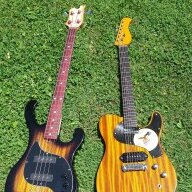
my P, my ATK, and my aluminum-necked T-40
Wait, what?!?! A Peavey T-40? With an aluminum neck?!?! U gots to tell us more!!! Pics please.
are they hollow or fully filled? mostly resin? would be curious. in thr cycling world carbon fibre is hollow for very light weight.
Not sure how Moses or Status or Klos or these NKOTB do it, but fwiw Modulus Graphite used to make their carbon fiber necks fully hollow. At some point they started adding reinforcing members that basically divide up that long hollow space into several smaller hollow spaces.
And Steinberger (the original company, not the current NS Design company) made the necks solid if I'm not mistaken.
man bikes ain’t cheap. I shake my head at 100k trucks for the cost… then i look at my bikes and go… “oh $h!t”
LOL. We can hang.


Wait, what?!?! A Peavey T-40? With an aluminum neck?!?! U gots to tell us more!!! Pics please.

Aluminum Peavey T-40 Style Replacement Bass Neck w/ 9.5" Fretboard Rad
6061 Aircraft grade Billet Aluminum bolt on neck Modern C shape profile (.770" at the 1st fret .830 at the 12th fret) 1.687" Nut Width 9.5" Fretboard Radius 34" scale 20 Stainless Steel Frets Brass Nut Side Dots CNC fret level and dress Screws Included
 www.hoxeyguitars.com

new best bass for METAL?Aluminum Peavey T-40 Style Replacement Bass Neck w/ 9.5" Fretboard Rad
6061 Aircraft grade Billet Aluminum bolt on neck Modern C shape profile (.770" at the 1st fret .830 at the 12th fret) 1.687" Nut Width 9.5" Fretboard Radius 34" scale 20 Stainless Steel Frets Brass Nut Side Dots CNC fret level and dress Screws Included
I've been so close to pulling the trigger on a reasonable t-40 and these necks for so long. By the time I get the options on the neck I like it's $1,150 plus the cost of the t-40 and it's just a hard sell at that point. Yes it would be awesome. But a t-40 at what would end up being $2000 or more? crazy.new best bass for METAL?


