
Enjoy the benefits of a premium membership!
Upgrade Account
-
TalkBass has been independent since 1998. Add your voice.
Create a free account to reply to discussions, view embedded media, and browse with fewer display ads.
Join free Log in
Want zero display ads or expanded classifieds tools? Compare plans.
You are using an out of date browser. It may not display this or other websites correctly.
You should upgrade or use an alternative browser.
You should upgrade or use an alternative browser.
Great bass tone... where to start??
- Thread starter Thumpa Bassie
- Start date
More options
Who Replied?


It starts in your head - what do you consider a good tone? Also remember it has to serve a purpose, that is, fit the music and situation (e.g. solo vs band).
Next are your fingers - the most prudent investment in improvement
Then strings - I find it that they can totally change the character of the tone. Two key factors imo are design (flats, roundwounds) and material (nickel, stainless steel). A very cost-effective way to change the sound.
The instrument - it has to be built well to allow for a proper setup. Action can be high or low, same with pickup height. This is important for different techniques, but some claim it affects the tone by itself. Also, there is the pickup type and location. This is a matter of flexibility and preference, but can work with other factors in various ways. Imo, too many options can be tempting to a novice player to play with the knobs instead of playing the music. The same goes for active electronics, and how they're designed (cut/boost vs filters like Wal and Alembic).
Amp/cabs and EQ - what I want from mine is to reproduce the sounds I put in, with little coloration. Or with good coloration. I think the essential frequencies for a good bass tone are the mids (assuming the basses are there). I don't really care for the highs, but some do.
I have not found the rest essential for my tone. Wood, cables, etc... I don't hear differences.
Next are your fingers - the most prudent investment in improvement
Then strings - I find it that they can totally change the character of the tone. Two key factors imo are design (flats, roundwounds) and material (nickel, stainless steel). A very cost-effective way to change the sound.
The instrument - it has to be built well to allow for a proper setup. Action can be high or low, same with pickup height. This is important for different techniques, but some claim it affects the tone by itself. Also, there is the pickup type and location. This is a matter of flexibility and preference, but can work with other factors in various ways. Imo, too many options can be tempting to a novice player to play with the knobs instead of playing the music. The same goes for active electronics, and how they're designed (cut/boost vs filters like Wal and Alembic).
Amp/cabs and EQ - what I want from mine is to reproduce the sounds I put in, with little coloration. Or with good coloration. I think the essential frequencies for a good bass tone are the mids (assuming the basses are there). I don't really care for the highs, but some do.
I have not found the rest essential for my tone. Wood, cables, etc... I don't hear differences.


I agree with the "get the best you can afford" comments.
But more so, I agree with the "practice unplugged" comments. Around 2000 I got an Epiphone El Capitain and spent months practicing with a genuinely acoustic instrument and this really focused my emphasis on making the notes sound right (consistent, no noise, appropriately muted). This is the most important advice anyone can get - everything after your fingers is only filtering the sound you've made. I'm a bit of a gear snob (my main basses are still my American ones) but I've been shown up by a guy playing a cheesy 60s MIJ thingy (the really crappy ones from before they started sending the good stuff over here) and many times have been the best sounding guy in the room with my Epiphone viola or my Chinese Danelectro and a Yorkville amp while the other guys are playing Ernie Balls and Rickenbackers through top of the line MarkBass and SWR rigs.
I will also say a good compressor set up right will make a HUGE difference.
Oh and the "EQ - less is more" rule is good - I tend to use the gain on my amps and the contour (on the ones that have it) and leave the EQ alone unless there's a problem with the room. And as a rule with gain, more is more, unless its too much in which case less is more again.
But more so, I agree with the "practice unplugged" comments. Around 2000 I got an Epiphone El Capitain and spent months practicing with a genuinely acoustic instrument and this really focused my emphasis on making the notes sound right (consistent, no noise, appropriately muted). This is the most important advice anyone can get - everything after your fingers is only filtering the sound you've made. I'm a bit of a gear snob (my main basses are still my American ones) but I've been shown up by a guy playing a cheesy 60s MIJ thingy (the really crappy ones from before they started sending the good stuff over here) and many times have been the best sounding guy in the room with my Epiphone viola or my Chinese Danelectro and a Yorkville amp while the other guys are playing Ernie Balls and Rickenbackers through top of the line MarkBass and SWR rigs.
I will also say a good compressor set up right will make a HUGE difference.
Oh and the "EQ - less is more" rule is good - I tend to use the gain on my amps and the contour (on the ones that have it) and leave the EQ alone unless there's a problem with the room. And as a rule with gain, more is more, unless its too much in which case less is more again.

For me the key was getting a tone I liked without any effects and then layering effects over that. I don't think I used an effect (other than a compressor) in a gig setting for probably the first 5 years that I gigged.
Learning natural dynamics was hugely important. And I have an inherent problem that I was a converted guitarist so I had to learn finger style from scratch. That took lots and lots of patience.
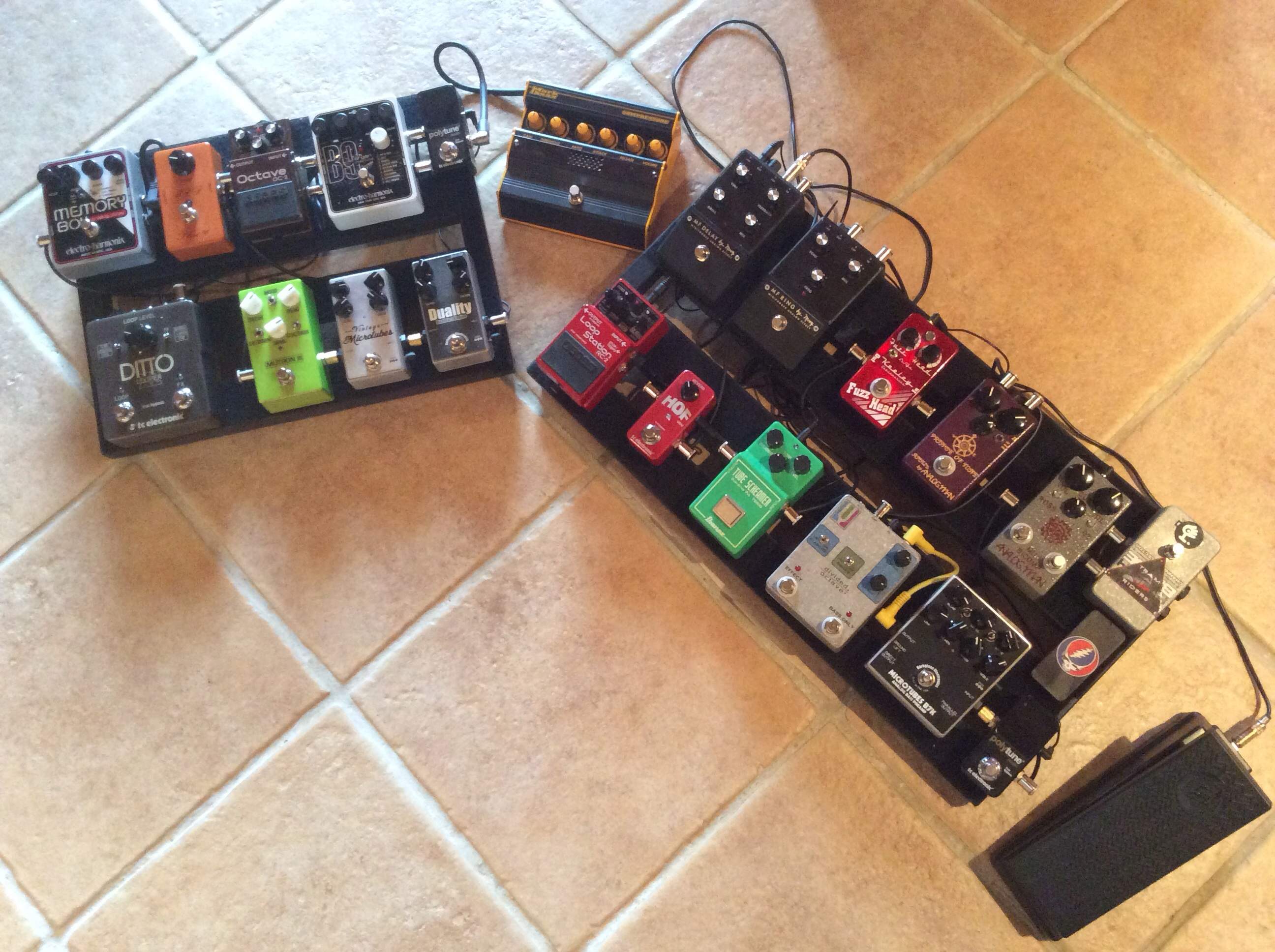
Now my boards look like this:
Learning natural dynamics was hugely important. And I have an inherent problem that I was a converted guitarist so I had to learn finger style from scratch. That took lots and lots of patience.
Now my boards look like this:

father of fires
Commercial User
A little hair to smooth out your playing and scooping the mids to round out your tone. Don't knock it till you try it.

As much I love nice basses I've found that a just "ok" bass with a good setup through a good amp with good technique will sound very good. The hierarchy of importance when you first start is this: technique> amp> bass> other stuff. Once you get the basics of good tone down you can start hunting for the "secret sauce" to your tone whether that be a specific pedal(s), a Wal bass, gold plated strings, whatever!
As much I love nice basses I've found that a just "ok" bass with a good setup through a good amp with good technique will sound very good. The hierarchy of importance when you first start is this: technique> amp> bass> other stuff. Once you get the basics of good tone down you can start hunting for the "secret sauce" to your tone whether that be a specific pedal(s), a Wal bass, gold plated strings, whatever!
Totally agree. Amp > bass when it comes to getting good tone.
Do you mean EQ or compression (smooth out sounds like comp, scooping sounds like EQ)? Either way, totally agree, as long as it's a hair. If you need to radically EQ you need: A new bass OR a new amp OR some technique.A little hair to smooth out your playing and scooping the mids to round out your tone. Don't knock it till you try it.
The more of either you use, the less of you and your bass you will hear.
I agree in that you can get a good bass a lot easier and cheaper than a good enough amp and so your investment will probably be weighted heavily in that direction. However, in reality the best amp in the world isn't gonna save a bad bass. And no a good bass isn't going to save a bad amp - but you can go into the house if you have a competent sound guy.Totally agree. Amp > bass when it comes to getting good tone.
Also, think of where the sound comes from, strings, fingers, bass then amp, then speaker, etc, etc. The closer you are to the source of sound the more a good one or bad one will influence what's at the end. No piece of equipment can "fix" a bad signal that has come into it, but even good equipment utilized badly can wreck it.
My 2 cents...
Nothing replaces hard work and practice. No getting around that.
You will never get something for nothing. Budget gear= budget sound.
Most basses sound more similar than different, but I have found that many amps that look nearly identical sound wildly different. Go figure.
When looking for a bass, focus on how it PLAYS. Sound can be tweaked, playability usually not so much.
When looking at an amp, remember that not all 2x10s / 2x15's / etc are the same. You get what you pay for - and this REALLY matters with cabs. I've found that with amps, it's not quite so true - I can make a cheaper head sound good with good cabs - but I can make a great head sound like caca with cheap cabs.
Nothing replaces hard work and practice. No getting around that.
You will never get something for nothing. Budget gear= budget sound.
Most basses sound more similar than different, but I have found that many amps that look nearly identical sound wildly different. Go figure.
When looking for a bass, focus on how it PLAYS. Sound can be tweaked, playability usually not so much.
When looking at an amp, remember that not all 2x10s / 2x15's / etc are the same. You get what you pay for - and this REALLY matters with cabs. I've found that with amps, it's not quite so true - I can make a cheaper head sound good with good cabs - but I can make a great head sound like caca with cheap cabs.
father of fires
Commercial User
Do you mean EQ or compression (smooth out sounds like comp, scooping sounds like EQ)? Either way, totally agree, as long as it's a hair. If you need to radically EQ you need: A new bass OR a new amp OR some technique.
The more of either you use, the less of you and your bass you will hear.
I meant a little bit of overdrive. Sort of like a quick and dirty compression and then massaging the mids. It doesn't have to be extreme. There's a reason old Fenders and Ampegs are THE go to bass tone for 90% of music out there. It's because they compressed and scooped.
I answered the question from an effects angle since we're in the effects forum.

It doesn't have to be extreme. There's a reason old Fenders and Ampegs are THE go to bass tone for 90% of music out there. It's because they compressed and scooped.
I answered the question from an effects angle since we're in the effects forum.[/QUOTE]
Okay, didn't get that.
Totally agreed with the idea of overdrive and have been contemplating doing that full tie myself, however, so far I've been able to get enough hair (as you call it) with the gain control on my amps - my favourites being the aforementioned Bassmans, Ampegs and SWRs which are modelled on a bassman in terms of gain and tone stack.
My other fear - 'cause I'm cheap and lazy - is a lot of pedals reduce bass to avoid getting muddy at higher levels on guitar.
I answered the question from an effects angle since we're in the effects forum.[/QUOTE]
I meant a little bit of overdrive. Sort of like a quick and dirty compression and then massaging the mids. It doesn't have to be extreme. There's a reason old Fenders and Ampegs are THE go to bass tone for 90% of music out there. It's because they compressed and scooped.
I answered the question from an effects angle since we're in the effects forum.
Okay, didn't get that.
Totally agreed with the idea of overdrive and have been contemplating doing that full tie myself, however, so far I've been able to get enough hair (as you call it) with the gain control on my amps - my favourites being the aforementioned Bassmans, Ampegs and SWRs which are modelled on a bassman in terms of gain and tone stack.
My other fear - 'cause I'm cheap and lazy - is a lot of pedals reduce bass to avoid getting muddy at higher levels on guitar.
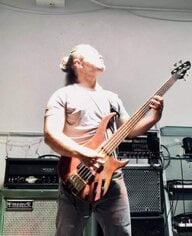
No secrets... fingers, ears, years.
A great practice (when possible and if you have a long cable) is to stand in front of the stage when sound checking. There is really no other way to know how you really sound in the mix. Over time the knowledge will kind of accumulate and you'll know more naturally how to dial in. Dialing in for the mix is really important to me, maybe that's a secret.
A great practice (when possible and if you have a long cable) is to stand in front of the stage when sound checking. There is really no other way to know how you really sound in the mix. Over time the knowledge will kind of accumulate and you'll know more naturally how to dial in. Dialing in for the mix is really important to me, maybe that's a secret.
Good bass, good strings, good setup, good amp, and a good pedalboard.
Learn to set up your bass. Experiment with different set ups. Strings, nut cut, neck relief, action, pickup height. All these things affect your playing style and sound. When you find "your" favorite setup, you will be more inspired to practice, and everything that you choose to add to your signal chain down the line, will be building on your best source, not fighting a diminished version of your instrument.
When it comes time to employ some signal processing, ask yourself what you want to achieve. Do you want to piss off your neighbors? (Ohnoho Blown Up, 80db of boost on tap) Frighten your dog? (Subdecay Noisebox) Nail those Cure songs for your audition? (Smoothie compressor>Zoom MS60b Bass chorus into Bass Detune) Etc,… etc……….
Have fun, and stop worrying about retaining dollars, just spend away…….

It's a rabbit hole for sure... but playing around with drive/distortion stacking will help you find some tones to like.
For instance, no matter how much I like a distortion or drive on its own, everything seems to sound awesome pushed into a B3K.
Just another flavor.
For instance, no matter how much I like a distortion or drive on its own, everything seems to sound awesome pushed into a B3K.
Just another flavor.
starts from owning a gretsch bass guitar.
but really, bass guitar and strings.
i love a gretsch g5123b. the look, color, and tone. it gets me notice. i'm learning to play with it's strengths.
i have half round addario string, they sound great new, they're alright now. i may switch to round wounds or ghs pressure strings. i don't like flats, but that have their place, just not in my rig.
to me, it's whatever is you or what you like to play ot here. my band has no rules on our equipment. whatever you have you play. you don't have to have a solid bass, 5 string, no effect or only use curtain effects.
i use effects made for bass and that don't effects the lowend. it's kinda boring, but hey my original tone goes through and i don't sound like a guitar.
also, it is in the fingers. it's not just bone and muscle make up the tone, it's also how to play. where you strum, if you slap, how hard you press, and how hard you hit. it doesn't matter what you hit as long as you mean it. bring your feelings into your hand and get into the groove.
but really, bass guitar and strings.
i love a gretsch g5123b. the look, color, and tone. it gets me notice. i'm learning to play with it's strengths.
i have half round addario string, they sound great new, they're alright now. i may switch to round wounds or ghs pressure strings. i don't like flats, but that have their place, just not in my rig.
to me, it's whatever is you or what you like to play ot here. my band has no rules on our equipment. whatever you have you play. you don't have to have a solid bass, 5 string, no effect or only use curtain effects.
i use effects made for bass and that don't effects the lowend. it's kinda boring, but hey my original tone goes through and i don't sound like a guitar.
also, it is in the fingers. it's not just bone and muscle make up the tone, it's also how to play. where you strum, if you slap, how hard you press, and how hard you hit. it doesn't matter what you hit as long as you mean it. bring your feelings into your hand and get into the groove.
Last edited:

totally dependent on what you consider "great tone". Which tone/tones do you like and want to incorporate or emulate? If you want some or all of those tones, use and do what the players who had those tones use and do. Or create your own tone.


