• TalkBass has been independent since 1998. Add your voice.
    Create a free account to reply to discussions, view embedded media, and browse with fewer display ads.
    Join freeLog in
    Want zero display ads or expanded classifieds tools? Compare plans.

Double Bass Grofiller Bass project

You have to be careful when you talk about Poplar. The stuff that is sometimes called Yellow Poplar is also called Tulip Poplar or the American Tulip tree (Liriodendron tulipifera) and is not even in the true Poplar family. The characteristics of this wood is quite different than the wood that comes from the true Poplar tree.
I am well aware of this, Bob. However in America, the wood referred to as poplar is almost always Liriodendron tulipifera. This is actually a magnolia species and unrelated to poplars altogether. Who knows why they call it poplar. American poplars are aspen and cottonwood, which are referred to as aspen and cottonwood. If European poplar is referred to it is called European poplar, Lombardy polar, Italian poplar, black poplar or white poplar.

Since George Boron is an American, there is no confusion about what he refers to. Nor is there any confusion about the density of the wood from the Tulip tree. I have never heard of European poplar being used for blocks;- linings only.
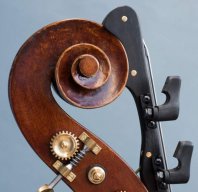
 
I believe that the original Tail block in my Prescott was Poplar (don't know what kind). It needed to be replaced during the restoration that Arnold did. He replaced it with a Willow block. The Prescott was a fairly heavy Bass. It was about 30lbs or so as I recall. I think that may be why it had a Poplar block to begin with an not Pine like the corner blocks and cross bars were. They were all original as well.
 
I have a poplar block cut out, but it doesn't seem to resonate when I (gently) rap it; seams dead. Other woods have a nice sounding ping (cedar, spruce, etc.) when hit. In my imagination..... the heavy poplar block might muffle, or cancel some of the neck vibrations and make a less responsive instrument. I have been searching the lumber yards for a substitute, Cedar or maybe Alder? seems light, strong, and very resonate.
Hope to get over this "stumbling block" soon.
 
ctregan, I certainly don't have the weight of decades of experience, and I haven't googled this up, but here's what I've been THINKing about the neck block. You want a wood that is strong and stable, straight grain and glues well. I don't know whether resonance or weight is essential. I don't think a muting effect will be significant, and if it is there it is not necessarily a bad thing unless its sheer volume you are after. If you think about it, the more the neck vibrates, the less the string will vibrate because the neck absorbs some of that energy, and the less sound will be transmit to the soundboard.

Go to one extreme - imagine a rubber neck - how would the string vibrate? flub. Now imagine a soft wood neck. string will vibrate more. A stiff hardwood neck - even more. a metal neck - the string will sustain for hours. But sheer sustain isn't everything. Will probably be a very bright sound, too. Will probably be over-resonant and screechy under the bow. But ... that's just my thinking. There are SO many variables. I don't know poplar. It seems to work on some instruments. If its strong and stable it'll probably do for your bass. If the sound ends up yoo dark, try a lighter tailpiece. and if its too bright (like mine has a bit of a tendency to be when bowed) you can try (as i did) a heavier tailpiece and shorter tailgut to "mute" the vibration a bit.

BTW if anyone with suitable experience disagrees (or agrees!) with my thinks, and cares to help get this thread back on track, I'd welcome the discussion.
 
ctregan, I certainly don't have the weight of decades of experience, and I haven't googled this up, but here's what I've been THINKing about the neck block. You want a wood that is strong and stable, straight grain and glues well. I don't know whether resonance or weight is essential. I don't think a muting effect will be significant, and if it is there it is not necessarily a bad thing unless its sheer volume you are after. If you think about it, the more the neck vibrates, the less the string will vibrate because the neck absorbs some of that energy, and the less sound will be transmit to the soundboard.

Go to one extreme - imagine a rubber neck - how would the string vibrate? flub. Now imagine a soft wood neck. string will vibrate more. A stiff hardwood neck - even more. a metal neck - the string will sustain for hours. But sheer sustain isn't everything. Will probably be a very bright sound, too. Will probably be over-resonant and screechy under the bow. But ... that's just my thinking. There are SO many variables. I don't know poplar. It seems to work on some instruments. If its strong and stable it'll probably do for your bass. If the sound ends up yoo dark, try a lighter tailpiece. and if its too bright (like mine has a bit of a tendency to be when bowed) you can try (as i did) a heavier tailpiece and shorter tailgut to "mute" the vibration a bit.

BTW if anyone with suitable experience disagrees (or agrees!) with my thinks, and cares to help get this thread back on track, I'd welcome the discussion.

All this makes sense to me. I've been preaching the benefits of a stiff neck for years. On the subject of tailblocks, I personally prefer the piece to have some wavy grain or other imperfection, because then it is less likely to split.
 
All this makes sense to me. I've been preaching the benefits of a stiff neck for years. On the subject of tailblocks, I personally prefer the piece to have some wavy grain or other imperfection, because then it is less likely to split.

Thanks for that. I figure the block is an extension of the neck anyway. Your comment re: wavy grain for tail blocks is food for more thinks. I am trying a built-up tail block for the bass I am building now, to avoid splits and because I didn't have a big enough single piece of wood to use. I made the block from five planks glued so that the grain runs in different diagonal directions in each. the middle strip is the densest wood. If it fails in the first few years or so I will call that a failure. If it lasts longer than ten years or so I'll be happy.

And no, Ken, I wouldn't do this on someone else's bass.
 
FWIW, Whenever there is a discussion like this (and they are quite common of late) I will trust someone like Arnold or Bob who has dedicated an entire life to building and repairing stringed instruments OF THE VIOLIN FAMILY over anyone else, everytime. Repairing guitars or basses , or building furniture is not the same. Heck, even I can do that!
If on occasion I opine regarding any aspect of DB setup or repair, it is with the caveat that my experience is limited and certainly worth the $.02 or less someone pays for it.

Certainly anyone reading any of these posts should exercise due diligence in checking the experience level of anyone giving advice. Anyone giving advice should remember that it isn't child's play either.
 
This bass is being built with a 15 year old, most of my questions and methods are geared to that level. So far we have learned not all basses come from the bass factory, and building one can be extremely complicated evan though it looks fairly simple.
FYI....I do not get my information by simply doing a search on Google, sometimes I use Yahoo.
Hope to have some new progress photos this weekend....
 
I think this has indeed gone waaaay over the top. It's far beyond being about basses or even the facts of the thread topic. Clearly we're now into the area of conflicting personalities, bruised egos and churlish unwillingness to get along and move the darned ball.

Seeing as though I've been a bit of a participant in this thread content-wise, I'm not going to do any moderation right now, other than to urge everyone to calm down. Nobody is going to "win" this thing, nobody's going to back down from any position and I guarantee you it will end unpleasantly. Why not stop now before we wind up closing the thread? When we get into threats of legal action, we're beyond kittens.

Just stop. It's simple.
 
This bass is being built with a 15 year old, most of my questions and methods are geared to that level. So far we have learned not all basses come from the bass factory, and building one can be extremely complicated evan though it looks fairly simple.
FYI....I do not get my information by simply doing a search on Google, sometimes I use Yahoo.
Hope to have some new progress photos this weekend....

The original topic here. ;)
I'd like to see this thread continue.
 
Okay, after about 30 angry PMs and a lot of hoo-hah in the middle of a busy day, I had a chance to confer with Damon about what should happen in this thread. We agreed that it should be cleaned of the argumentative stuff and that the stuff that is basically on topic should stay. We were waiting for Jeremy to chime in, but since he's got a newborn in the house, we thought we'd spare him. Sooo...here's the thread with edits. It's probably not perfect, but all of the deletes are of the "soft" variety, so Paul can lookinto what was done later if anybody's still terribly unhappy with the result. I didn't spend a lot of time on the edits, and I hope it doesn't come to that, since life is busy.

If members want to insult or argue with each other, please take it to PM or email and leave the thread on topic. If anyone has problems with the way the thread was edited, my PM box is always open...just be patient, as there's a lot going on in life these days, and it might take a while to get things settled.

Take a cue from the king, folks...

Invalid Link Removed
 
I use a cheap heat gun, from Harbor Freight (<$10)...you get a lot more heat, a lot more quickly--you just have to be careful not to scorch.

Heat the wood first, all clamps ready at hand; then brush the glue on liberally, and somewhat runny--not too thick. Clamp the rib in place...you should have LIQUID glue oozing out around the joint-- not gel. Sizing the blocks ahead of time with hide glue helps, as Matthew said.

Incidentally, not all hide glue smells bad...some has a fresh pleasant smell, almost like bread, or similar.... Or is junior just being oversensitive?