• TalkBass has been independent since 1998. Add your voice.
    Create a free account to reply to discussions, view embedded media, and browse with fewer display ads.
    Join freeLog in
    Want zero display ads or expanded classifieds tools? Compare plans.

Grounding a headless bass

sgl

Sep 18, 2011
249
809
Hey everyone, not sure if it's a stupid question - I'm planning on making a body to a headless neck I have. I want to use the Riviera bridge system for it since I really like the looks of it. How do I ground the pickup though? Is it enough to wire the electronics to one of the saddles? Does it matter if the saddles touch each other, and does it matter if the headpiece (ABM) is conductive?

Thanks, appreciate the help

 
Not a luthier (maybe I should avoid visiting their corner?), but from what I have seen....

If things stay separate (bridge pieces not connected together), run grounds to each individual saddle (similar to how Ibanez does on their Monorail bridges: https://www.talkbass.com/threads/routed-bridge-footprint-affect-on-tone.992829/).

If the headpiece is conductive across all strings (instead of individual headpieces for each string), you should be able to get away with a single ground even if the bridge pieces are separate. This method runs strings to ground through headpiece to the bridge piece that has a ground wire. I have read this is basically how Strandberg does things. Apparently they ground one of the bridge pieces and use the zero fret to ground the other strings to that bridge piece (source: There seems to be a grounding issue with my guitar. The buzz doesn't disappear when I tough the strings, but it does disappear when I touch the switch or output jack. What can I do? - .strandberg* Guitars Knowledge Base).

If the bridge pieces are not separate, then single ground wire will be fine.
 
Last edited:
Will this work as intended with coated/wrapped strings like Elixirs?
It should work at least as well as coated strings work on a "normal" bass, which is not always well. If a string is not conductive at the headpiece, then I doubt it is conductive at the saddle. Reputable source pointing to this being an issue with "normal" basses and most coated strings: https://sadowsky.com/wp-content/uploads/2022/09/BassGear_Coated-Strings-1.pdf

"Normal" = single piece bridge that is conductive across all strings (assuming the string is conductive)
 
Last edited:
  • Like
Reactions: dk_bass
Just to make sure we're on the same page, this is how the Riviera saddles and routing looks like. Not sure how to run a wire between them all.

1000108839.jpg


And this is the headpiece:

1000108841.jpg


However, I do have a zero fret on my neck, so I guess running one wire to one of the saddles should work.

By the way I never had a grounding issue with coated strings, and I use DR Neon on most of my basses. Just in case, I'll use gold coated strings for this one :)
 
Years ago Mike Lull did some work on a bass of mine with monorail type bridge saddles. To address the grounding issue he simply ran a piece of copper shielding tape under all of the saddles. Fortunately the bass had a copper'ish finish, so it wasn't super apparent between the saddles at a glance, but was noticeable if you stared at it for any length of time. I always thought it was a bit of a hack solution, but it was effective and that bass was basically dead silent. I didn't love the execution, but I did love the net effect. That might not be appropriate here depending on how visible it would be, but it's a cheap and easy option.
 
  • Like
Reactions: EliasA
You're not grounding the pickups by connecting the bridge to ground. You're grounding yourself.

Depending on the pickups, you may not need to ground the bridge / strings / player. EMG, for instance, recommends not grounding the bridge when using their active pickups. I have a feeling other hum cancelling pickups may be able to skip the bridge ground as well.
 
You're not grounding the pickups by connecting the bridge to ground. You're grounding yourself.

Depending on the pickups, you may not need to ground the bridge / strings / player. EMG, for instance, recommends not grounding the bridge when using their active pickups. I have a feeling other hum cancelling pickups may be able to skip the bridge ground as well.

EMGs saved me from grounding the last time :)

I plan to use a Seymour Duncan SMB-4D. This one:

1000108819.jpg


I think the grounding is necessary with this one, but not sure.
 
Years ago Mike Lull did some work on a bass of mine with monorail type bridge saddles. To address the grounding issue he simply ran a piece of copper shielding tape under all of the saddles. Fortunately the bass had a copper'ish finish, so it wasn't super apparent between the saddles at a glance, but was noticeable if you stared at it for any length of time. I always thought it was a bit of a hack solution, but it was effective and that bass was basically dead silent. I didn't love the execution, but I did love the net effect. That might not be appropriate here depending on how visible it would be, but it's a cheap and easy option.
Yes. Run copper tape underneath the saddles. Run a ground wire to the electronics (make a hole if it doesn't already have one).

If you don't like the copper peeking through you can color it with a black sharpie or paint it just in those spots. If the saddles are close together should be ok.
 
It should work at least as well as coated strings work on a "normal" bass, which is not always well. If a string is not conductive at the headpiece, then I doubt it is conductive at the saddle. Reputable source pointing to this being an issue with "normal" basses and most coated strings: https://sadowsky.com/wp-content/uploads/2022/09/BassGear_Coated-Strings-1.pdf

"Normal" = single piece bridge that is conductive across all strings (assuming the string is conductive)
Coated strings are usually grounded by the ball end contact with the bridge. So from this standpoint it is important that each bridge component is grounded since there may not be electrical contact through the nut.
 
Last edited:
Make a brass or aluminum block to inlay into the body for mounting the tuner/bridge units to. You'd definitely get continuity, but you'd also have the added benefit of increased pressure to transfer more vibration to the body.
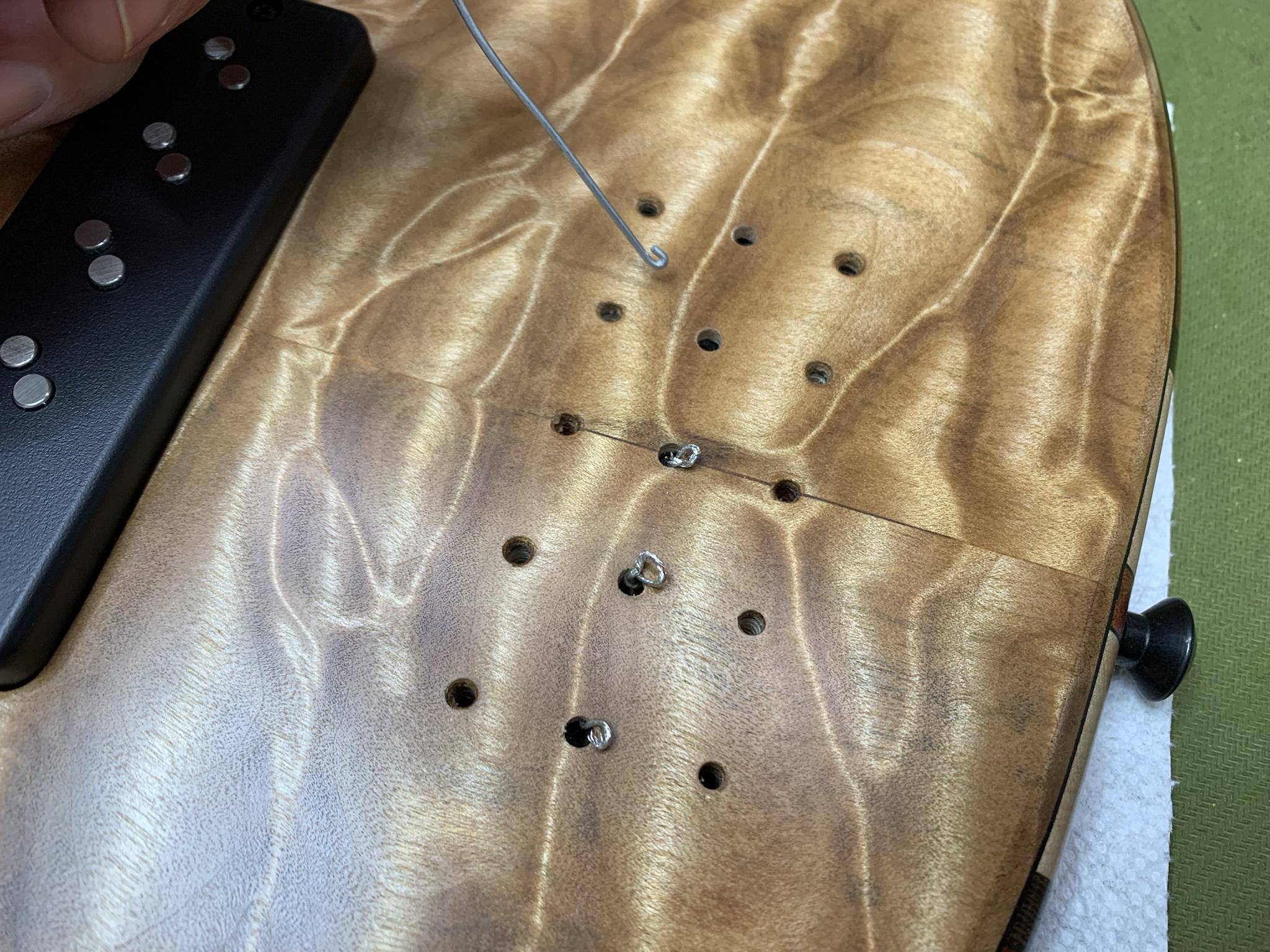
IMG_0127.jpg
I do it in most of my builds for the structural benefits, but it certainly aids the ground, too.
(it's screwed and epoxied into the body, by the way)

@Bruce Johnson could probably give more details of the benefits than I could, I learned this method from watching him.