• TalkBass has been independent since 1998. Add your voice.
    Create a free account to reply to discussions, view embedded media, and browse with fewer display ads.
    Join freeLog in
    Want zero display ads or expanded classifieds tools? Compare plans.

Guild Humbuckers somebody must know something

I never found this circuit to be all that useful, just another bell/whistle they added for who knows what reason.

A period curio really. They probably were thinking of bassists going into the studio and either doing the Morricone/Spy Theme baritone jangly thing, or needing an undefined rumble down at the bottom of a dense (and probably mono) mix of richly orchestrated pop/light music. And the player would probably be using a felt pick or something like that!

This is the era of sonic presets in instruments. In the '60s they really got the most out of passive guitar circuits, and by the '70s a lot of that technology simply went in the bin. The worst offender was when flush guitarists went to Gibson and asked for a stereo ES-355, which had two Varitone circuits ganged to a single rotary switch. The Varitone would always be in the circuit (though this seems to vary with era) and was a crude passive notch filter that used a choke. The stereo ES-355s had two of these circuits in there, one volume and tone per pickup, and ran to a TRS jack, so that you could feed two amps with one signal per pickup. Even the Rickenbacker 4001 basses back then had a capacitor permanently wired in series with the bridge pickup simply to remove bass frequencies. Because who wants bass frequencies from a bass! That is what the neck pickup is for, right?

Look at this beast:

Galanti-1_WEB.jpg


What do those six switches do!?!?! I bet the back of the pickguard looks like an old telephone exchange. Even Fender got dragged into this madness with the Jaguar and Jazzmaster schemes. The 'poker chip' on a Les Paul doesn't say "neck pickup" and "bridge pickup" or anything that lucid either. Manufacturers sort of hid the actual function of switches and knobs behind a vague marketing lingo, and it seems that players didn't want anything as simple as 'bridge pickup' until maybe the late '60s?

Switches also probably helped sell instruments, especially budget ones like the guitar above, simply because it made them look more richly appointed. Does a Stratocaster need two tone controls? Yes, if the competition has one! Doubly so if the 'budget' Telecaster needed only one. And again Leo Fender imagined that guitarists would only want a twangy 'electric spanish' tone from the bridge pickup on a Stratocaster, so it doesn't have a tone control. And on the originals you couldn't blend the pickups either; you simply had one of each of the three pickups to toggle through. Neck pickup for Jazz, middle pickup for ballads, bridge pickup for Hawaiian pastiches... it probably said something like that in the manual!
 
yup, I believe your right. The prevailing marketing thought was that if it had "more" it must be better.

Not to mention what a hip swingin guy you would be sporting one of these in your turtle neck, sport jacket and beatle boots
 
Last edited:
  • Like
Reactions: Axstar
I read this as I sit here with my wide cords, Fender hoodie and turtleneck on!
yup, I believe your right. The prevailing marketing thought was that if it had "more" it must be better.

Not to mention what a hip swingin guy you would be sporting one of these in your turtle neck, sport jacket and beatle boots
A period curio really. They probably were thinking of bassists going into the studio j and either doing the Morricone/Spy Theme baritone jangly thing, or needing an undefined rumble down at the bottom of a dense (and probably mono) mix of richly orchestrated pop/light music. And the player would probably be using a felt pick or something like that!

This is the era of sonic presets in instruments. In the '60s they really got the most out of passive guitar circuits, and by the '70s a lot of that technology simply went in the bin. The worst offender was when flush guitarists went to Gibson and asked for a stereo ES-355, which had two Varitone circuits ganged to a single rotary switch. The Varitone would always be in the circuit (though this seems to vary with era) and was a crude passive notch filter that used a choke. The stereo ES-355s had two of these circuits in there, one volume and tone per pickup, and ran to a TRS jack, so that you could feed two amps with one signal per pickup. Even the Rickenbacker 4001 basses back then had a capacitor permanently wired in series with the bridge pickup simply to remove bass frequencies. Because who wants bass frequencies from a bass! That is what the neck pickup is for, right?

Look at this beast:

View attachment 2824098

What do those six switches do!?!?! I bet the back of the pickguard looks like an old telephone exchange. Even Fender got dragged into this madness with the Jaguar and Jazzmaster schemes. The 'poker chip' on a Les Paul doesn't say "neck pickup" and "bridge pickup" or anything that lucid either. Manufacturers sort of hid the actual function of switches and knobs behind a vague marketing lingo, and it seems that players didn't want anything as simple as 'bridge pickup' until maybe the late '60s?

Switches also probably helped sell instruments, especially budget ones like the guitar above, simply because it made them look more richly appointed. Does a Stratocaster need two tone controls? Yes, if the competition has one! Doubly so if the 'budget' Telecaster needed only one. And again Leo Fender imagined that guitarists would only want a twangy 'electric spanish' tone from the bridge pickup on a Stratocaster, so it doesn't have a tone control. And on the originals you couldn't blend the pickups either; you simply had one of each of the three pickups to toggle through. Neck pickup for Jazz, middle pickup for ballads, bridge pickup for Hawaiian pastiches... it probably said something like that in the manual!
 
  • Like
Reactions: Axstar
A period curio really. They probably were thinking of bassists going into the studio and either doing the Morricone/Spy Theme baritone jangly thing, or needing an undefined rumble down at the bottom of a dense (and probably mono) mix of richly orchestrated pop/light music. And the player would probably be using a felt pick or something like that!

This is the era of sonic presets in instruments. In the '60s they really got the most out of passive guitar circuits, and by the '70s a lot of that technology simply went in the bin. The worst offender was when flush guitarists went to Gibson and asked for a stereo ES-355, which had two Varitone circuits ganged to a single rotary switch. The Varitone would always be in the circuit (though this seems to vary with era) and was a crude passive notch filter that used a choke. The stereo ES-355s had two of these circuits in there, one volume and tone per pickup, and ran to a TRS jack, so that you could feed two amps with one signal per pickup. Even the Rickenbacker 4001 basses back then had a capacitor permanently wired in series with the bridge pickup simply to remove bass frequencies. Because who wants bass frequencies from a bass! That is what the neck pickup is for, right?

Look at this beast:

View attachment 2824098

What do those six switches do!?!?! I bet the back of the pickguard looks like an old telephone exchange. Even Fender got dragged into this madness with the Jaguar and Jazzmaster schemes. The 'poker chip' on a Les Paul doesn't say "neck pickup" and "bridge pickup" or anything that lucid either. Manufacturers sort of hid the actual function of switches and knobs behind a vague marketing lingo, and it seems that players didn't want anything as simple as 'bridge pickup' until maybe the late '60s?

Switches also probably helped sell instruments, especially budget ones like the guitar above, simply because it made them look more richly appointed. Does a Stratocaster need two tone controls? Yes, if the competition has one! Doubly so if the 'budget' Telecaster needed only one. And again Leo Fender imagined that guitarists would only want a twangy 'electric spanish' tone from the bridge pickup on a Stratocaster, so it doesn't have a tone control. And on the originals you couldn't blend the pickups either; you simply had one of each of the three pickups to toggle through. Neck pickup for Jazz, middle pickup for ballads, bridge pickup for Hawaiian pastiches... it probably said something like that in the manual!
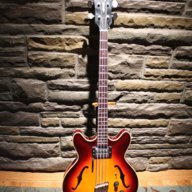
 
I just took a peek and it doesn't appear to be an inductor plate under the pup. Just a piece of foam type material.

That is good! I'm guessing Guild erased the inductor-based 'Suck' switch circuitry at around the same time they moved to the humbuckers then? I'm not sure. I just spotted in the EB-2D thread in 'Basses' that early Guild Starfires and the Gibsons shared the same circuitry. Gibson buried the 'choke' inductor in an inlaid brick of wax under the bridge.

With your bass, I reckon that if you unscrew the 2-way switch and move it over to the f-hole, you could probably jimmy a jumper wire onto either side of the 220 k ohm resistor, but I wager Guild used black insulation to cover the bare legs of the component. There is probably a quick 5-minute mod you could perform with copper tape to simply bypass the resistor in a totally non-intrusive way. It would be handy to have a wee peek at the switch though to make sure!
 
The inside of a JS II bass is a confusing place. The deep/hard switch is down the bottom left:


ztuwb8jsilrg4diyoyjz.jpg


The circuit confuses me. Firstly, guild loved their copper foil! Secondly they used white wires for everything!

One pickup runs to the bottom right hand pot, which is a tone pot. This pickup is connected in series with a 150 k ohm resistor, which is beige in colour. The other end of this resistor runs to the left hand lug of the tone pot and continues to the right hand lug of the volume pot. This is how the pickup 'enters' the circuit. The other pickup runs firstly to the deep/hard switch at the bottom left. This switch simply bumps a capacitor in series with the output of the pickup (cutting lows) or shorts out the capacitor. The output of this switch runs to the top left hand pot, which will be the volume pot for the other pickup.

Guild are both economic and complex in how they implement their wiring here. The capacitors for the tone controls run off the middle lugs of the tone pots. The legs of these capacitors are insulated. Rather than ground the capacitor on the back of the tone pot (as Fender do), Guild use Gibson's '50s principle of running the leg of the cap through the outer lug of the volume put and then to the back of the volume pot itself. This grounds one side of the cap, and the tone control simply bleeds signal to this grounded cap depending on where it the pot is turned. The middle lug on both volume controls run to the 3-way pickup switch, which then runs to the output jack. Again this is Gibson family wiring. Put the 3-way switch in the middle position and either volume could act as a master volume when you turn it down.

So... the resistor appears to be in series with the bridge pickup! I've read that these basses had phase issues, and quite a pronounced 'nasal' tone. Perhaps, because of the way the pickups were wound, Guild used two of the same pickup without figuring out how they would blend together? The resistor simply bumps down the output of the bridge pickup to stop the two pickups being in/out of phase in an unpleasantly nasal manner. Fender had a signature Jazz bass out there for a while (for whom I remember not) that had a switch that punted a fixed resistor in series with the bridge pickup. This stopped the pickups from phase-cancelling as much as a stock Fender Jazz. It was meant to mimic turning down the bridge volume control a hair, but because it wasn't sending signal to ground it didn't do quite the same thing. The fifth 'blender' knob on a Rickenbacker sorta does the same thing. It introduces the resistance of the 'blender' pot in series with the output of one of the pickups. This pot doesn't send signal to ground, so it doesn't turn the volume completely down for the pickup, simply hush it up a bit.
 
  • Like
Reactions: wold
The inside of a JS II bass is a confusing place. The deep/hard switch is down the bottom left:


The circuit confuses me. Firstly, guild loved their copper foil! Secondly they used white wires for everything!

One pickup runs to the bottom right hand pot, which is a tone pot. This pickup is connected in series with a 150 k ohm resistor, which is beige in colour. The other end of this resistor runs to the left hand lug of the tone pot and continues to the right hand lug of the volume pot. This is how the pickup 'enters' the circuit. The other pickup runs firstly to the deep/hard switch at the bottom left. This switch simply bumps a capacitor in series with the output of the pickup (cutting lows) or shorts out the capacitor. The output of this switch runs to the top left hand pot, which will be the volume pot for the other pickup.

Guild are both economic and complex in how they implement their wiring here. The capacitors for the tone controls run off the middle lugs of the tone pots. The legs of these capacitors are insulated. Rather than ground the capacitor on the back of the tone pot (as Fender do), Guild use Gibson's '50s principle of running the leg of the cap through the outer lug of the volume put and then to the back of the volume pot itself. This grounds one side of the cap, and the tone control simply bleeds signal to this grounded cap depending on where it the pot is turned. The middle lug on both volume controls run to the 3-way pickup switch, which then runs to the output jack. Again this is Gibson family wiring. Put the 3-way switch in the middle position and either volume could act as a master volume when you turn it down.

So... the resistor appears to be in series with the bridge pickup! I've read that these basses had phase issues, and quite a pronounced 'nasal' tone. Perhaps, because of the way the pickups were wound, Guild used two of the same pickup without figuring out how they would blend together? The resistor simply bumps down the output of the bridge pickup to stop the two pickups being in/out of phase in an unpleasantly nasal manner. Fender had a signature Jazz bass out there for a while (for whom I remember not) that had a switch that punted a fixed resistor in series with the bridge pickup. This stopped the pickups from phase-cancelling as much as a stock Fender Jazz. It was meant to mimic turning down the bridge volume control a hair, but because it wasn't sending signal to ground it didn't do quite the same thing. The fifth 'blender' knob on a Rickenbacker sorta does the same thing. It introduces the resistance of the 'blender' pot in series with the output of one of the pickups. This pot doesn't send signal to ground, so it doesn't turn the volume completely down for the pickup, simply hush it up a bit.
Now my juices are really flowing. I will attempt to post a pic of the of the back side of the switch. It would be great to be able to just jump it out. Although procuring copper foil in my neck of the woods could be tough.
Axstar, you have a knack for explaining things while imparting self confidence in what you say. You must be a teacher or an Electrical Engineer of some type i'm guessing. I have another question that is abit off topic.
The serial number sticker in my starfish has both a written and a stamped number. What may this stamped number be?
 
OK, I see. Never knew that. So now all I have to do satisfy my obsession with this bass is get Sherlock Holmes, James Bond, Napoleon Solo and Austin Powers to try to find the secret Guild manufacturing documentation.
 
Challenge met.

Amazing! Did you use a dental mirror or something? Very cool to see the electronics 'in state' rather than fished out the F-holes. Because Guild haven't designated different colours to individual wires it is hard to 100% work out what is happening in there, but I'm not seeing anything suspicious, and the white wires are consistent with the JS II wiring I posted above (as are the pots and caps, as well as the grey insulating tubes and the black insulation on the capacitor legs).

The bad news is that all of my hypothesis over the last two pages have been entirely wrong. There is neither an inductor or a fixed resistor doing anything to foul up the tone of your bass. As far as I can see the switch simply puts that capacitor in series, cutting lows, or it gives you the full signal. I don't know where the switch is in the signal path of the components here, but I'm guessing it falls after the volume and tone controls, but before the output jack (like half of the JS II wiring).

After all of this, and apologies for the trek round the houses, I think your bass just sounds the way it is because of the design. That humbucker is probably reasonably hot, and being placed right down the end of the neck of a shortscale instrument will give it a predominantly warm, bass-heavy tone. The rosewood saddles on the bridge will probably bleed off a bit of high frequency content as well. I've played a vintage M85 that was a lovely bass, but it wasn't really all about the definition or treble bite side of things.

It seems that, looking at the wiring here, the 'deep' tone is basically giving you the full low-frequency response of the pickup, given the design of the pickup, the location of the pickup and the design of the bass.
 
  • Like
Reactions: Crater and wold