• TalkBass has been independent since 1998. Add your voice.
    Create a free account to reply to discussions, view embedded media, and browse with fewer display ads.
    Join freeLog in
    Want zero display ads or expanded classifieds tools? Compare plans.

Guitar player looking to get into Bass.

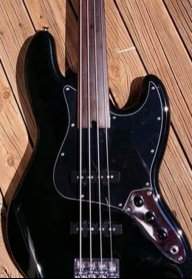
Based on the kind of music you prefer, a Fender style Jazz bass sounds like it would suit you best. Maybe even a Jaguar (great for guitarists switching over to bass).
Not to go into brands as you mentioned, but reasons for recommending the Jazz- thinner neck than the P Bass and the dual jazz pickups have more bite to them than the P-bass pickups which are..well, thumpier for lack of a better word. I've had quite a number of basses, active and passive- but really for old school type music, it's a no-brainer, I pick up my passive Fenders- none of my other basses can get the right kind of sound.
Another thing I have to mention - don't get a 30w amp. Even the best, most expensive bass will sound like crap on them- it'll probably discourage you if you hear what kind of sound comes out of it. The speaker is too small and the wattage too low to get crisp tones and sound. You'll want at least an 80w-150w even for playing around in the home. Easier to turn down the volume than being underpowered to begin with. A used amp on CL can be very reasonable and should easily fall within your budget. I bought my 150w Fender Bassman for $80.
This is good, but on the contrary I would Recommend the P. It will get used to the differences of guitar and bass. Mainly because the neck is like half a baseball bat :) I don't think you can go wrong with a p, at any level. That said the jazz, and the jaguar are both great. I would recommend the p for a starter, it is a lot more forgiving than those two. Once you get used to the neck.
 
Any old P bass that seems well enough put together and a decent amp. If you aren't looking to play with a drummer a small combo will do but will run out of gas if you need loud. A two to three hundred watt rig will get you into full band territory. Most important, the amp is more important than the bass. An inexpensive bass will sound good through a quality amp. But an expensive bass will sound cheap through a crummy amp.
 
Dude - I started on guitar before running with both for the next 30 years. The world of bass is just as complex as the world of guitars. That said its easy to find a budget setup that you will enjoy playing.

Get a 34" scale - they're not tough to learn. You're not exactly doing barre chords and arpeggio sweeps on the bass.

Bass anps require more watts and more speaker to produce those low notes. A Vox AC30 might be a powerhouse guitar amp, but in the world of bass we add a zero on to the end of everything. 2-300 watt combo amps are common. People run 1,000+ watt power amps for the big cabs.

What to do? Go to Guitar Center and just sit down with a few basses and amps. See which feel and sound right to you.

A budget of $250 for bass and $250 for amp should get you something you can enjoy.

My recommendation? I like an active 4 string Jazz bass, and an amp with a couple 10's (with built in compression). That said, I have a dozen basses, and only grab my Jazz bass 1/4th the time.

You might prefer a Schecter, or an OLP, or some other brand/design.

Don't think of your guitar background as something you have to factor in. It only helps you as you know your way around a fretboard and have some left/right hand coordination. Don't think you have to restrict yourself to a short scale bass for any reason.
 
Hi welcome to the low end club, where your aim is to move people and get them to feel your groove.

I would say stick to a 4 string to start with, try and go for something passive, perhaps a P style would suite what you said you will be playing as its the classic bass used in those genre however a Jazz neck is slimmer and easier so a J might be worth a look, the squires aren't a bad place to start. I can think of plenty worse. a good Active Hybrid bass might be something like a Ibanez GSR200 very affordable and nice to play.

As for an amp for home use, perhaps a Fender rumble 40 (40w) combo if you like clean bass tones. or a Hartke HD50 hydrive (50w) combo if you like a lil bit more growl. I wouldn't go any lower in power than that for bass as you need a lot more power than a guitar for low end frequency reproduction. it may even pay to go a bit further on the models above and look at the Rumble 100 or HD75 or maybe even a Hartke Kickback 15 (150w) as these could just about keep up with a drum kit and guitar for company if volume levels are kept in check. Ideally for a gigging bassist, you would be looking at a minimum 250w head into a 4x10 cabinate.
 
Last edited:
If you go full scale, another "old school" bass to try other than the Fender standards (Jazz and P bass), is the Stingray bass. Within your price range, a used Sterling Sub Ray is well within your budget as used ones go for $150-190. These are powerful basses being active and all, very different from Fender basses but the old Musicman Rays have their place in history and has roots in old school late 70s music and funk. The Sterling Sub Rays are pretty popular basses these days along with the Squier CV and VM lines as they balance affordability and quality pretty well. I had 3 at one point but decided to pare down to 1.

But again, always good to try as many basses as you can-full scale/short scale, all different kinds . Have fun trying them out.
 

Attachments

  • 2014-02-23 15.09.33.jpg
    2014-02-23 15.09.33.jpg
    372.3 KB · Views: 17
Welcome to TB!

I recommend a Squier jazz bass to start because I'm loving both of mine and the price is right! An instructor is a good idea in the beginning because the technique is (should be) different from guitar, and it's easier to learn than to unlearn / relearn.

Don't let TalkBass give you bad GAS - start with one bass and just play the crap out of it. You'll develop your own GAS all by yourself ;)
 
I'm planning on playing with fingers instead of using a pick. I already know how to use a pick so playing with fingers is interesting to me. I think i'll be comfortable with either method. But, does a short scale bass hinder finger plucking at all? Do I want a wider string spacing? I have a couple 7 string guitars, and one is a 26.5" scale, so i'm used to playing different necks and scales. I guess i'm wondering if there are things i can do on a 34" scale that can't be done on a short scale. And, is it hard to find strings for a short scale?
Thanks.

Good man. Normally, I discourage guitar players to take up bass, but since you're approaching it the right way... you have my blessing.
 
The Ampeg will get plenty loud into a decent cab of the correct impedance. I'd just use that for now. You'll need a cab anyway.
Yep

Looked up the ampeg. It has a clean channel with plenty of controls. Dual amplifiers (could they be bridged for 180watts into a single 8 ohm cab I wonder?) Can you turn the chorus off on the second amp? - or just run a clean and a chorus cab - chorus works well for bass anyway. 90watts into a good bass cab (say a single 15 or a 2 x 10 or 2 x 12) would get you into jamming and rehearsing with friends territory.

If it's a combo, disconnect the internal speaker.

No need to get a bass amplifier for the moment while you've got this thing in your arsenal already.
 
Did the same thing a bit over a year ago, moving from guitar to bass. Got to agree with those that suggest the Jag VM Short Scale. It's a really easy transition from guitar, it is built unbelievably well for the money and sounds great. I'm looking to add another bass soon but the Jag will stay with me for a long time yet.
 
As someone who fairly recently switched to bass after nearly two decades as a guitar player, I didn't find the longer scale all that daunting. I would definitely recommend starting with a four string. Call me "new-school," but I have a Schecter and an Ibanez, both of which have slimmer necks and active electronics. I will not even try to recommend active or passive, but both brands manufacture either. As far as the amp, I agree that you need higher wattage. You can raise hell with a 30 watt guitar amp, but I wouldn't go below 100 watts. That is my two cents.
 
Based on the kind of music you prefer, a Fender style Jazz bass sounds like it would suit you best. Maybe even a Jaguar (great for guitarists switching over to bass).
Not to go into brands as you mentioned, but reasons for recommending the Jazz- thinner neck than the P Bass and the dual jazz pickups have more bite to them than the P-bass pickups which are..well, thumpier for lack of a better word. I've had quite a number of basses, active and passive- but really for old school type music, it's a no-brainer, I pick up my passive Fenders- none of my other basses can get the right kind of sound.
Another thing I have to mention - don't get a 30w amp. Even the best, most expensive bass will sound like crap on them- it'll probably discourage you if you hear what kind of sound comes out of it. The speaker is too small and the wattage too low to get crisp tones and sound. You'll want at least an 80w-150w even for playing around in the home. Easier to turn down the volume than being underpowered to begin with. A used amp on CL can be very reasonable and should easily fall within your budget. I bought my 150w Fender Bassman for $80.

+1, the Squier Jaguar sounds about right: Squier Vintage Modified Jaguar Bass - Short Scale Silver | Sweetwater.com or
[Invalid or Expired Link Removed]
 
I was in the same position as the OP about 2 years ago. Now well over half my playing time is on bass rather than 6 string.

As others have said, don't bother with a 30w amp. I know what you're thinking: 30 watts sounds like a decent amount of power for around-the-house, jam sessions, or even small gigs. It is--on guitar. For bass, think in the range of 5-10 times the wattage you would need for a similar setting on guitar.

If I were you, I'd be thinking along the lines of a 200 watt head and a 1x12 cab. For example, the Gallien-Krueger MB200. They're affordable and come up on the classifieds here on the forum pretty often.

Head/cab is the way to go. Combos are a waste of time IMO.
 
Years ago, I was at a friends house in San Diego. He had a really beat-up, crappy guitar in the corner of his living room, so I picked it up and started playing some fun little rhythm riffs on it...kinda playing to myself. When I looked up, he was looking at me in awe. Startled, I asked,"why you lookn at me like dat?" He said," I never heard anyone make that thing sound GOOD before."
Point is: You can make any bass sound good if you want to. Put YOUR spirit on it, and don't make it do your work for you bcuz it cant. Find a cheap used bass that has a decent neck, fretboard, electronics, etc.
Find an amp that's in the same league and go for it. Choose an easy song that you like and learn it well to stay encouraged. And don't worry (yet) about name brands with higher price tags. You can always upgrade when you are ready. Don't get sucked into all the Brand-Loyalty that goes on on this site. Let your Eyes-Ears and Hands make your decision for you.
Many Awesome Photos have been taken with crappy instamatic cameras over the years.
Many Fantastic song lyrics and poems have been written with beat-up, stubby pencils.
And...Tons of great music has been made on beater instruments.
You hold all the keys.(no pun intended)
 
  • Like
Reactions: dabbler
I'm not looking for clear answers around bass brand names because I know that can be subjective, but maybe some tips on pickup configurations for those styles I listed, advice on number of strings, what kind of amp is good to start with, which string spacing should I start with (hands are probably normal size, finger tips are on the beefy side) and what should I look at when buying used like action height or neck cracks.
Thanks!
Well, if you are new to bass, string spacing, neck shape, pickups, string type, etc. are kind of moot. You'll conform to whatever you're playing. I'm a guitarist who picked up bass too.
I'd like to suggest getting a Yamaha RBX or Squire Vintage Modified Jazz Bass. Build quality is good for what you pay.

You can try different strings later. Learn to play with whatever is on the bass and you can gauge (ha ha) what string size you might want to try out later on, same, thicker, or thinner.

Much like electric guitars, you want to avoid major problems that are visible and audible, like missing bridge parts, damaged nut/neck/fretboard/body, non-working input jack or volume/tone potentiometer. Damaged paint isn't a big deal.