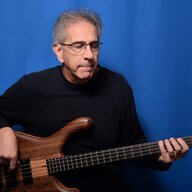
I guess they figure how hard can it be? I mean it's only four strings. Or five. Or six. Or eight. Or ten. Or twelve. Or eighteen...

TalkBass has been independent since 1998. Add your voice.
Create a free account to reply to discussions, view embedded media, and browse with fewer display ads.
Join free Log in
Want zero display ads or expanded classifieds tools? Compare plans.
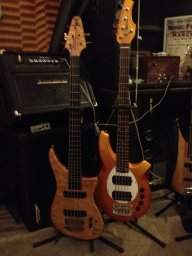
"They", who?I guess they figure how hard can it be? I mean it's only four strings. Or five. Or six. Or eight. Or ten. Or twelve. Or eighteen...

On Chicago's Craigs List today there is an argument brewing that's really kind of funny. It began by a bass teacher creating an ad titled, "Friends don't let friends learn bass from guitarists".
On TB, such a generalization would most certainly be met with the wrath of uber-trolls (such as myself), but I think there's an interesting argument that can be made here...on both sides of the fence.
My own opinion is that there's two types of guitarists that *could* be included in this generalization. The first kind is one who's technically proficient (dare I say talented???) on guitar, whereas the other kind is one who's simply a talented musician / songwriter who's main instrument happens to be guitar. That said, I'd go so far as to say the former is less likely to understand the intricacies of how bass fits in to a song than the latter. Of course, the ad (and subsequent responses) don't seem to make this distinction, so perhaps I'm the only one who sees it this way?
I've seen a large number of great guitarists who could wield a pick and run scales up and down the neck of the bass but couldn't PLAY the bass. That's not to say guitarists couldn't be great bass players, in their own right. However these types of "bass players" (and I put that in quotes for a reason) don't necessarily "get" how to play the bass. IMO, of course.
I'm curious about everyone's thoughts.
Don't agree with this. The bass shouldn't require significantly more strength unless it's not setup right . Speed/coordination, nah, you need that on the bass too to at least the same degree as the guitar (if you're a fretless player the requirements on the bass are even higher technically).

It's definitely an issue, as scale length and string thickness have inherent differences between bass and guitar. It's not really a debatable issue, except for those who don't get it. Lower action will undoubtedly make a bass easier to fret, but it will never, and I mean NEVER be as easy to fret a bass than it is a guitar, unless the strings on the guitar are more than 1/2" off the fricken' neck!I am surprised you were the only one to give me crap about that, it's a highly debatable observation.
It's merely my personal experience from transitioning from guitar to bass. Typically, you *are* involved in faster fingers on the guitar, that part I definitely stand by. However, you throw in the fact that you're playing with your fingers usually (as opposed to a pick) and it does require more strength to get notes on bass (I stand by this comment too, I am pretty certain that's probably a scientific fact)- the need for speed and dexterity issue does increase on the bass pretty damn quick. More resistance from thicker strings just means more effort and that makes the bass a heck of a lot harder in a hurry.
Like I said, off the top of my head, that was just the one thing I noticed. Hand and finger positions on the fretting hand were a breeze when I started playing bass. But doing it all with good tone, sufficient finger pressure to eliminate fret buzz, and then throwing in a plucking right hand- well, that made it a different story, even at moderate tempos.

Only if the guitarist has not spent the time to become a bass player as well. Being able to play the guitar does not disqualify one from becoming a bass player.Most of these posts seem to support my beliefs that, while a guitarist can possibly be a great bass player, there's a difference between a guitarist who plays bass and a bass player.

Only if the guitarist has not spent the time to become a bass player as well. Being able to play the guitar does not disqualify one from becoming a bass player.
Exhibit B - Cliff Burton: a guitarist who got lost one day and picked up a bass. He even had to distort it into sounding like an electric guitar.

I played guitar in the band I am in for 6 years, all that time I was hearing bass lines the bassist was missing. It drove me crazy.
Now I am playing bass in the same band and what do I hear: the guitar parts the current guitar player is missing, and that's now making me crazy.
You can't win it seems.

More like a veterinarian trying to perform surgery on a person...I know several excellent guitarists who can play pretty much okay on the bass, but none of them is what you'd call really great in that respect.
To use an analogy - if you need medical help, there may be occasions when a doctor of general practice may be able to do the job that you need them to do for you. But there will be other occasions when only the best specialist will be good enough.

"They", who?
Bass and guitar are different instruments with different sounds and different roles, and any musician with half a brain, even a guitarist, can easily figure this out. .

Found your error, assuming facts not in evidence....
Randy