• TalkBass has been independent since 1998. Add your voice.
    Create a free account to reply to discussions, view embedded media, and browse with fewer display ads.
    Join freeLog in
    Want zero display ads or expanded classifieds tools? Compare plans.

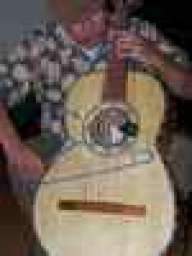
Guitarron anyone?

...Juan Lemus Reyes
Fabricante de Guitarras
Guitarrones y Vihuelas
Mechos a Mano
(sign. & date looks like:) J.E.deFevrero, 1970
To.deMayo No 22
Villa Artesanal
Paracho, Mich
and a handwritten (serial number?) '1905'

If anyone knows anything about this maker, I'd like to hear from you !!
I don't know about this PARTICILAR maker . . . but Paracho, Michoacan has a long history as the acoustic guitar-making capital of all Mexico . . .

"Fabricante de Guitarras - - - - - - Maker of (acoustic) guitars,
Guitarrones y Vihuelas - - - - - - - guitarrones and vihuelas,
Hechos a Mano" - - - - - - - - - - made by hand (handmade)

"To.deMayo No 22 - - - - - - - - - that's the address of the shop/factory . . .
Villa Artesanal
Paracho, Mich"

In Paracho you can find instuments of all levels of quality (and price) . . . and if that handwritten serial number means that your guitarron is the 1905th one made in that shop, at least you know that the maker(s) have had a lot of experience making them . . . it's not a "first build" by any means . . .

good luck . . .
 
Juan Lemus Reyes seems to be the father of Jacinto Lemus Reyes ?

Jacinto is also a well known guitarron maker.
He was second in a competition at a guitar fair:

http://www.mimorelia.com/vernota.php?id=21402

Moreover he has a MySpace web site:

Link Removed

I found a Lemus Reyes instrument at Invalid Link Removed

but the shipping to Europe (by FedEx) was almost twice the price of the instrument.

It's really hard to get a guitarron here in europe !
 
I tried a guitarron once at a jam session of friends and co-workers. The axe belonged to Pat Quilter (the "Q" in QSC), who has a big collection of musical instruments. I don't recall if he had it tuned the standard way. Anyway, it was pretty cool, and I was surprised that it wasn't too difficult to make the transition from bass to guitarron.
 
Guitarróns are fretless, of course, and the very short fingerboard stops at the body, and you get only 7 fret positions. The action is PAINFULLY high.

I have a "jazz guitarron," by which I mean it has been altered. A new nut to hold entirely different strings: A custom made low E1 String, so it is tuned EADGCF--i.e., in fourths all the way across. The fingerboard now extends over the body almost to the sound hole, so that I have a full octave on each string. BUT MOST IMPORTANTLY, the new fingerboard sits on top of the original and its thickness is tapered so that the action is about half as high as originally. I can actually play the thing painlessly now. The modifications were done by luthier Alex Watson (www.watsonguitars.net) and the custom strings came from Guadalupe Custom Strings (Link Removed).

I also added an endpin, so I play from a chair, very much like a cellist, except with no arco, of course. It's pretty strange, but its a gas!
 
I found a string set "La Bella Guitarrone Metal, GUI" that seems to be tuned like a guitar. Does anyone have experiences with it ?

Well, the traditional tuning of a guitarrón for Mariachi music is ADGCEa, with the "a" on the first string actually a thicker string than the C and E and tuned lower than the C. You hold the guitarrón almost top facing up (not quite), and you pull up on the strings with wrist action--i.e., outward from the sound hole to play it. You pull two strings at once in octaves giving it a big sound, which you need because large Mariachis often have multiple trumpets.

The best guitarrón method is still Nati Santiago's, which is available at [Invalid or Expired Link Removed], with a CD of scales and examples of simple songs.

To accomodate the upward pull on the strings without buzzing, the guitarrón has really high action--like 3/8" to 1/2" where the neck joins the body, which is also where the imaginary 7th fret would be. That's all you get--7 imaginary frets--because the fingerboard does not extend over the body at all. The downward distortion of the variously-sized strings because of the high action results in a strange thing that seems to defy the laws of physics: The imaginary frets are not always perpendicular to the length of the neck. and they are not even always straight lines from string to string. You get zig-zaggy imaginary frets that kind of fan out along the neck.

This bothered me horribly when I first got it. One night after hearing a great Mariachi performance at Garibaldi's in Guadalupe, California, I tried to ask the non-English-speaking guitarrónist about this, but he didn't get the problem. It didn't dawn on me until I was driving home that he simply didn't care that the C on the imaginary third fret on the low A string did not line up across the neck with the F on the imaginary third fret of the D string. He knew where to press his fingers down to get whatever note he needed; what did he care if each string had it's own imaginary frets?

You learn twelve notes using twelve finger positions, and that's pretty much it. Actually, though, I guess guitarrón geniuses like Santiago could do more with it, alternative fingerings and such, but most Mariachi guitarrónists I see just seem to be playing the same twelve notes with the same twelve finger positions. Some don't use two strings for G#, which is a real bastard to play. (They all seem to know the same often-used ending, though. It's kind of a Mexican-music version of the A-Train ending, with a two-note stinger.)

When I first got my guitarrón, I could only "play" it for 3-4 minutes at a time because the action was so painfully high. How can you get good playing 3-4 minutes a few times a day? I was reduced to putting one of those old-fashioned rubber page-turner fingers on each finger of my left hand to try to play longer. Eventually, I learned that you need to use the flats of the fingers, sometimes two at a time, to play the notes, not the fingertips. (See the photo of Nati's left hand at the website, above.) But it still was painful.

I obviated this problem entirely by having my guitarrón greatly modified to play blues and jazz, which is what I'd rather play anyway. (I've described the modifications elsewhere in these threads.) So I couldn't play Mariachi guitarrón music on it anymore, even if I wanted to.
 
Here's something I've been wondering. Is it possible to tune one of these things with a low E? (I assuming the strings would need to be changed) People often mention how loud the guitarron is, which mad me wonder if it might be a viable alternative to a regular acoustic bass guitar.


Yes, it can be done. I tried tuning the low A down to an E, but it did not work at all. Way too loose to sound an E. (Another poster states that he made that work, but I sure don't know how. Wasn't even close on my guitarrón.) So I had a couple of custom low E strings made by Guadalupe Custom Strings (guadalupecustomstrings.com). They only charged me $8 a piece for them, but that was a year ago so . . . ? Ask for Jacob. He's the low E-string maker.

As far as loudness is concerned, if you're going to play only one string at a time (generally, guitarrónists pull two strings in octaves) it very well may not be loud enough for use without amplification, with which I have no experience at all. Especially that new low E string, which the guitarrón was not designed to play. On mine, the low A booms out noticeably better than that new low E, but it does allow me to play regular doublebass lines. Maybe someday I'll experiment with amplification--I suppose just playing close to a mike would be the first and easiest thing to try, but I haven't even tried that yet.
 
  • Like
Reactions: 47th Street
Well, you've got me pegged, froggie. I've got a beer belly, although I'm working to get rid of it.

But I think a skinny guy with strong hands would really be the ideal Mariachi guitarrónista because a fat-backed guitarrón sitting on a fat belly results in you really having to reach for the thing. It's not quite all that bad since it's a bit more of the side of the guitarrón against your belly than the back of it, but I still think that a fat human belly is a drawback. You have to have strong hands and fingers, though--or work hard to get them. Supporting the guitarrón's weight is not a problem because it's surprisingly light. Feels like an enormous eggshell with a handle on it.
 
  • Like
Reactions: 47th Street
I found a string set "La Bella Guitarrone Metal, GUI" that seems to be tuned like a guitar. Does anyone have experiences with it ?

Hi, I'm from Mexico, and I often play guitarron and teach, to answer your question, if its helpful for u, for guitarron (the strings that we use in Mexico are called Selmer) there are several colors as red, yellow, blue, green, I suggest this brand (Selmer),:)
 
Here's something I've been wondering. Is it possible to tune one of these things with a low E? (I assuming the strings would need to be changed) People often mention how loud the guitarron is, which mad me wonder if it might be a viable alternative to a regular acoustic bass guitar.

Don't bother - it is what it is. It is a viable alternative as is a tuba or any other bass instrument. Why change it and make it inferior -
 
  • Like
Reactions: 47th Street
"Thumper" or "The Greased Pig"

upload_2017-11-28_0-59-38.png


Dunno if anyone is still watching this thread, but just in case...

This is an unusual instrument, customized from an older, relatively high-quality unaltered Jacinto Lemus Reyes guitarron I purchased in a San Jose CA shop in 1998.

upload_2017-11-28_1-0-51.png


Apologies to Antiques Roadshow, but it's been lovingly modified. It's now a guitarron with four flatwound electric bass strings EADG (the extra two tuners were removed), an extended, raised ebony fingerboard, carved ebony & spruce bridge, and custom-milled 2-piece brass tailpiece.

The custom work was done on the pristine original instrument by a genius named Mark Brown in Campbell, CA ~1999. Mark, for some reason, became as obsessed with my odd project as I was - maybe because I paid on time, maybe just because he wanted to use his new milling machine on something interesting.

Why do it? At the time, there were many occasions where I didn't want to pack/haul/risk my nice carved URB. Thumper is a lot of fun unamplified in a campfire jam playing old timey or bluegrass, or busking on a street corner with a squeezebox player, or in a string band, or any kind of polka, tex-mex, 1-5/1-4 oompa-type dance stuff. Killer at a beach party, and a lot cheaper to fall on drunk in the dark than the URB. And its name was earned, with a good solid, tunable THUMP you can feel without an amp – unlike any acoustic bass guitar I’ve ever tried.
 
Good for you!
That instrument is gorgeous!

We traveled to the West Coast Of Mexico to meet the Australian branch of the family, for Christmas...15? years ago...Zihuatanejo , as in ‘Andy was waiting for Red’!
Spent an hour with my hands on a beautiful guitarron...the store owner was very cool and patient...even offered to ship it home for free!
$200 USD, cash...
“We” passed on it... :banghead::banghead::banghead:
 
  • Like
Reactions: TolerancEJ
Good for you!
That instrument is gorgeous!
We traveled to the West Coast Of Mexico to meet the Australian branch of the family, for Christmas...15? years ago...Zihuatanejo , as in ‘Andy was waiting for Red’!
Spent an hour with my hands on a beautiful guitarron...the store owner was very cool and patient...even offered to ship it home for free!
$200 USD, cash...
“We” passed on it... :banghead::banghead::banghead:
Cool! I'm no expert on Guitarrons by any stretch, but did learn they come in different sizes (Thumper is a little larger than average) and aren't often made with the attention to quality found in guitars, possibly because their role in mariachi bands seems more percussive than harmonic, at least to me. I've never hear any underlying sustained bass tone in mariachi bands from the guitarron, just clear percussive single tones and octave double-stops driving the band. Maybe this is why they can get away with having such high action. Precise intonation does not seem to be 1st priority in its natural application. The ebony board on Thumper raises the action 3/8", and the steel strings are tunable (the tuners are better than wooden pegs, but not much) - though its short scale still makes intonation challenging. I've found 2-3 shots of tequila really makes it sound great - to me at least.:bassist:drool
 
  • Like
Reactions: 47th Street