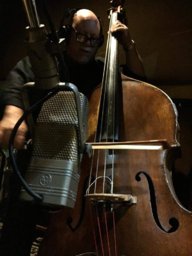
I've had an unusual opportunity lately. About 5 years ago, my beloved '32 Juzek was almost destroyed on a gig when someone got their foot caught in the cable while on break. To keep from falling, the guy jerked his foot forward which launched the bass up into the air where it came down on the bridge (as a sidenote, I always disconnect my bass from the cable on break now). Massive damage. Mike Shank finished repairing/restoring it a few weeks ago and, the man is a magician, I got my bass back. It was MY bass. Not something that just looked like it. It sounded and played like it did 5 years ago and it still had the same Spiros Mittels that were on it when I took it to him. It took him a long time but it was worth it. I played the hell out out of it when I got it back and it opened up beautifully.
When the '32 was damaged, I found a '28 Juzek that sounded and played remarkably similarly to the '32 and I bought it. It's been my main bass since then. It now sports guts with Anima A/E.
I had a rehearsal at my house the other day and I was able to play each bass alternately so I could get a real comparison between two very similar sounding, great basses; one strung with Spiros and the other with guts. It was a highly unique opportunity.
The overall consensus was the one strung with guts sounded better. This could be partially because, over the past 3 years, I've become really proficient at making the gut string sound my own. But when A-B'd, the Spiros sounded thinner and weaker in comparison. Of course, they were more direct sounding and when playing a melody, particularly when the D string was used a lot, they sang more forcefully. You can also "muscle" the steel better. If you need to interject something musically, you can force your way into the mix in a way that is more difficult with the softer attack of the guts.
I think Spiros are better for some applications such as many kinds of pop/folk/rock. The stronger mids and the narrower focus of the sound mixes better when there is a dense group of instruments. I kind of like steel better with latin and funk as well for similar reasons. But when it comes to any kind of swing-based jazz, the guts deliver in a way the Spiros just don't. They sit better in the mix and, after quite a bit of practice and experience, I can now play faster and more accurately on the guts than I ever could with Spiros so my soloing has improved immeasurably as I can pull off technical things with ease that would have been extremely difficult with higher tension strings. Not only that but my options for playing the bass without an amp have increased immeasurably. I usually play with an amp but mostly so I can solo easier. If I wasn't soloing, I could probably play without an amp 80% of my gigs. A little over a year ago, I was late for a gig and got there just as we were supposed to start playing. I didn't have time to set up my amp so I just pulled the bass out of the bag and started playing figuring I'd set up the amp on break. It was a loud gig with drums bashing away and NO ONE noticed I wasn't amplified except during my solos; during one someone from the audience yelled out for me to "turn up". I didn't bother setting up the amp at all that night. You just can't do that with any kind of steel string. When looking for the elusive "my bass but louder" sound, guts really deliver.
Because the mid-range of the guts is so much less of the overall sound than with steel, it is also much easier to amplify. With steel, it was a constant fight to get the amp to sound right in any new room. That problem has effectively gone away. So much more of the sound is fundamental with guts that my amp sounds pretty much the same from room to room. It's really nice to be able to put the amp ANYWHERE, plug in and get the sound you're looking for immediately and without hassle.
Getting used to guts after steel is a challenge and one that everyone who tries it has to overcome. You really do have to relearn how to play on them. The touch is very different and if you try to play them like steel strings with the same touch, you'll be cutting them off your bass before the first set break. When I first put them on, trying to play fast was like trying to run through snow. Now I can play Cherokee at 300 bpm all night and solo afterward. Also, I had a lot of tricks and go-to licks with steel strings that just didn't work with gut and it took a while to develop a set of tricks and go-to licks that worked with gut (interestingly many of those sound lousy on steel strings). Anyone who wants to use gut strings has to go through that transition which can be tough if you're a pro and playing lots of gigs.
I'm going to leave the Spiros on the '32 (although I'm going to put an Olive G on; the Spiro G is just too painful to use now) and use it for those gigs and recording sessions that are more pop/folk/latin/funk oriented. Over the past couple of years, I did miss the steel on those sessions. The main bass is staying gut. It has really become my sound now and, as long as the majority of my gigs are swing-based jazz gigs, I can't forsee ever giving that up.
mark










 Admittedly, upright has a attention getting look, so if I get some work for that reason alone, so be it.


