
Slight tangent to the thread, but what are the names of these recordings? I've honestly never thought about what bass Charlie was playing on any given record...Charlie just always sounds like Charlie.

TalkBass has been independent since 1998. Add your voice.
Create a free account to reply to discussions, view embedded media, and browse with fewer display ads.
Join free Log in
Want zero display ads or expanded classifieds tools? Compare plans.

Slight tangent to the thread, but what are the names of these recordings? I've honestly never thought about what bass Charlie was playing on any given record...Charlie just always sounds like Charlie.
I’m with Chris Fitzgerald in that Charlie Haden sounds like Charlie Haden no matter what bass or strings. No doubt!
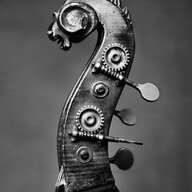
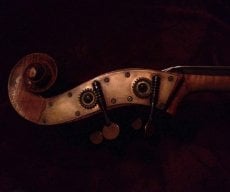
Anyway, here’s a pic from the back cover of the original vinyl of Closeness. This isn’t the Vuillaume because it has a plain scroll.
But then also, here’s a pic from the “third” duet record, with HAmpton Hawes on the great artist house label (Jan. 76) that was recorded the same year as Closeness (Jan & mar 76). It’s definitely the Vuillaume, it’s even mentioned down at the bottom of the page.
So you could be right Jason—perhaps the pic with the bass on the back of Closeness was a pic from another time period. That pic threw me off. But I have heard him in person with a Pollmann (old enough) and I remember others in these pages referring to it.

Another nice duet record. Looks like the same figured scroll from the Hawes duet record that the liner notes call a Vuillaume, c. 1840.Could this be the Pollmann?View attachment 3305189
That's what I always thought as well. And his bass on this recording sounds much brighter than usual.I always thought that that ornate carved edging was a Pollmann thing. But I admit to not knowing much—there are others who I’m sure can provide more definitive info.

Wound gut strings can differ in core diameter. At least the older way of construction that is still used for some sets. That older way of construction is one layer of windings on a gut core. Some even use an E with a broken winding unwound for a d string or an A unwound for a G string.While I am posting. I use all plain gut. And I recently came to think about, a difference between wound strings and plain strings, is that wound strings often have the same core thickness, or at least more similar from, G to E. This also goes for wound gut. Which give wound strings a more similar elasticity across strings, for a given tension. Whereas plain strings, being all core, have a huge difference in core thickness. Which could mean, the thicker strings have less elasticity for a given tension. Just something more to ponder in my quest for the most uniform feel across strings...
Yes, but that still means the core of wound gut E and A strings are closer to plain D and G's (a combination used by many). And I was definitely talking about stretching, allthough bendability is also interesting.Wound gut strings can differ in core diameter. At least the older way of construction that is still used for some sets. That older way of construction is one layer of windings on a gut core. Some even use an E with a broken winding unwound for a d string or an A unwound for a G string.
But if several layers of metal are used for the windings the same core can be used for all the strings of the set.
If you mean length elasticity or stretching under tension with elasticity you are right, but the windings of a thicker string Ora thicker core makes the string stiff.
A thick core damps the string more than a thinner core, but easy bendability of a string becomes limited by either a thick core or thick windings. Longer use of strings might stretch the string, so that the windings have microspaces in between for easier bending and/or the winding material might get deformed because of the pressure during the bending that happens with vibration of the string.
Of course the core material itself and the the construction of the core has a high influence on bending too.
A thicker core of the same material and construction needs a higher force to stretch. Since plucking is an elongation of the string, the force you need to displace the string by the same amount is less if you do that closer to the middle of the string. I hunk this is the reason why you have problems with plain gut. I got my experience with gut strings primarily with viola da gamba and Violone (a small cello-sized one), so I know why I try to avoid gut strings on a double bass. On the other hand a naked gut high C string is much easier to play than a Spiro high C. I have a set of Efranos and older Pirastro Gold/Gelb gut strings, just in case I might need them some time, but I am currently happy with metal wound synthetic core strings.I am for instance thinking about the "sweet spot" distance from the end of the fingerboard, where you prefer to pluck the strings. Where the "give" is perfect (to you). You (I) want that to be uniform from string to string. And that depends on both tension and stretching elasticity. In my current setup I feel I want to pluck the G and D closer to the end of the board than A and E. That sort of thing I am working on, while staying with my "dogma" of plain guts.


