When we're playing Roma Swing (Gypsy Jazz) tunes the soloists employ all kinds of scales like Spanish Phrygian and Hungarian Minor. I'm encouraged (forced almost) to solo as well and I'm really uncomfortable doing it. But anyway, can I stick with my tried and true natural minor and dorian minor scales I know and use for regular jazz tunes or should I start making the effort to learn those "Gypsy" scales?

Enjoy the benefits of a premium membership!
Upgrade Account
-
TalkBass has been independent since 1998. Add your voice.
Create a free account to reply to discussions, view embedded media, and browse with fewer display ads.
Join free Log in
Want zero display ads or expanded classifieds tools? Compare plans.
You are using an out of date browser. It may not display this or other websites correctly.
You should upgrade or use an alternative browser.
You should upgrade or use an alternative browser.
Gypsy Jazz soloing?
- Thread starter MichelD
- Start date
More options
Who Replied?Soloing is a vast topic! It will probably take you many years to become a great soloist. In my opinion "scales" and "modes" are not the best path to reach your destination.
My simple advice to improve as a soloist (if you can't take lessons for whatever reason):

My simple advice to improve as a soloist (if you can't take lessons for whatever reason):
- Memorize all the chord tones of each song's harmony.
- Memorize each song's melody.
- For each song, choose one (or more) famous solos, and transcribe these solos from the original recordings.

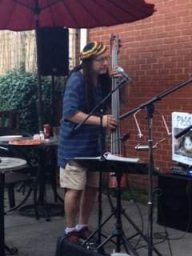
I played in a gypsy jazz trio for a couple of years and soloed using the maj and min scales. Can't say that my solos were any good but using different scales would not have made them any better

Play what sounds good. If it doesn't, try again. I record long stretches of lead improvs, then go back and sift through looking for any bits worth keeping. Though I agree with what @Mushroo said, especially chord tones vs. scales. Of course, I'm still a lousy soloist, but that's how I'm making forward progress (brute force and repetition).
Harmonic Minor scale. (Lowered 6th, raised 7th) Learn it, love it. It's your Gypsy Jazz friend and companion.

Regardless of genre, I always like when the primary soloing instruments rarely quote each other, but both get quoted by the rhythm section which then expands on what they were saying.
Got a recording rig to use to learn the other guys' collections of typical phrases?
Learning the scales in every position is good, but I think that it should be looked at as an end, and not the means. The means having been nicely laid out in #2.
Got a recording rig to use to learn the other guys' collections of typical phrases?
Learning the scales in every position is good, but I think that it should be looked at as an end, and not the means. The means having been nicely laid out in #2.
I can't reproduce a heard melody to save my life, and I've been trying to for 51 years.
Practicing that specific skill will do more to improve your soloing than everything else combined.
I hit a roadblock on playing by ear, until I found the right teacher. Up until that point I had been studying mostly with bass teachers. Then I found an ear-training class through the Adult-Ed/Extension School of the local music conservatory. The class met once a week, with fewer than a dozen adult students. It was a supportive environment, with a great teacher. This finally helped me through the mental block and allowed me to learn songs by ear.
So hang in there, don't give up! With the right teacher and a lot of practice, you will be able to reproduce on the bass what you hear with your ears. And this will help you become a great soloist!
I've been trying to learn to solo "meaningfully" (not just scale / arpeggio practice wankery) for decades as well, progress has been slow. Until, that is, I started trying to teach myself to solo on bass clarinet and guitar concurrently - both forced me to think in ways you just don't have to on bass. The cross-product of the two approaches has been especially beneficial. Starting to improve my playing on bass and everything else as well, like a general increase in musicianship that helps everywhere...Practicing that specific skill will do more to improve your soloing than everything else combined.
I hit a roadblock on playing by ear, until I found the right teacher. Up until that point I had been studying mostly with bass teachers. Then I found an ear-training class through the Adult-Ed/Extension School of the local music conservatory. The class met once a week, with fewer than a dozen adult students. It was a supportive environment, with a great teacher. This finally helped me through the mental block and allowed me to learn songs by ear.
So hang in there, don't give up! With the right teacher and a lot of practice, you will be able to reproduce on the bass what you hear with your ears. And this will help you become a great soloist!
Latest posts
-
-
 How can Fender release a "Vintage" series with an unplayable bridge?
- Latest: ImTheOnlyOne
-

-

-
