IMHO it's essential that you avoid injury. So please use the necessary restraint to avoid pushing your body over the edge.
My suggestion is consider if your tone is actually bad. If not, then embrace your natural sound and make the most of it. That's not to say you should stop working on tone generation, just don't make a big deal of it. It's not unusual for different bassist to have a different sound.
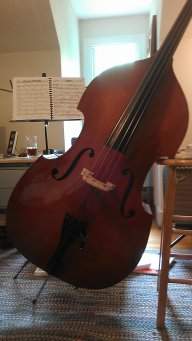
I assume others can produce the desired sound on you instrument...so the instrument is not the problem. Let's be clear, instrument and setup can be a significant factor. A different instrument or setup may help.
Having the biggest possible instrument is not necessarily the best way to produce a big sound. The last instrument I used professionally was a 7/8 and it required a more aggressive approach. Essentially I had to put significantly more force and energy into the instrument to get a sound out of it. It was actually a fine instrument, but I generally prefer a bass that feels like the sound is waiting to jump out of it, rather than a bass I have to flog.
If the instrument is not a factor, about all you can do is try to perfect your technique so you can produce the desired tone while playing with reasonable efficiency, so you don't tire prematurely or incur injury.
A potential problem is that all of us have a bit different physiology. So this means ideal technique can vary from person to person. Also there is no guarantee that your physiology will allow you to adopt a technique that produces the desired tone...especially if that technique relies on the application of a lot of force.
I don't have what I most would consider a big sound either. If I play hard enough to get a big sound, it wears me out and I suspect I would get a a repetitive use injury if I did it all the time. It wasn't really a problem for me, because I used an amp almost all of the time, so I did not need a big acoustic sound.
Another physiological factor is the thickness and hardness of callouses. For those who develop hard callouses, the sound tends to be bigger and also more clear/articulate.
I don't typically develop thick, hard callouses on my finger tips. On the few occasions where I have, it was not long before I ripped them off...which tends to makes continuing to play rather painful. So brute force techniques are simply not for me. It was far more important for me to remain healthy, so I could do the job reliably.
I used two different plucking techniques. Normally I brace my thumb against the side of the finger board and use index and middle finger. The fingers are straight and generally work together, although there are some instances where the plucking fingers work independently. This approach produces a bigger sound and gives more endurance. But there is an upper limit to how fast I can pluck. Also the max speed decreases if I try to produce the biggest sound possible. You can use a rest stroke or free stroke with this approach...but often the finger(s) passes through the string and then strikes the fingerboard, which adds sort of a percussive quality to the notes.
The second technique uses arched index and middle fingers independently. The thumb is not braced against the finger board as the palm has to be free to move across the finger board as I play across the strings. The technique is used for fast technical passages. It's really hard to produce a sustained big sound with this technique as it relies on finger strength, rather than engaging large muscle groups. IMHO this approach favors more of a free stroke.
In order to balance both techniques, I back off a bit on the straight finger approach. Otherwise I would wind up overplaying while using the arched finger approach.
One last idea. You indicate that you are young. It takes time to develop the necessary strength, endurance, and technique to produce a big sound. Again, we are all different and progress at different rates on different aspects of technique. Perhaps you are ahead of your peers in some ways, and in other ways your peers have develop quicker than you. Be patient. Perfection as a musician tends to be a life-long journey.
My suggestion is consider if your tone is actually bad. If not, then embrace your natural sound and make the most of it. That's not to say you should stop working on tone generation, just don't make a big deal of it. It's not unusual for different bassist to have a different sound.
I assume others can produce the desired sound on you instrument...so the instrument is not the problem. Let's be clear, instrument and setup can be a significant factor. A different instrument or setup may help.
Having the biggest possible instrument is not necessarily the best way to produce a big sound. The last instrument I used professionally was a 7/8 and it required a more aggressive approach. Essentially I had to put significantly more force and energy into the instrument to get a sound out of it. It was actually a fine instrument, but I generally prefer a bass that feels like the sound is waiting to jump out of it, rather than a bass I have to flog.
If the instrument is not a factor, about all you can do is try to perfect your technique so you can produce the desired tone while playing with reasonable efficiency, so you don't tire prematurely or incur injury.
A potential problem is that all of us have a bit different physiology. So this means ideal technique can vary from person to person. Also there is no guarantee that your physiology will allow you to adopt a technique that produces the desired tone...especially if that technique relies on the application of a lot of force.
I don't have what I most would consider a big sound either. If I play hard enough to get a big sound, it wears me out and I suspect I would get a a repetitive use injury if I did it all the time. It wasn't really a problem for me, because I used an amp almost all of the time, so I did not need a big acoustic sound.
Another physiological factor is the thickness and hardness of callouses. For those who develop hard callouses, the sound tends to be bigger and also more clear/articulate.
I don't typically develop thick, hard callouses on my finger tips. On the few occasions where I have, it was not long before I ripped them off...which tends to makes continuing to play rather painful. So brute force techniques are simply not for me. It was far more important for me to remain healthy, so I could do the job reliably.
I used two different plucking techniques. Normally I brace my thumb against the side of the finger board and use index and middle finger. The fingers are straight and generally work together, although there are some instances where the plucking fingers work independently. This approach produces a bigger sound and gives more endurance. But there is an upper limit to how fast I can pluck. Also the max speed decreases if I try to produce the biggest sound possible. You can use a rest stroke or free stroke with this approach...but often the finger(s) passes through the string and then strikes the fingerboard, which adds sort of a percussive quality to the notes.
The second technique uses arched index and middle fingers independently. The thumb is not braced against the finger board as the palm has to be free to move across the finger board as I play across the strings. The technique is used for fast technical passages. It's really hard to produce a sustained big sound with this technique as it relies on finger strength, rather than engaging large muscle groups. IMHO this approach favors more of a free stroke.
In order to balance both techniques, I back off a bit on the straight finger approach. Otherwise I would wind up overplaying while using the arched finger approach.
One last idea. You indicate that you are young. It takes time to develop the necessary strength, endurance, and technique to produce a big sound. Again, we are all different and progress at different rates on different aspects of technique. Perhaps you are ahead of your peers in some ways, and in other ways your peers have develop quicker than you. Be patient. Perfection as a musician tends to be a life-long journey.