I'd like some advice on hardening a poplar burl top. I imagine I'd make some type of form, cover it in wax paper, pour on some Minwax Wood Hardener, and fin. But maybe I need some schoolin. So thanks for any knowledge!

Enjoy the benefits of a premium membership!
Upgrade Account
-
TalkBass has been independent since 1998. Add your voice.
Create a free account to reply to discussions, view embedded media, and browse with fewer display ads.
Join free Log in
Want zero display ads or expanded classifieds tools? Compare plans.
You are using an out of date browser. It may not display this or other websites correctly.
You should upgrade or use an alternative browser.
You should upgrade or use an alternative browser.
Hardening punky wood, burls
- Thread starter goodchicken
- Start date
More options
Who Replied?
Cyanoacrylate seems to be a popular choice. There should be a few threads around here about it. How about sharing a pic? We like wood porn.
I like found, salvaged, punky weird woods, including driftwood. If I'm sealing up something punky/rotted and soft, I typically use Smith's Clear Penetrating Epoxy Sealer on the backside, and then regular epoxy (System Three or West Systems) for the top. Lately, I've been using PC Petrifier's Wood Restore. I've found that the PC Petrifier can be sanded back and the surface of the wood can still be dyed or stained, whereas once it's sealed with epoxy, I don't find it takes colour as well if at all. 


My old friend Mike Lipe used burl tops on a lot of his guitars, and I helped him with them. They were a pain, but we worked out a system. First, we glued the top down onto the body with Titebond. Then, I gave it one or two coats of CPES*. The CPES would soak into the soft chunks of the wood and firm it up. Let it cure about 24 hours. Then I squeegeed on 1-3 coats of West Systems epoxy. The epoxy would fill the gaps and bring it up to a smooth surface. Like a heavy duty version of grain filling. Then sanded level to 220, and spray on whatever clear coat we were using.
*CPES is Clear Penetrating Epoxy Sealer, a very low viscosity epoxy that will soak into rotted or porous wood. It used to be only available from Smith's Company, which I used for years. But in the last few years, a few competitors have come into the market. I recently bought a kit of Total Boat CPES, which claims to work as well as the Smith's, but without the strong fumes. I haven't tried it yet.
Edit: Sometimes, if we wanted to emphasize the figure, I would add black or brown pigment to the West Systems epoxy.
*CPES is Clear Penetrating Epoxy Sealer, a very low viscosity epoxy that will soak into rotted or porous wood. It used to be only available from Smith's Company, which I used for years. But in the last few years, a few competitors have come into the market. I recently bought a kit of Total Boat CPES, which claims to work as well as the Smith's, but without the strong fumes. I haven't tried it yet.
Edit: Sometimes, if we wanted to emphasize the figure, I would add black or brown pigment to the West Systems epoxy.

Opps I totally forgot about figuring how to do the coloring stage of it, glad yall didn't lol!
So looks like I'll start with CPES. Bruce, so you've had luck with adding pigments to WEST Epoxy? I've tried adding black Angelus Leather Dye to Zpoxy, but it wouldn't cure properly. Maybe that alky based dye just wouldn't work?
I guess I'd like to darken the figure, and then maybe go over it with a clear that has been tinted blue and add a green outer burst... kind of an oceany theme.
Thanks for the help yall!

Rôckhewer
Commercial User
- Feb 28, 2015
- 2,922
- 9,028
- Disclosures
- Owner/Builder- RockHewer Custom Guitars LLC
Here's my experience...Cyanoacrylate seems to be a popular choice
I "hardened" a fairly punky spalted maple top by flooding with CA... and it was a nightmare.
Not because of the odor and toxicity (which sucked)
But because once the CA cured, the punky areas that soaked up the most... were then much harder than the surrounding wood that was already too dense to soak up very much.
This creates a potentially uneven sanding situation.
If your sander has a flexible backer... and you use aluminum oxide paper...(for wood)... it won't sand evenly. The wood eats away faster than the CA fortified punk.
I switched to a sharper (silicone carbide) paper... and a hard backer... and had much better results getting it "flat".
If I ever use punky wood again... I would probably go with the epoxy based solutions posted above... or preferably... get the wood vaccuum stabalized first.
I bought some unstable Buckeye burl once...
....nope....gave it away.
I got 2 poplar burl tops that were purchased by a client...and sent to me.... that I (politely) refused to work with. I provided maple burl instead.
Not a fan of punky wood.
Last edited:
CPES and then fill voids with West System or equivalent quality epoxy is what I've done as well. I learned the process from my brother who is a finish carpenter and uses CPES and West Systems to restore old rotted woodwork in historical buildings.
I've used the transparent and opaque pigments from US Composites with great results in epoxy:
Colored Pigments
FWIW I also really like their epoxy as a cheaper alternative to mainstream name brands (i.e. West Systems).
I've used the transparent and opaque pigments from US Composites with great results in epoxy:
Colored Pigments
FWIW I also really like their epoxy as a cheaper alternative to mainstream name brands (i.e. West Systems).
The trick to adding pigments to epoxies is to use a concentrated pigment, and only use a tiny amount. My favorite pigment for epoxy is Smooth-On's So-Strong Colorant. It's specifically made for use with epoxies, polyurethanes, and polyesters. One drop of black will make 2 oz of West Systems pure opaque black.
The leather dye you tried was probably thinned way down with alcohol. Too much alcohol will mess with the chemistry of epoxy.
https://www.reynoldsam.com/product/strong-color-tints/
The leather dye you tried was probably thinned way down with alcohol. Too much alcohol will mess with the chemistry of epoxy.
https://www.reynoldsam.com/product/strong-color-tints/


I'm in possession of both some figured Redwood tops, and Bay Laurel burl that I would like to stabilize/harden.
I will also be using some paulownia in a build.
I'm watching with interest, and researching.
I trust Bruce's advice and experience.
I'm also looking at PC Products. Have found some positive experiences in other forums.
CA scares the bejeezuz out of me fumes and mess.
The minwax hardener is reported to work well but exceedingly volatile.
I'm reading boat building sites and turner sites.
Invalid Link Removed
I will also be using some paulownia in a build.
I'm watching with interest, and researching.
I trust Bruce's advice and experience.
I'm also looking at PC Products. Have found some positive experiences in other forums.
CA scares the bejeezuz out of me fumes and mess.
The minwax hardener is reported to work well but exceedingly volatile.
I'm reading boat building sites and turner sites.
Invalid Link Removed
I recently acquired some spalted maple and always thought it would be cool to have as a fret board, but because of the softness of it I knew it wouldn’t work. I did a lot of searching to see if someone out there had a process for it. After a few weeks of searching I found someone (who happened to be in my back yard!) and he stabilizes the material so it can be used for any piece on the guitar. Che k out some of his pics. Really cool stuff!
If you take a peak at some of the customs you’ll see he’s used spalted maple for everything even the neck.
Custom - DeMont Guitars
If you take a peak at some of the customs you’ll see he’s used spalted maple for everything even the neck.
Custom - DeMont Guitars
Couldn't find any pics of customs, except for one Goldfinch he's selling in his online store. I find this website thoroughly confusing... large number of staff for what they do?I recently acquired some spalted maple and always thought it would be cool to have as a fret board, but because of the softness of it I knew it wouldn’t work. I did a lot of searching to see if someone out there had a process for it. After a few weeks of searching I found someone (who happened to be in my back yard!) and he stabilizes the material so it can be used for any piece on the guitar. Che k out some of his pics. Really cool stuff!
If you take a peak at some of the customs you’ll see he’s used spalted maple for everything even the neck.
Custom - DeMont Guitars

He's on Reverb, looks like he trades in lots of flotsam and jetsum electronicsCouldn't find any pics of customs, except for one Goldfinch he's selling in his online store. I find this website thoroughly confusing... large number of staff for what they do?
I think he's the guy who bought the rights to the Guyatone name and proceeded to kill it. I had one run in with him over some old parts. Didn't leave a good impression with me.
GuyatoneI think he's the guy who bought the rights to the Guyatone name and proceeded to kill it. I had one run in with him over some old parts. Didn't leave a good impression with me.
In 2013 Guyatone joined forces with DeMont Guitars of Oswego, IL, USA and now manufactures in both the US & Japan.

For stabilizing punky wood, you might want to consider this:
About Black Forest Resins
[Invalid or Expired Link Removed]
About Black Forest Resins
[Invalid or Expired Link Removed]

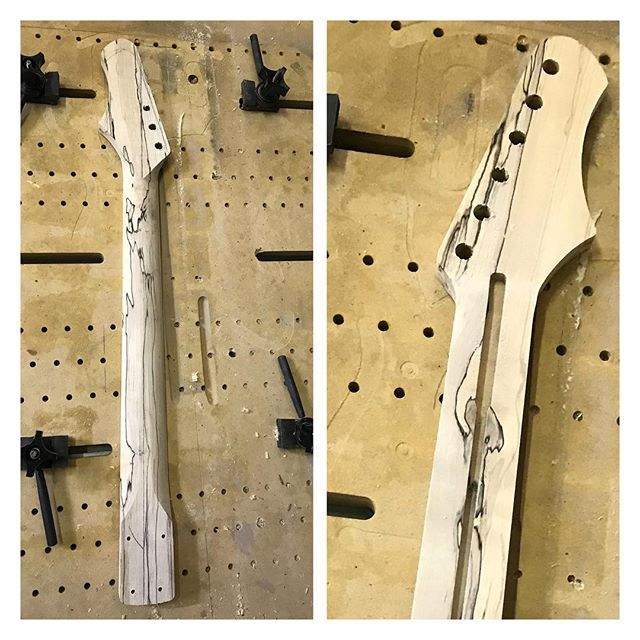
Here is one of his one of his resin pressure stabilized necks. Adding the resin obviously adds a little weight but i thought it is unique and fun. I’ll probably have it done to some spalted fretboards for a future build.
Maybe I'm wrong but wouldn't a lite use of a torch on the wood give you better contrast in the wood.. Then do the epoxy.. You'll need aa torch to prevent. Bubbles in most epoxies..
I'd wonder if the flame would be a bit harsh on this soft wood. Not sure though. I was going to dyes and/or pigmented paints to get some cool coloration.
That is bar table top coating, will bury the wood , but not penetrate. Designed as a pour on finish . Would protect it from dings and such, but the opposite of what we're going for.For stabilizing punky wood, you might want to consider this:
About Black Forest Resins
[Invalid or Expired Link Removed]
Last edited:


