• TalkBass has been independent since 1998. Add your voice.
    Create a free account to reply to discussions, view embedded media, and browse with fewer display ads.
    Join freeLog in
    Want zero display ads or expanded classifieds tools? Compare plans.

HARMONICS: Can a real bass player here please explain to me what I am missing?

Jul 2, 2025
134
1
103
My interest originally started trying to mute strings but one thing led to another so here I am thoroughly confused.

I'm puzzled by what I hear most clearly for me at fret/position 7 (all strings). The harmonic at this position is especially loud and clear, so it's easy to produce.

Both my tuner's display (StroboStomp) and my ears agree that the pitch of the harmonic is exactly 1 octave higher than the corresponding fretted position here.

My question is, WHY?

The string length, either between the fingertip contact at the harmonic node or the fretboard at the same position to "play" the note, is exactly the same (minus any insignificant intonation issue)!

In an "analogous" case, if I play the harmonic at the 12th position, both it and its fretted note have the same pitch!

So I'm clearly not understanding "something". What am I missing? Please help. I'm new at this. TIA
 

In short, when you play an open string you're not just hearing the open string, you're hearing different parts of the string vibrating on top of that fundamental pitch (although our brain doesn't hear multiple pitches, it hears those upper partials as timbre). These partials occur at 1/2 (second partial), 1/3 (third partial), 1/4, 1/5, etc. the length of the string in every location, so for the partial that occurs at 1/2 the length the string there's only one location, at 1/3 the length there's 2 locations, 1/4 3 locations, and so on to infinity. This is completely irrespective of the fretted note that lies under those harmonics, especially when you start playing higher partials closer to the nut. Since outside of the octave harmonic each partial has multiple locations, both towards the bridge and towards the nut, only one of those locations will be the same as the fretted note: for the third partial that's the 17th fret, for the fourth partial that's the 24th fret, if your bass had a bunch more frets the fifth partial would be located around the 28th fret, the sixth would be the 31st, the seventh around the 34th fret, and the eighth around the 36th fret.
 
This needs just a little math to explain :)

The 7th fret approximately divides the string in such a way that the distance between fret and bridge is 2/3 of the original string length. Thus you get a note with (3/2) the base frequency, i.e. one fifth interval higher.

It also leaves 1/3 (=1 - 2/3) of the string length to the saddle. If you softly press that point and pluck the string, every frequency that isn't a multiple of 3 ( = 3/1) times the base frequency gets filtered out, because such a frequency would move the string at the point of your finger and gets immediately dampened. The resulting harmonic note has thus 3 times the base string frequency.

The ratio between the fretted note frequency and the harmonic note frequency is the fraction

(3*base frequency) / ((3/2)* base frequency)

which is the same as

3/(3/2) =2

A frequency ratio of two is an octave, matching your observation.
 
This

To put it simply, each note is a concoction of notes above the original note. That's why when you "cut it in half", you get an octave above (which would be the 12th fret on an open string of a guitar). The 7th fret, octave and a half. The 5th fret, 2 octaves, an so on. You get the same exact thing on open notes on brass instruments.
 
My interest originally started trying to mute strings but one thing led to another so here I am thoroughly confused.

I'm puzzled by what I hear most clearly for me at fret/position 7 (all strings). The harmonic at this position is especially loud and clear, so it's easy to produce.

Both my tuner's display (StroboStomp) and my ears agree that the pitch of the harmonic is exactly 1 octave higher than the corresponding fretted position here.

My question is, WHY?

The string length, either between the fingertip contact at the harmonic node or the fretboard at the same position to "play" the note, is exactly the same (minus any insignificant intonation issue)!

In an "analogous" case, if I play the harmonic at the 12th position, both it and its fretted note have the same pitch!

So I'm clearly not understanding "something". What am I missing? Please help. I'm new at this. TIA
 

In short, when you play an open string you're not just hearing the open string, you're hearing different parts of the string vibrating on top of that fundamental pitch (although our brain doesn't hear multiple pitches, it hears those upper partials as timbre). These partials occur at 1/2 (second partial), 1/3 (third partial), 1/4, 1/5, etc. the length of the string in every location, so for the partial that occurs at 1/2 the length the string there's only one location, at 1/3 the length there's 2 locations, 1/4 3 locations, and so on to infinity. This is completely irrespective of the fretted note that lies under those harmonics, especially when you start playing higher partials closer to the nut. Since outside of the octave harmonic each partial has multiple locations, both towards the bridge and towards the nut, only one of those locations will be the same as the fretted note: for the third partial that's the 17th fret, for the fourth partial that's the 24th fret, if your bass had a bunch more frets the fifth partial would be located around the 28th fret, the sixth would be the 31st, the seventh around the 34th fret, and the eighth around the 36th fret.
Dude your bass has 36 frets? Dope!
 
Dude your bass has 36 frets? Dope!
No, but my double bass's fingerboard has the equivalent of 31 frets

In all seriousness, I used more than 24 frets just to create more examples since on a normal 20–24 fret bass there's only two, maybe three, places where a harmonic node matches a fretted note (kind of; I didn't get into it in my original post, but the fifth and seventh partials--two octaves and a major third and two octaves and a minor seventh respectively--are significantly flatter compared to 12-tone equal temperament).

In short, when you play an open string you're not just hearing the open string, you're hearing different parts of the string vibrating on top of that fundamental pitch (although our brain doesn't hear multiple pitches, it hears those upper partials as timbre). These partials occur at 1/2 (second partial), 1/3 (third partial), 1/4, 1/5, etc. the length of the string in every location, so for the partial that occurs at 1/2 the length the string there's only one location, at 1/3 the length there's 2 locations, 1/4 3 locations, and so on to infinity. This is completely irrespective of the fretted note that lies under those harmonics, especially when you start playing higher partials closer to the nut. Since outside of the octave harmonic each partial has multiple locations, both towards the bridge and towards the nut, only one of those locations will be the same as the fretted note: for the third partial that's the 17th fret, for the fourth partial that's the 24th fret, if your bass had a bunch more frets the fifth partial would be located around the 28th fret, the sixth would be the 31st, the seventh around the 34th fret, and the eighth around the 36th fret.
Replying to myself 12 hours later, I'll also add that when a note is fingered the fretted note essentially becomes a new open string, which is why artificial harmonics work
 
This needs just a little math to explain :)

The 7th fret approximately divides the string in such a way that the distance between fret and bridge is 2/3 of the original string length. Thus you get a note with (3/2) the base frequency, i.e. one fifth interval higher.

It also leaves 1/3 (=1 - 2/3) of the string length to the saddle. If you softly press that point and pluck the string, every frequency that isn't a multiple of 3 ( = 3/1) times the base frequency gets filtered out, because such a frequency would move the string at the point of your finger and gets immediately dampened. The resulting harmonic note has thus 3 times the base string frequency.

The ratio between the fretted note frequency and the harmonic note frequency is the fraction

(3*base frequency) / ((3/2)* base frequency)

which is the same as

3/(3/2) =2

A frequency ratio of two is an octave, matching your observation.
This is exactly what I was looking for. I never really appreciated until now that, unlike the fretted string, BOTH higher AND lower pieces either side of the touch point are free to vibrate. So the string "lengths", touched and fretted at the same point, are NOT the same and so my paradox is resolved! :p
 
This is exactly what I was looking for. I never really appreciated until now that, unlike the fretted string, BOTH higher AND lower pieces either side of the touch point are free to vibrate. So the string "lengths", touched and fretted at the same point, are NOT the same and so my paradox is resolved! :p
Great answers from bass players!
Fred Frith (multi instrumentalist who did play bass on John Zorn's Naked City) built guitars with a movable pickup, or attached by the nut that picked up the unheard harmonic. he also "prepared" those guitars with stuff including wind up toys. Made beautiful music that way, I done seen it live.
 
Press down on the string between the 7th and 8th frets and now play the "short" part of the string. It will be the same pitch as the harmonic.
LOL only if you have frets. But that's a very good observation and would have been equally confusing how doubling the length of the string could produce the same pitch when plucked! I get it now.
 
You know about sliding harmonics on a fretless, right?
Not really. Moving contact along the string off of the node just extinguishes the sound for me. But I've only had my fretless since I got it from Thomann in March.

ETA: Went and watched Tony Franklin, a combination of touch and subsequent sliding along fretboard. It works! Here the effect on pitch of a string's "length" for a given set of harmonics along its original length is clear.
 
Last edited:
I apologize if I missed this in another comment, but I didn't see it in a few I looked at

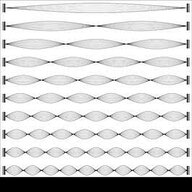
With the other info here- the interesting part is that where we 'fret' to voice the harmonic is the 'node,' which is where the string stays stationary for that particular overtone.

IMG_6098.jpeg


So, though it's a little more complicated, at these nodes the string is staying still and not vibratin laterally

So the reason a harmonic sounds there is that you are actually MUTING the other harmonics and the fundamental, but the node is not muted because where your fretting hand is touching, the string is already not moving, so you don't interrupt that particular harmonic

Note that this implies that the harmonics are all present on an open note, which is true. The strength of the harmonics of a note due to the physical properties and the electrical properties are what *tone* is
 
  • Like
Reactions: mambo4

Latest posts