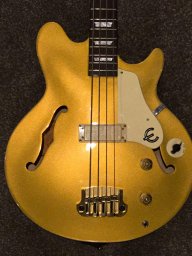
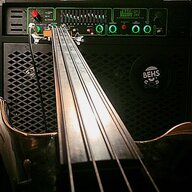
Although I play 5 strings exclusively, I have multiple simple basses doing one thing great, instead of a complex bass trying to do everything. Each bass has different strings for its designated role.

TalkBass has been independent since 1998. Add your voice.
Create a free account to reply to discussions, view embedded media, and browse with fewer display ads.
Join free Log in
Want zero display ads or expanded classifieds tools? Compare plans.




I dunno, for me these choices are based on the project I’m working on. I’m a firm believer of having the correct tools for the job and letting your ears be your guide. And that starts with my sound production gear first. Amps that allow great tonal control, and the right cabs. You have that, and learn how to properly use it (and no, you aren’t getting the best sounds just reading the owners manual. This take time work and study) and have a 5 string JB (or reasonable equivalent), you can cover 90% of music written today.Some players start with a passive, 4-string, 1-pickup, Fender-shaped object (FSO).
Over time, some players end up moving in the direction of a 5- or 6-string, 2- or 3-pickup, active EQ, non-FSO with many knobs and switches, as their preferred bass.
Other players end up where they started, or going "back" to the simplest setup possible - passive, 4-string, 1 pickup (maybe 2), FSO, 2 to 3 knobs at an absolute maximum.
I'm a minimalist so you know my answer - simplest tool that gets the job done. Wanted to see yours.

Thanks everyone for voting and thoughtful responses. I have the same thoughts as Geri here, although I still consider that answer "simple". Those 3 tones really are the 3 that I have always loved. Never mind that I get my Precision tone from the neck pickup of Jazz basses...I’ve sought out Jazz tone (both pups 100%), Stingray tone, and Precision tone for nearly 40 years. Complexity was never a factor.
Same here, each of mine has its own sound and purpose.I have multiple simple basses doing one thing great
Took me a little too long to get here, but the trip was fun. Learned a lot. Just not quick enough. Money well spent.I dunno, for me these choices are based on the project I’m working on.
A lot of those subtle differences you hear playing by yourself, tends to disappear when the notes start flying when playing with an ensemble. And as long as your bass sounds like an electric bass, it’s in tune, presentable, and you know your parts, nobody is going to care what you are playing.



In a way, this wondermous hobby has amounted to years of trial and error for me. I guess that experience has simplified my flow chart in terms of what I might rule in or rule out as a candidate to bring home. I honestly prefer to have one of each on hand - a simple passive instrument along with a more complex bass that includes two pickups and an on-board preamp that lets me dial up two or three useful tones in a snap. I use both at my gigs doing classic rock and dance covers. Not an either/or decision for me. I can't say that I prefer one over the other.Some players start with a passive, 4-string, 1-pickup, Fender-shaped object (FSO).
Over time, some players end up moving in the direction of a 5- or 6-string, 2- or 3-pickup, active EQ, non-FSO with many knobs and switches, as their preferred bass.
Other players end up where they started, or going "back" to the simplest setup possible - passive, 4-string, 1 pickup (maybe 2), FSO, 2 to 3 knobs at an absolute maximum.
I'm a minimalist so you know my answer - simplest tool that gets the job done. Wanted to see yours.