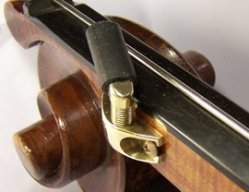
Couple of things to assist you and *your* formula for fitting. First, don't be afraid of a sharp knife - think utility knife, large exacto - something really sharp. You're going to shave the rough curvature on the foot, and a knife will do this in a fraction of time to sand. Second, tracing the old feet onto the new blank is good if the previous bridge was correct, but you can also trace the top curvature onto your blank as pictured, using a pencil guided by the top itself, marking onto the blank. Gotta have the extra wood to carve away so this has to be done early and planned for. Third, after you've carved some curvature into the feet, you can use the sandpaper-on-the-top method for the final fit, but you need a guide to control the motion of the blank. I use a quick clamp, clamped on the blank top, with the bar protruding towards the tailpiece. I then stack blocks and shims on the saddle area (usually a series of 2x4, 1x2s and paint stirrer shims taped together) to the right height to give me the blank angle I want (blank backside perpendicular to the top), the blocks act as the guide for the clamp bar. Works excellently, produces a precise fit with no rollover or feathering at the feet edges.