
I think it sounds good but it in no way sounds anything like an upright IMO.

TalkBass has been independent since 1998. Add your voice.
Create a free account to reply to discussions, view embedded media, and browse with fewer display ads.
Join free Log in
Want zero display ads or expanded classifieds tools? Compare plans.
I can certainly understand that there's a lot you can do on electric that'd be quite difficult to do on upright; but for basic playing, I don't think there's that much you can do on upright that you can't reproduce reasonably well on electric. I'm thinking the common uses for upright bass: jazz (1917 to last week); traditional country; folk; bluegrass; rockabilly. Obviously not including classical orchestral music.The physical and tonal differences between the instruments often mean that you can't play the SAME THINGS on electric as you do on upright. It's a feel thing as much as a clinical note choice thing. It's why those of us who double on the regular know that there are some things that just work better on one vs the other. It's not just about 'getting the exact same tone.' There's more to consider. Yes, you can play the exact same line with the exact same notes.... but it's a different thing. This bass would be a better choice for sure than some other electrics if you're trying to get in the same 1,000 square feet in terms of 'acoustic bass vibe'. Steve Swallow is one of the few players to really get in the same 10 square feet in terms of tone and feel.... because he was an upright player to begin with.
I can't forget Christian McBride; his tone and playing is incredible!

I can certainly understand that there's a lot you can do on electric that'd be quite difficult to do on upright; but for basic playing, I don't think there's that much you can do on upright that you can't reproduce reasonably well on electric. I'm thinking the common uses for upright bass: jazz (1917 to last week); traditional country; folk; bluegrass; rockabilly. Obviously not including classical orchestral music.
Will it sound just like an upright bass? No, clearly no. Will the listener enjoy music with a clear bass line that outlines harmony and rhythm? Almost certainly yes.
And don't get me wrong, I'm an upright player and I far prefer it to the electric bass. I just think that too many people, finding themselves where they need to substitute the electric bass for upright, focus too much of their attention on trying to get the TONE as close as possible, while apparently paying insufficent attention to what they're playing and having it be suitable for the setting.

I have the same bass and I do the same thing for pit band work; it does the job nicely. I leave the mute off if there are arco parts and use a compressor for sustain and a volume pedal to fake that. Played near the neck it works well, especially in the lower register. It helps to use the right strings and a URB modeler (I have a Zoom A3 for that, and the compression).I had one of those Ibanez SRH 505F and it sounded great. And I have to say that with a set of Labella Tapewounds, a foram mute and some eq it sounded very upright-ish.
It could not fool a double bassist but it did an amazing job as a substitute for that register, specially for guys like me that don't usually play the real deal.

He's Siberian but kinda the same thing. All those guys, Main Coon, Norwegian, Siberian I have worked with and they are all smart and enjoy the snowI think maybe my cat is that ones long lost twin, at least part Maine Coon, and smart as hell.


Those basses sound very good to me, and I like that guy's playing too.
Dario's sounds a lot like an upright, I think.


Those basses sound very good to me, and I like that guy's playing too.
Dario's sounds a lot like an upright, I think.

The bass is an Ibanez SRH 505F. They have been around for for a while. It gets a decent upright sort of tone, but it won't fool double bassists.
Yes very much so.Dario Derrida translates traditional Jazz on a bass guitar better than anyone else I have heard.

Horn players and guitarists have been transcribing him.Dario Derrida translates traditional Jazz on a bass guitar better than anyone else I have heard.
Horn players and guitarists have been transcribing him.

The bass is an Ibanez SRH 505F. They have been around for for a while. It gets a decent upright sort of tone, but it won't fool double bassists.
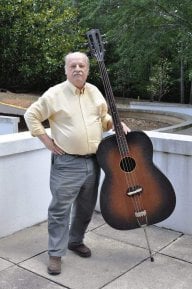
As a senior citizen I play the upright without studying. I play what is within my grasp, and as I continue I try to extend my reach.I think these are nice examples of real upright. I have fallen in love with double bass lately. If weren't a senior citizen who still messes up on electric, I would study the upright.