Some heads have two amplifiers like the Hartke LH 1000. I can run it as a dual mono or bridge both channels. There is also a balance knob. I just wonder if some of you use this possibility to drive different sounding speakers and then blend the sound with the balance knob.

Enjoy the benefits of a premium membership!
Upgrade Account
-
TalkBass has been independent since 1998. Add your voice.
Create a free account to reply to discussions, view embedded media, and browse with fewer display ads.
Join free Log in
Want zero display ads or expanded classifieds tools? Compare plans.
You are using an out of date browser. It may not display this or other websites correctly.
You should upgrade or use an alternative browser.
You should upgrade or use an alternative browser.
Heads with two amplifiers built in.
- Thread starter jsa0100
- Start date
More options
Who Replied?
Some heads have two amplifiers like the Hartke LH 1000. I can run it as a dual mono or bridge both channels. There is also a balance knob. I just wonder if some of you use this possibility to drive different sounding speakers and then blend the sound with the balance knob.
Sure you can, the old Carvin Heads (R600 and R1000) had two amplifiers and also a built in crossover.
You could biamp using the two amps and crossover, using two cabinets of course or just plug each amp full range into a different enclosure.
While I don't have one of those heads, my "large venue rig" has two Carvin cabs (a 2 x 10" and I usually use a single 18" as well), with each cabinet powered by a channel of a QSC PLX-1602 power amp.
When I first set this system up I figured I would "balance" the output of the cabs using the gain knobs on the front of the power amp. As it turns out there was no need to do that, the rig sounded best with both channels just turned up all the way.
Analogeezer

Some heads have two amplifiers like the Hartke LH 1000. I can run it as a dual mono or bridge both channels. There is also a balance knob. I just wonder if some of you use this possibility to drive different sounding speakers and then blend the sound with the balance knob.
I have some old GK 2000RBs that can run dual mono, bridged, or biamp. I bought these because I wanted the sound of an 800RB with more power. I biamped an 800RB for a few years and it was the clearest and most articulate bass rig I have ever run.
One possible idea would be to use a bass cab in the traditional position behind you, and then run one or two kick back cabs in front, aimed back at your head. I have done this with my GK 700RB/112 combo. If you get the spacing and balance right, you get the perception that you are engulfed in the sound. This is not necessarily the best strategy if your rig is carrying the room, as separating the cabs is likely to result in comb filtering (uneven response).
In general mixing dissimilar bass cabs is hit and miss. There are thousands of threads on TalkBass that discuss this. The easiest and IMHO best solution is to find one cab that you really like, and then buy however many you need to meet your volume requirements.
The problem with dissimilar cabs is they may cancel and/or work against each other at some frequencies. There are two relevant parameters: 1. phase, 2. group delay. If these factors vary too much between the two cabs, it tends to degrade the quality of the lows.
This problem is often associated with mixing cabs with different size drivers, but the problem is actually related more to how the cab is tuned than driver size. In fact, a skilled designer can produce cabs with different size drivers, that can be mixed and matched however you see fit. For example, all of the Mesa Subway cabs are designed so the 10s, 12s, 15s all work well together.
I also have an Epifani UL902C. While it has dual power amps, it does not have a balance control, and it cannot run in bridge or biamp mode. The sole benefit is you can run a lot of cabs. Each output section is rated for 900W at 4 ohms, so it has a total combined power potential of 1800W. It's the second most powerful head in my collection. Only the SVT8-Pro is rated for more power (2500W at 2 ohms).
Here is a little experiment I did with the UL902C.
The cabs are Genz Benz 1288t Uber Quads. Each cab is 8 ohms, so each side of the UL902C is seeing a 4 ohm load (two cabs).

I have some old GK 2000RBs that can run dual mono, bridged, or biamp. I bought these because I wanted the sound of an 800RB with more power.
[
I wish I knew you 10 years ago when I went through 2 of these. Each one had a power amp failure. VERE hard-hitting amp with great tone.!!
I have some old GK 2000RBs that can run dual mono, bridged, or biamp. I bought these because I wanted the sound of an 800RB with more power. I biamped an 800RB for a few years and it was the clearest and most articulate bass rig I have ever run.
One possible idea would be to use a bass cab in the traditional position behind you, and then run one or two kick back cabs in front, aimed back at your head. I have done this with my GK 700RB/112 combo. If you get the spacing and balance right, you get the perception that you are engulfed in the sound. This is not necessarily the best strategy if your rig is carrying the room, as separating the cabs is likely to result in comb filtering (uneven response).
In general mixing dissimilar bass cabs is hit and miss. There are thousands of threads on TalkBass that discuss this. The easiest and IMHO best solution is to find one cab that you really like, and then buy however many you need to meet your volume requirements.
The problem with dissimilar cabs is they may cancel and/or work against each other at some frequencies. There are two relevant parameters: 1. phase, 2. group delay. If these factors vary too much between the two cabs, it tends to degrade the quality of the lows.
This problem is often associated with mixing cabs with different size drivers, but the problem is actually related more to how the cab is tuned than driver size. In fact, a skilled designer can produce cabs with different size drivers, that can be mixed and matched however you see fit. For example, all of the Mesa Subway cabs are designed so the 10s, 12s, 15s all work well together.
I also have an Epifani UL902C. While it has dual power amps, it does not have a balance control, and it cannot run in bridge or biamp mode. The sole benefit is you can run a lot of cabs. Each output section is rated for 900W at 4 ohms, so it has a total combined power potential of 1800W. It's the second most powerful head in my collection. Only the SVT8-Pro is rated for more power (2500W at 2 ohms).
Here is a little experiment I did with the UL902C.
View attachment 4525435
The cabs are Genz Benz 1288t Uber Quads. Each cab is 8 ohms, so each side of the UL902C is seeing a 4 ohm load (two cabs).
I have the Performance 1000 which was Epifani's budget offering. It also has (2) power amps (500w @ 4 ohm), no blend control, but can do 1000w bridged / 8 ohm load only. I could do (2) 8 ohm cabs per side...maybe 2x10's...but stuck with one 5.25 ohm cab per side instead.
Riis

- Apr 29, 2003
- 9,082
- 9,805
- Disclosures
- Contributor- Bass Musician Magazine | Marketing Manager- Trickfish Amplification
Wayne Jones WJBA 2000 comes to mind. Two 1000w amps, with a blend (pan) knob.
I wish I knew you 10 years ago when I went through 2 of these. Each one had a power amp failure. VERE hard-hitting amp with great tone.!!
Yes I think this model had some pretty serious reliability problems. I have actually cobbled together 2 working amps out of 3 purchased
 . Probably spent a total of about $600, so it's not too bad. Not 100% confident in one of them.
I think the main problem is the variable fan circuit has some problems. Over time the fans seem to degrade to the point where the circuit does not produce enough voltage to get them to start spinning.
Some of the transistors and FETs on the output card are pretty much unobtanium. So if the outputs smoke, the card is unrepairable.

Aside from their intrinsic sound character, a reason I love my 800RB and SM400S is that each has 2 amps. This makes using any reasonable combination of the various cabs I've collected over the years really viable (they vary in efficiency so separate power controls is huge).
I run everything full range, though both heads are capable of biamping.blaming.
2-amp heads are gas enablers! If I didn't have this flexibility I'd own fewer cabs.
I run everything full range, though both heads are capable of biamping.blaming.
2-amp heads are gas enablers! If I didn't have this flexibility I'd own fewer cabs.

I used to run my LH1000 that way. I had a 1x15 cab with a 3015LF neo and a 2x10 neo cab on top. Both had tweeters but I turned the 1x15's tweeter way down.Some heads have two amplifiers like the Hartke LH 1000. I can run it as a dual mono or bridge both channels. There is also a balance knob. I just wonder if some of you use this possibility to drive different sounding speakers and then blend the sound with the balance knob.
I used the balance to remove boom from the room but also to get heavy low end when needed.
It's more stuff to carry than some people want. Now I mostly just use a Mesa class D amp with a good 1x12.
I love both options.

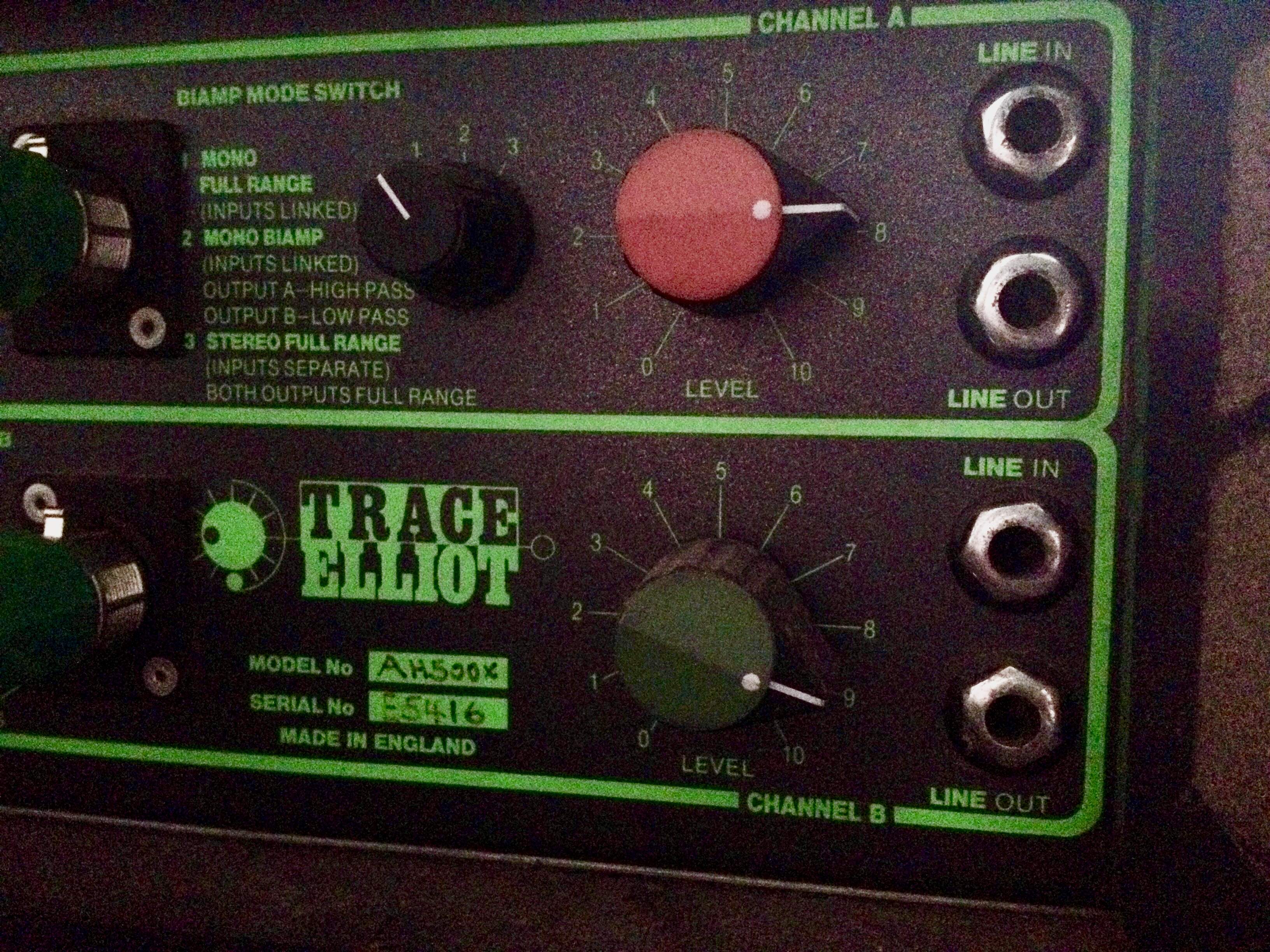
Trace Elliot AH500X is a dual mono head with several output options;
1) Full Range - mono 250w per channel output;
2) Mono Biamp - using the adjustable internal xover both the low and high channels can be set (channel A for high freqs and channel B for low freqs);
3) Stereo out - for stereo basses, both channels are outputted full signal.
Plus, it's got the 11 (or 12 band eq depending on the series), footswitch, noise reduction, cool black light, etc.
And it can get way past stupid loud.
1) Full Range - mono 250w per channel output;
2) Mono Biamp - using the adjustable internal xover both the low and high channels can be set (channel A for high freqs and channel B for low freqs);
3) Stereo out - for stereo basses, both channels are outputted full signal.
Plus, it's got the 11 (or 12 band eq depending on the series), footswitch, noise reduction, cool black light, etc.
And it can get way past stupid loud.

Some heads have two amplifiers like the Hartke LH 1000. I can run it as a dual mono or bridge both channels. There is also a balance knob. I just wonder if some of you use this possibility to drive different sounding speakers and then blend the sound with the balance knob.
Eden World Tour Pro 600 or 800, Eden World Tour series 500 or 800 meet your criteria. Unfortunately, Eden was finished off by Marshall and is now owned by a holding company selling off the remaining inventory. If interested, likely you will need to buy one used.
I do use two different cabs and blend them with the balance knob. The interesting thing is while each cab is fine on it's own, together it's an awesome experience. There is another TBer on this board (rip van Dan) who has a ton of experience with Eden amps who could publish a book on them.
One other point to consider, these are not class D heads, have two large transformers and are considered heavy by todays standards. That said, these are incredible sounding amps with tons of options, like a 3 band midrange EQ and built in compression (such that it is). 15-20 years ago these amp were considered one of best on the market.

Some heads have two amplifiers like the Hartke LH 1000. I can run it as a dual mono or bridge both channels. There is also a balance knob. I just wonder if some of you use this possibility to drive different sounding speakers and then blend the sound with the balance knob.
Yes. Especially handy if the speaker cabs present different impedence to the amplifier.


The SWR Mo' Bass. It had built-in effects and dual power amps. It didn't have a crossover, but one of its tricks was that you could run the effects on one side or both, and switch this "dual mode" on and off with a footswitch.
I've got one that's pretty beat up, but it still sounds great. But I'll never believe the manufacturer's claim of 450W/side.
I've got one that's pretty beat up, but it still sounds great. But I'll never believe the manufacturer's claim of 450W/side.
Some heads have two amplifiers like the Hartke LH 1000. I can run it as a dual mono or bridge both channels. There is also a balance knob. I just wonder if some of you use this possibility to drive different sounding speakers and then blend the sound with the balance knob.
The double amp I thought would be the holy grail was the Peavey Megabass. It was a 200 x 200 watt with a built in crossover and separate post gain controls for each amp. Although I never obtained one, I always thought it would be cool.
I didn't ever own a bass head that contained two amps, but I did (still do) have a few different amps with a built-in variable-frequency electronic crossover and a balance control. I used a second outboard amp with these amps being fed a signal from one side of the crossover and used the amp that contained the crossover being fed by the signal from the other side of the crossover. That was just plain old bi-amping, which never seemed to work as well as running one or both amps in full range. I did bi-amp several times on outdoor gigs with decent success. It always seemed to me I had a deficiency in my "tone" at or near the crossover frequency any time I bi-amped. I would end up boosting frequencies around the crossover point at set up sound check. My guess is the built-in crossovers I used probably did have a dip at the frequency where the crossover was set due to the characteristics / quality of the crossover(s).
Anyway, my opinion of bi-amping is that it's extra gear & setup time for little benefit. I do still "semi" bi-amp by running a small combo amp fed by the high side of the crossover. This helps with definition if needed. I often point that at the drummer since they are only hearing the the rumble off the back or side of my main cabinets.

SWR did this on the SM-400 and bigger amps. Carvin did it as well. I never really got into the whole Bi-Amp thing.
SWR did this on the SM-400 and bigger amps. Carvin did it as well. I never really got into the whole Bi-Amp thing.
It's kinda neat but I frequently find it to be a mis-assignment of the available enclosures which are full-range capable in most instances.
Riis

This, ( Not this particular one ), was my gigging amp in the 70s.
A Valco/Monkey Wards special. Two all-tube amps in one head.
Indestructible, and loud as heck through the 2x15 fridge cab it came with.
Wish I still had it. This guy is asking more for it used than I paid, new, with cab, back in the day.


