• TalkBass has been independent since 1998. Add your voice.
    Create a free account to reply to discussions, view embedded media, and browse with fewer display ads.
    Join freeLog in
    Want zero display ads or expanded classifieds tools? Compare plans.

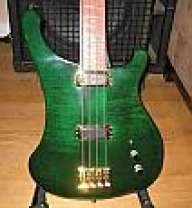
Help identify this bass please

Anyone know about these. I have done numerous searches to find one like it. I have found some that say Squier Series, but none that were MIM. I have not found any that have the one piece P/G. According to this site, http://www.guitardaterproject.org/fender.aspx, It says that it was made in the Ensanada plant in 1994 or 95.

Is it considered a Fender or a Squirer? Not that it matters too much, I just wanted to know.
 

Attachments

  • Bass pics 005.jpg
    Bass pics 005.jpg
    30.1 KB · Views: 242
  • Bass pics 006.jpg
    Bass pics 006.jpg
    27.3 KB · Views: 396
I was wanting to put the traditional jazz control plateand p/g on it, but i would have to drill new screw holes in it, and I don't want to ruin any value the bass may have. Anyone know of any replacement p/g's in this style, or would it really matter that much to "upgrade" it? I want a tort on it bad.
 
Interesting additional fact: That bass was made right around the time the Ensenada plant burned down. Most likely the bass you pictured was made soon after they got the new plant up and running.

Something that many people don't realize is that these bodies and necks were cut in America and were sent to Mexico for finish and assembly, something the Fender has done for years to keep cost down.

https://www.entrepreneur.com/tradejournals/article/15687115.html

." Global Sourcing Production of Mexican-made Stratocasters begins in California, where all necks and bodies are fabricated on computer-controlled machines. "This approach allows us to better utilize our large capital investments in the U.S.," stated Schultz. These parts are then trucked approximately 100 miles to the Ensenada plant where they are sanded, painted, and assembled. "By keeping the labor-intensive steps in Mexico, we're able to produce high-quality guitars at the most affordable price points. Our combination of working in both the U.S. and Mexico is tough to beat."
 
It's a Fender Squire. Nice looking bass, btw.
Thank you very much. Is there a difference between a Fender Squier series and a Squier by Fender?
I once tried to get a p-Bass like this, with a large "Fender" logo and little "Squier" series logo.
I think these are earlier Squiers, probably during some sort of transition or factory issue.

All that I have found have been P's, no J's.
 
In the early/mid 90s there was a transitional period where Squier production was happening in Mexico. I've even heard rumor that there were very small runs of MIA Squiers.


All of the MIM Squiers from that time period had their bodies and necks cut in America. I don't think any were actually assembled in America though.

On another note, there ARE some Fender Stds from the era that were made entirely in America, though they were priced as the MIM Stds. They built them here when the plant burned down. A few years later they also made the "California Series", which have the "AMXN" serial number prefix.
 
A relevant post from TDPRI

Originally Posted by whitele


You might have heard of mexican made Fender guitars with a black headstock decal, sometimes associated with some mystery Squier Series made in Mexico. It’s true that there actually was a “Squier Series” that was made by Fender in Mexico and featured a black decal on the headstock, but not all mexican made Fender guitars with such a black label were part of that very “Squier Series”. Since there appears to be a lot of confusion and half-knowledge about these guitars out there, I decided to do some research on my own.

The black label was used by Fender Mexico for a limited time only between 1993 and 1998. It can be found exclusively on the rather short lived mexican “Traditional” and “Squier” series for the Telecaster, Stratocaster and Precision Bass. Usually, Squier is to Fender what Epiphone is to Gibson. In this very case, the use of the name “Squier” had nothing to do with the actual Squier brand, as the series was named “Squier Series”, but it was by all means a Fender series, not a Squier series. The keyword is “series”, not “Squier”. The regular mexican “Standard” series was available too at the time, but it already featured the same silver-ish logo that is still used for it today. However, between 1993 and 1998, both labels (the black AND the silver-ish one) were used for mexican made Fender guitars, but for (slightly) different guitars.

The guitars with the black label consisted mostly of overstock american made Fender necks and bodies. The parts were shipped to Mexico for assembly with mexican made pickups and far eastern hardware and electronics. The overall quality of these guitars turned out to be below the Squiers made in Japan and Korea, whose production came to an end around the time the mexican made guitars with the black label surfaced, yet above Squiers made in China and Indonesia, whose production had not yet begun at the time. The guitars ended up on the american and european market for just about as much as a guitar from the regular “Standard” series would cost at the time.

Some (not all!) of the guitars were sold for a few bucks less as they came with 1-ply pickguards and hardware of slightly lesser quality. Those guitars (and those only!) had an additional smaller “Squier Series” label on front of the headstock, right were the artist models have the artist’s signature. Though some owners probably sanded off their “Squier Series” label, it is not true that all guitars with a black label had a “Squier Series” label in the first place. Most guitars with the black label featured tuners and bridges of decent quality as well as 3-ply pickguards. These guitars did not have the additional “Squier Series” label and were called the “Traditional Series”, which was stated nowhere on the headstock but the guitars were listed, advertised and sold as such.

The “Traditional Series” can be considered the slightly better but the “Squier Series” sure is the more obscure. At the end of the day, there really is not that much difference between the two. The most significant difference can be found on the Telecaster. The Telecaster from the “Traditional Series” had the traditional through-body stringing, while the Telecasters from the “Squier Series” were Top Loaders with different bridges, saddles and no string holes in the back.

The guitars from that very “Squier Series” are official and genuine Fender guitars like any mexican made Fender guitar regardless, and if you have a mexican made Fender Telecaster, Stratocaster or Precision Bass with a black label and a serial number beginning with MN3, MN4, MN5, MN6, MN7 or MN8, you have a genuine Fender guitar – with or without a small “Squier Series” label.
 
All of the MIM Squiers from that time period had their bodies and necks cut in America. I don't think any were actually assembled in America though.

On another note, there ARE some Fender Stds from the era that were made entirely in America, though they were priced as the MIM Stds. They built them here when the plant burned down. A few years later they also made the "California Series", which have the "AMXN" serial number prefix.

While the US plant may have helped out with bodies and necks I doubt all of them were done that way. There were indeed MIA Squiers as a friend of mine has two of them. They do not have the Fender logo large like that they have the Squier logo and "Made in America" on the headstock. There is mixed reports on whether or not these were made from MIA parts or leftover stock from Japan.

I have heard many people claim that Fender shipped bodies and necks to Mexico but have never seen proof and to be honest it just doesn't seem likely. If you have some sort if source for your information I would be very interested.
 
In addition I don't think that fire in the Mexican plant story has been verified as true either. Many people said the MIA Squiers were due to the fire yet Fender experts have said it's much more likely that it was just an interim solution between Japanese Squier production and Mexican Squier production. I always assumed that the small Squier series decal of the time was an effort by Fender to increase Squier sales by downplaying the logo. Then they decided to use the Fender logo on the Mexicans and export Squier production elsewhere.
 

Latest posts