• TalkBass has been independent since 1998. Add your voice.
    Create a free account to reply to discussions, view embedded media, and browse with fewer display ads.
    Join freeLog in
    Want zero display ads or expanded classifieds tools? Compare plans.

Help identify this p-bass pickup

Hello!
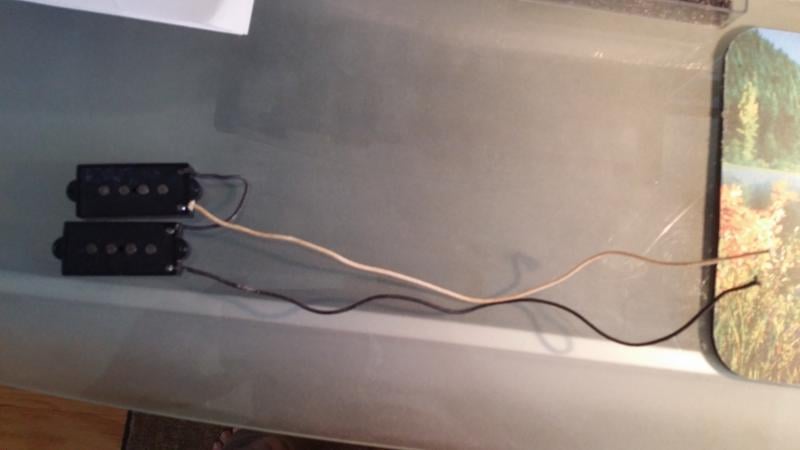
Attached are a number of pictures of a p-bass pickup I recently acquired. I was told it was from the mid 60's. I will point out that it has heavy black bobbins, the magnet tops are not flat but rather they are "chamfered", the winding wire looks to be burgundy in color (enamel wire?), the black and white leads are cloth covered and rather long. I am trying to identify the vintage of this pickup. Another question I have is why the black wire so long? Normally that wire is soldered to the basses brass ground plate and is cut noticeably shorter than the white wire in the process. Any help is greatly appreciated. Thanks...
20140809_150238_zps789fe0a7.jpg
20140809_150212_zps5b384083.jpg
20140809_150052_zps5aa2e719.jpg
20140809_150146_zps7240fd1f.jpg
20140809_150037_zpsc700e98d.jpg
 
It really doesn't look anything different from most vintage-like P bass pickups, but as you say it has beveled polepieces. That narrows it down somewhat, usually that would make it a Fender.

Might be worth asking as seymourduncanforums where a lot of pickup fanatics hang out.
 
Thank you for your input. I do appreciate it. I took uOpt's advice and also ran the same question on The Duncan forum. I also added these three pictures here. I think the first 2 pics show that the solder joints for the leads are original. The last pic also shows the method used to solder the winding wire into the bobbin rivets. The winding wire doesn't just pass through the rivet it is also wraped a few times around the bobbin edge.
20140810_031904_zpsd87f71ea.jpg
20140810_031800_zps4c50d5c1.jpg
20140810_031358_zpsd9618a78.jpg
 
With regard to these possibly being Fender USA vintage re-issue stuff, did you notice the pole piece height "stagger" in picture #1 (original post). The re-issue vintage stuff either has only raised A string pole pieces, or the poles are highly polished like the bumper on a '57 Cadillac or they're flush and have no stagger at all (all same height). I can't find a Fender USA re-issue/vintage repro or AVRI that has these rough "sand-cast" finished pole pieces that are beveled AND staggered. Anyone?
My understanding from doing A LOT of reading over the past few days on this is that early/mid 60's were in fact staggered and beveled.
 
I would guess maybe spb1. The fender 60s reissue i had, the poles were beveled much more.

If you have a dmm you could measure resistance. Spb1 should be 11.2 to 11.4 k and a fender reissue would be about 10.5 to 10.8 k i guess. The reissue i had measured 10.8k.
 
Spoke to the person that owned the '65 p-bass that this pickup came out of. He has some noteriety in Nashville and tells me it came out of a Fender '65 P-bass he owned. Yes, his bass could have been altered before he got it but he doesn't think so and I'm good going with it being a Fender '65 pickup. Thanks for the input...
 
A 65 should have a grey bobbin with a date on the bottom, and wound with plain enamel wire. The wire looks a bit lighter than plain enamel; it might also just be from the lighting. The middle poles look like a modern bevel and all of them are rather clean; the solder joint look newer; none of that good old lead rosin residue is present. That funky fit with poles clearing covers is dead give away for Mojotone flat work.
 
A 65 should have a grey bobbin with a date on the bottom, and wound with plain enamel wire. The wire looks a bit lighter than plain enamel; it might also just be from the lighting. The middle poles look like a modern bevel and all of them are rather clean; the solder joint look newer; none of that good old lead rosin residue is present. That funky fit with poles clearing covers is dead give away for Mojotone flat work.

This,

I can guarantee that is not an original 1965 P pickup.
 
lol... I returned the pickup for a full refund today. Too many doubts from people like yourselves that are much more experienced than I am on the vintage stuff. The kicker was an email response from Curtis Novak who saw the pictures and stated that it definately wasn't a mid 60's Fender. He said he wasn't sure what it was but he was "positive what it isn't". That was good enough for me.
 
Watch it be an even earlier pickup with redone solder joints.

Then again, maybe not ;) OK, I'll reinstate my "sorry." Sorry if I gave you bum advice, but I honestly never knew that they changed to gray bobbins in the mid 60's. That'll learn me!