• TalkBass has been independent since 1998. Add your voice.
    Create a free account to reply to discussions, view embedded media, and browse with fewer display ads.
    Join freeLog in
    Want zero display ads or expanded classifieds tools? Compare plans.

Help Me Design My Next Test!

I haven't read the whole thread.

BUT, I'd like to see:

1) RW vs Maple fretboard! All other variables consistent: same body, p'up, and strings (preferably nickel AND stainless steel). I'm tired of hearing "rosewood doesn't sound different than maple".... I've A/B'd the same bass IN A BAND SITUATION w/ both maple and rosewood fretboards and I KNOW that the maple board seems to cut through the mix better and the higher notes ring out more. Here's my thoughts: 3 things touch the strings (the source of the actual vibration that becomes your sound) when you play non-open strings: the bridge, the frets and fretboard, and your fingers.... 'nuff said IMO :).

2) Different body woods w/ the same necks, pickups, fretwire and strings. I definitely know this affects overall sound because I've swapped bodies w/ a friend on my Lakland Decade, from mahogany to alder, and HEARD the difference.

ALSO, please record while playing all up and down the fretboard, since I think a maple fretboard really shows itself in the higher registers.
 
1) RW vs Maple fretboard! All other variables consistent: same body, p'up, and strings (preferably nickel AND stainless steel). I'm tired of hearing "rosewood doesn't sound different than maple".... I've A/B'd the same bass IN A BAND SITUATION w/ both maple and rosewood fretboards and I KNOW that the maple board seems to cut through the mix better and the higher notes ring out more. Here's my thoughts: 3 things touch the strings (the source of the actual vibration that becomes your sound) when you play non-open strings: the bridge, the frets and fretboard, and your fingers.... 'nuff said IMO :).

While I agree that necks sound different, it's not practical to actually run a RW v Maple fingerboard test since the RW fingerboard is attached to a different piece of wood to make up the neck so it's impossible to tell if any difference in tone is due to the different piece of wood or the fingerboard. It immediately introduces an ambiguity due to the 2 variables so the cause of the effect cannot be isolated.

If a test was run with many necks maybe a trend could be seen but it would only be valid for that specific group of samples. IME I've noticed enough crossover with both types of necks/fingerboards to realize that's it's really down to what a particular neck contributes rather than a cut and dry comparison of fingerboards.
 
Antny said:
While I do appreciate your tests, and applaud you for it, personally, wood, bridges, strings, etc. dont matter at all to me. I can take my 60's passive pbass that's held together with duct tape and nails (really!) and make it sound like a spanking fresh Rickenbacker if I want it to. All through the magic of the tone knobs, my Sansamp and TC Electronic head. Slight variations in tone due to the body wood (if they even exist) are EASILY manipulated by technology. The only reason I have multiple basses is to change up the feel/comfort level/mood of my day, and if I want a 5th string. That's it. Tone? I can get an infinite amount of varying tones through my electrical gear.

I'd like to see you get a Stingray tone from a pbass...
And strings don't matter, you say too?
I call troll...
 
When submitting a test, don't say: one is maple, another is rosewood. Just post and see whether people detect a difference. You can make both clips with the same bass, no change.
Let the thread run to get comments. Then, edit the start to include what the test subjects actually were.
That way, listening without knowing what parameters vary, or whether they vary at all, you will get a better result.
If you say one is maple and another rosewood, people may be biased to imagine a difference and vote maple for the one they perceive to be brighter, for instance.
Lose preconceptions. Don't say what the variable is, initially, and sometimes make your test subjects identical, as a further control.
Also, like many already said, the fewer variables, the better. Ideally just one at a time.
 
When submitting a test, don't say: one is maple, another is rosewood. Just post and see whether people detect a difference. You can make both clips with the same bass, no change.
Let the thread run to get comments. Then, edit the start to include what the test subjects actually were.
That way, listening without knowing what parameters vary, or whether they vary at all, you will get a better result.
If you say one is maple and another rosewood, people may be biased to imagine a difference and vote maple for the one they perceive to be brighter, for instance.
Lose preconceptions. Don't say what the variable is, initially, and sometimes make your test subjects identical, as a further control.
Also, like many already said, the fewer variables, the better. Ideally just one at a time.
Yeah, he could say "There are two recordings here, they may have been made by two different basses, or the same bass. See if you hear a difference."
 
While I do appreciate your tests, and applaud you for it, personally, wood, bridges, strings, etc. dont matter at all to me. I can take my 60's passive pbass that's held together with duct tape and nails (really!) and make it sound like a spanking fresh Rickenbacker if I want it to. All through the magic of the tone knobs, my Sansamp and TC Electronic head. Slight variations in tone due to the body wood (if they even exist) are EASILY manipulated by technology. The only reason I have multiple basses is to change up the feel/comfort level/mood of my day, and if I want a 5th string. That's it. Tone? I can get an infinite amount of varying tones through my electrical gear.
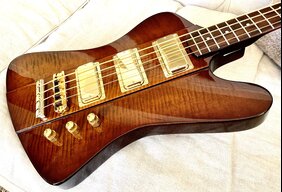
i have ALOT of amps, preamps, cabinets and outboard gear (effects) and i find it impossible to make any one of my five split pickup p basses sound like either of my two rickenbackers. yeah, you can put some new roundwounds on one and eq the heck out of it, but, IMO it still won't sound anything like a ric.
 
Sorry for the delay. I have the flu. :(

Anyway, yes, that sounds perfect. Now what specific tests do you suggest?

Dan - sorry to hear about the flu, hope you feel better soon.

As for tests, I won't go into all the details of the recommended set up for each test here (I'll IM you over the weekend with specifics) as that could prejudice the listeners that will be helping to prove your hypothesis. But in essence I'd recommend we drop test 2 (as noted in the previous post I made), I just don't see any easy way to manage all the variables associated with determining the degree to which each individual can hear a difference. So if you agree I'd recommend revising the hypothesis as noted in my previous message and proceeding with the set up of the following tests.

Qualification Test A - Home (non internet) live observations. All blind tests. Perform an acoustic A/B test and Perform an amped A/B test. Use a panel of at least 3 listeners for each blind test. Perform the test again with a different player and same 3 listeners. Just focus on the bass tone with no mix. Then repeat the amped blind live test with a mix as noted in test #2 below.

Qualification Test B - A simple internet tone test with one bass - use the same bass and hold all settings exact and at the same setting you'll use for the next two tests, no changes of any type on this test. The goal is to see how accurate the internet listening audience can be on identifying note "A" vs note "B" on a given bass. Again, I'll IM you with some suggestions on how to set this up. Once we find a pool of people that can relatively accurately hear a difference in notes over their computer we'll focus on those individuals for the remainder of the internet tests. Obviously other TBers can join in with their observations for fun and enjoyment but we'll only officially count the responses from the TB pool that passes this qualification test.

Test #1 - Set up a blind internet wood tone test using the pool of expert TB listeners that accurately spotted note differences in test B . The expert TB listeners will need to try to identify which of three bass tones is different or if all three are the same. This will be done with an exact simple single note from each bass and all settings identical. Nothing trickey, nothing fancy, no mix. Just straight up tone.

Test #2 - Set up a blind internet wood tone in a mix test using the same pool of expert TB listeners from the previous test. The expert TB listeners will need to try to identify which of the three bass tones is different or if all three are the same. This will be done with both basses at the exact same settings but in 3 different types of mixes. Mix one will be a jazz trio with a walking bass line, mix two will be a club mix with deep dub and mix three will be a shread mix with a pick. Other types of mixes could be added if you want.

Again, if you feel this would answer a lot of the questions out there and at the same time eliminate a lot of the variables let me know. If it's a go I'll PM you with some suggestions on how to set up the actual tests to further isolate variables and drive real comparisons in the test protocols.

Of course everything will also need to be documented as best as possible and probably some photos as well. If it goes good and looks like real science it might even make a sticky so others in the future can repeat the test with their bass builds and add to the pool of science, thus creating a prevailing theory.

Your thoughts?
 
Dan, as someone who was once kicked off a music enthusiast board for daring to suggest that humans could not discern the difference between a 24 bit audio file and a 16 bit dithered version of that same file, you have my full admiration and trust for entering this area. These tests you propose will make TalkBass an even more valuable resource for all of us. If you pull off a TENTH of the tests discussed in this thread, I will re-up my supporting membership for 20 years.

Well, that or invest in one of those new Yamahas with the post-assembly synthetic wood aging process applied. That just SOUNDS all sorts of worth my money.

Remember that on the internet, if someone personally attacks you without provocation, you're likely doing something right.
 
KingRazor said:
You know what I would like to see? Have two bass bodies hanging from the ceiling. Just bodies, no finish, no hardware, no nothing. Put a mic up to them and hit each one with a hammer.

I'm sure the results would be interesting.

Visit a local luthier. I was shown around by a great one local to me. Very interesting. He makes acoustic instruments and was telling me how he chooses woods, and a particular bit of wood from each type, according to how if perceived the guitar was sounding as he starts to put it together. Various bits resonatdd differently and he says he can choose them to "direct" the type of sound he wants to get out of an instrument.
 
Dan,

I would ask you to build a body out of a wood/plastic composite. It's a relatively new material that can supposedly be worked in the same fashion as wood and has the same density of walnut. If the density is like that of walnut you could record comparisons of the composite and walnut. I think this could be a very ineresting one.

Edit: You could also throw in a body made of basswood for chits and giggles.
 
Bongolation said:
From a scientific standpoint, it's meaningless.

Why are you wasting your time and ours?

Hey, you asked.

You want a meaningful test protocol, you eliminate all extraneous variables.

If you are doing comparisons, you record direct in, no amp, no effect, no EQ, no band, no VSTs -- nothing but raw signal with bass controls nulled.

Any other way is corrupt and pointless.

False. The scientific method involves holding all variables (except one) constant, not eliminating them. If you want to test the efficiency of 2 cars, for example, you can use the same road/air/fuel for both. There is no need to eliminate any variables, nor can you do so (how would you eliminate the variable of fuel?)

If you disagree your approach can also be used to throw out the cable, and see where that will get us.
 
i have ALOT of amps, preamps, cabinets and outboard gear (effects) and i find it impossible to make any one of my five split pickup p basses sound like either of my two rickenbackers. yeah, you can put some new roundwounds on one and eq the heck out of it, but, IMO it still won't sound anything like a ric.

I find that with a certain setup a Precision can sound quite close to a Ric--closer than any other Fender I've played. I think it has to do with the simple circuit preserving highs and the fact that the P pickup is positioned very close to where the Ric treble pickup is positioned. Just my experience, as primarily a Ric player but also a dabbler in Fenders and MusicMans.
 

Latest posts