• TalkBass has been independent since 1998. Add your voice.
    Create a free account to reply to discussions, view embedded media, and browse with fewer display ads.
    Join freeLog in
    Want zero display ads or expanded classifieds tools? Compare plans.

Help troubleshooting Jazz bass

I have carefully checked the ground connection of both shielded cavities, electronics cavity shielding (which actually connects directly to the neck pickup cavity), the bridge, the case of the 3 pots, the grounded terminal of the two volume pots, the cable jacket and the ground connection at the output jack. Everything is <1 ohm.

I know my music room is noisy. I plugged my other Jazz bass into the same cable last night and confirmed that it produces the "normal" dual-single coil noise I expect in my music room. Similar noise levels with each pickup solo, dead silent with both fully on. That bass has Fender 75th anniversary J bass pickups in it.

Next steps:
1. I will see if I can ground the magnets on the bridge pickup from the top as an experiment - see if it has any impact on noise (as dwizum suggested). If this does nothing:

2. Disconnect the pickups and measure the resistance. Might as well check that (as soflbass suggested). I really hate unsoldering connections on the potentiometer case though. I worry about over heating the part. You have to dump in a lot of heat to get that solder to melt. (Why don't they put little soldering tabs on these pot cases?)

I have to say, what is really puzzling me at this point is how quiet the Neck pickup is when solo. It isn't dead quiet, but the noise level is very low for a single coil. The bridge pickup is just about normal. The neck pickup wiring is better shielded than the bridge pickup because it runs under the metal pickguard and control plate. The bridge signal runs through a drilled hole in the body that is unshielded. So maybe the root of the problem is that I need to do what dwizum suggested, shield the wire in that little 2 or 3 inch section. Maybe I can do that with copper tape?? Hmmm...
Well, I've gotta think your pickups are wound in the same direction then.

Hum + hum = more hum.
 
My 1-1/2 cents says, I would first of all unsolder the Bridge pickup and see how that sounds, then re-solder bridge and unsolder neck, then if still noisy, re-solder bridge pickup to the neck pot. This will tell if the pickup is crappy or the pot may need replaced. Take it one step at a time.
I have seen crappy pots and cheap jacks mess up a basses tones and then replace them all and wow great tones and quieter...Just a thought.
Personally I would put in 3 new CTS pots, Orange cap 47 and Switchcraft jack. But that's just what I do on my cheaper basses.
Good luck with the fix.
I don't believe a pot would create any noise like the OP is describing.
 
I also checked that the pickup magnets are opposite polarity.

How did you confirm this?

It seems unlikely that they are improperly wound (both same direction) because besides the noise, I get the normal scooped J bass sound with both pickups on. Besides the noise they sound normal. They are also at near equal volume when run separately.

Which model of Squier do you have specifically?

I am looking through the specs on several of the Squier jazz models and none of they call out RWRP for the electronics. I am not convinced they are which would explain pretty much explain everything you are describing
 
[QUOTE="skycruiser, post: 27080157, member: 337344"
Might as well check that (as soflbass suggested). I really hate unsoldering connections on the potentiometer case though. I worry about over heating the part. You have to dump in a lot of heat to get that solder to melt. (Why don't they put little soldering tabs on these pot cases?)
[/QUOTE]
Your iron probably doesn't have enough power; you need at least a 40W iron and a larger surface are tip to transfer the heat effectively.
 
I also checked that the pickup magnets are opposite polarity.

How did you confirm this?

It seems unlikely that they are improperly wound (both same direction) because besides the noise, I get the normal scooped J bass sound with both pickups on. Besides the noise they sound normal. They are also at near equal volume when run separately.

Which model of Squier do you have specifically?

I am looking through the specs on several of the Squier jazz models and none of they call out RWRP for the electronics. I am not convinced they are which would explain pretty much explain everything you are describing

I used a disk magnet. I marked one side and confirmed that it was attracted to one set of poles and repelled from the other set. From this I deduced that the magnet poles are oriented in the opposite direction.

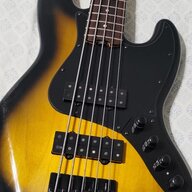
It is the 40th Anniversary Vintage model. I would be absolutely shocked if they did not use RWRP pickups for these - or at least that they did not intend to. This is a most basic and fundamental feature of any dual single coil bass!

BUT even if they are not RWRP, I would expect similar noise pickup on each one when solo. At least that is my experience with other J basses with similar shielding.
 
Your iron probably doesn't have enough power; you need at least a 40W iron and a larger surface are tip to transfer the heat effectively.
I have plenty of power. It's not that I have difficulty doing it. What I don't like is that you have to heat a huge heat-sink (the pot case which is by the way thermally connected to a huge metal plate!) to melt the solder. So you end up putting a lot of heat into the entire pot. I think generally it is not a good thing to do repeatedly to an electronic component.
 
That is why it is really worth it to get a desoldering gun. The one that heats and sucks at the same time. Or if not at least a soldering iron/wand that has interchangeable tip. A flat tip helps in unsoldering faster. But we sure to have a solder sucker as well. Those do not cost too much

I have plenty of power. It's not that I have difficulty doing it. What I don't like is that you have to heat a huge heat-sink (the pot case which is by the way thermally connected to a huge metal plate!) to melt the solder. So you end up putting a lot of heat into the entire pot. I think generally it is not a good thing to do repeatedly to an electronic component.
 
One of the biggest mistakes while doing the wiring for a passive bass ( or even active ones ) is soldering the ground wires to the back of a potentiometer.

The appropriated way to do that is using a lug inside the cavity.

Soldering to the back of pots was always a bad idea, even in Leo Fender's days...
 
Just an example:

6898175825_2df10be58a_b-jpg.1910386
 
Does not appear to be the pots. Noise from the bridge pickup is the same with either pot. I tried disconnecting each pickup one at a time, then switched pots, one at a time and then both swapped. The noise follows the bridge pickup.

I also shielded the bridge pickup wires through the hole between the pu cavity and the electronics cavity. No impact on noise.

Measured pickup resistance.
Bridge 7.34k
Neck 6.98k

Maybe it's time for a pickup swap...
 
  • Like
Reactions: pcake
That's why I said "A DEFECTIVE" pot....

I just removed a MN250K from a Fender Deluxe preamp that was causing a lot of hum with the bridge pickup. With the control fully rolled to the neck, no hum. Dead center, hum. Rolled all the back, lots of hum.

I Just changed the pot and problem was solved.
This is a passive bass, no onboard preamp.
 
  • Like
Reactions: SulzerType2
One of the biggest mistakes while doing the wiring for a passive bass ( or even active ones ) is soldering the ground wires to the back of a potentiometer.

The appropriated way to do that is using a lug inside the cavity.

Soldering to the back of pots was always a bad idea, even in Leo Fender's days...
There isn't any issue with soldering ground wires to the pot case, as long as the low side of the control is soldered to the lug as well. With a large enough iron, it only takes a few seconds to solder the wires.