
Enjoy the benefits of a premium membership!
Upgrade Account
-
TalkBass has been independent since 1998. Add your voice.
Create a free account to reply to discussions, view embedded media, and browse with fewer display ads.
Join free Log in
Want zero display ads or expanded classifieds tools? Compare plans.
You are using an out of date browser. It may not display this or other websites correctly.
You should upgrade or use an alternative browser.
You should upgrade or use an alternative browser.
Help with some port tuning
- Thread starter rdk
- Start date
More options
Who Replied?rpsands said:The frequency and port area you want to shoot for is different for every system (combination of box and speaker parameters).
I guess the only way to ask the question is, what does the port tuning mean. If my port is tuned at 44hz, low E, what am I looking to have as far as results. Is that frequency going to be produced very clearly? Much more clear than with out the ports? Does the port affect other frequencies as well?

No, it sort of "shapes" the lowend response curve, and it is specific to the driver/box combination. If you're looking at winIsD charts, load up a speaker/box you're familiar with and just adjust the tuning up and down. Watch how the bass response changes, as well as how it affects excursion/power handling limits down there.
I guess the only way to ask the question is, what does the port tuning mean. If my port is tuned at 44hz, low E, what am I looking to have as far as results. Is that frequency going to be produced very clearly? Much more clear than with out the ports? Does the port affect other frequencies as well?
You don't tune it to a particular note, like 41hz low E or something. It adjusts the response of the lowend of the spectrum....below 200hz. When you first get into this stuff, if you've been a musician all your life, it can be difficult to sort of "re-train" your brain to think in terms of frequency instead of pitch.
For an example, load up 2 box models of some driver, keep the box and everything the same, make one a sealed box, the other ported, lay the 2 graphs on the same chart and see the differences.
For electric bass, the big part of it's output is at the first overtone, 82hz for low E, 62hz for lowB. It would sound weak if the fundamental were missing entirely, but it's not as much meat of the sound as you might think at first.
will33 said:No, it sort of "shapes" the lowend response curve, and it is specific to the driver/box combination. If you're looking at winIsD charts, load up a speaker/box you're familiar with and just adjust the tuning up and down. Watch how the bass response changes, as well as how it affects excursion/power handling limits down there.
Thanks Will33. You're always very helpful. I have been messing with my design and I have adjusted it to get a pretty nice smooth response with a rolloff where I want. I was only curious because it was saying my port tuning was something rediculous like 10-15 hz. I mean plot looks good, math.......not so much.
Thanks Will33. You're always very helpful. I have been messing with my design and I have adjusted it to get a pretty nice smooth response with a rolloff where I want. I was only curious because it was saying my port tuning was something rediculous like 10-15 hz. I mean plot looks good, math.......not so much.
Something's screwy there. A tuning that low would be pretty much the same as a sealed cab, and you'd never be able to physically fit enough port in a box to tune it that low. Just for kicks, model the same driver, in the same size sealed cab and compare the 2 curves.
Here's a photo of what I'd like. The yellow is the vented (obviously) and the closed is the red. I like the vented graph but the port size it's telling me I need is 7 inch diameter. I could build this with rectangle ports but that adds to construction time and material. I want to figure out the round ports.
Attachments

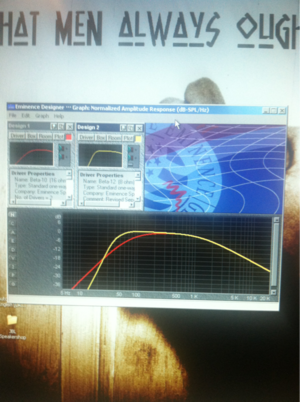
Curves look decent, bit, we'd need the specific driver model, box size, etc. to nail anything down.
What do you mean it tells you you need a 7" port. Could do it with 2 or 4 smaller diameter ports.
Rule of thumb is, set your power input to the drivers excursion limit. You want to keep port air velocity 20 meters per secon or lower with straight pipes. Can get away with 30 m/sec. if your ports are flared on both ends. By my experience anyway regarding audible chuffing. If you get down to small ports, say 2" diameter or less, then you get a lot of port wall surface area in relation to open area and turbulence, etc. gets worse and can sort of "choke off" or upset the relationship under higher power.
Shelf ports are another good option if you need that much area.
What do you mean it tells you you need a 7" port. Could do it with 2 or 4 smaller diameter ports.
Rule of thumb is, set your power input to the drivers excursion limit. You want to keep port air velocity 20 meters per secon or lower with straight pipes. Can get away with 30 m/sec. if your ports are flared on both ends. By my experience anyway regarding audible chuffing. If you get down to small ports, say 2" diameter or less, then you get a lot of port wall surface area in relation to open area and turbulence, etc. gets worse and can sort of "choke off" or upset the relationship under higher power.
Shelf ports are another good option if you need that much area.


What are some things to look at when tuning your ports. I understand that the port extends the low end but what does the port tuning actually mean? Is that the lowest frequency the cab produces before roll off?
Link Removed shows the near field response of a vent and a small woofer.
The vent is tuned to bolster the anemic response of the woofer.
Notice the notch in the woofer response under the peak of the vent.
The notch is typical of a near field measurement of a woofer at the tuning frequency.
This is a dip in the output, where the cone motion is almost completely stationary.
This point is the maximum loading on the driver.
The notch method is easier and a bit more reliable than the impedance tuning method.
The T/S specs will get you in the ball park, but the real proof of the design is always with the measurements.
A good rule of thumb is not operating the cab below the tuning frequency.
The reason is, the driver rapidly loses acoustic loading from the vent below this frequency.
You run the risk of over excursing the driver and damaging the suspension.
Well I was kinda modeling a 2x10 that i saw. The 2x10 had only 1 port so I was just trying to get a good response with just 1 port. Solely for learning purposes. I'm using eminence beta 10.
The whole beta line has a big "boom hump", or peak in their bottom end, that's why it takes such a crazy low tuning to make the curve flat. That hump can make boom in bad rooms, but also helps to just get plain output from lower power amps.
will33 said:The whole beta line has a big "boom hump", or peak in their bottom end, that's why it takes such a crazy low tuning to make the curve flat. That hump can make boom in bad rooms, but also helps to just get plain output from lower power amps.
Tried this post once it didn't work.
Hey will. What would you think of the beta 10's in a sealed 8x10 with a tweeter. We're going for a punchy bass tone. Maybe a little twang. Kinda like a pop rock/punk tone. A little mid rangey. Would this setup be versatile for other genres?

Mr. Foxen
Commercial User
Ports are pretty irrelevant to midrange. Unless you get them wrong enough to have mids coming out of them (like directly behind the speaker cone). Lining and stuffing is all about the midrange as far as cabs are concerned, otherwise it mostly comes from the speaker. Box tuning software is only relevant up to about 200hz.


